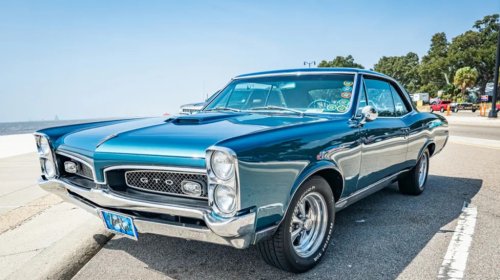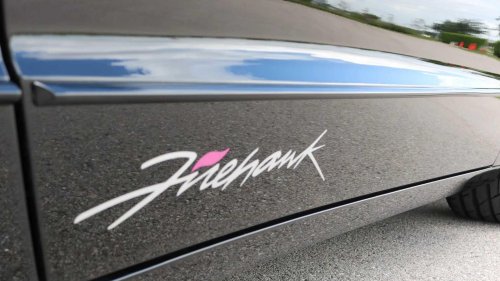
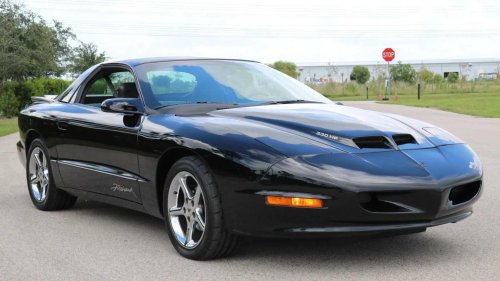
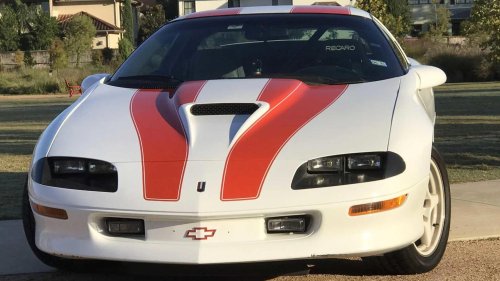
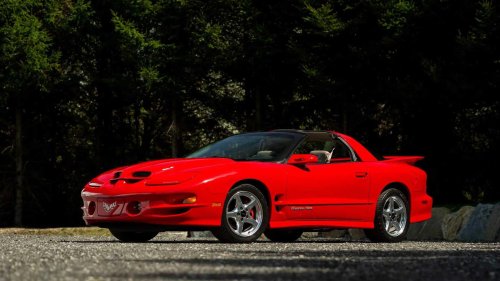
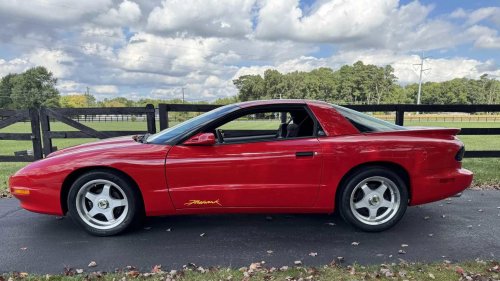

















Nobody contests the fact that the 1960s were the golden age of the American muscle car. Before the Oil Crisis, but after the invention of the Chevy small block V8. Engines may be more powerful today than they were back then, but the 1960s were an era of rapid innovation and at-home hot-rodding, making for a very exciting time on the drag strip.But, we would argue that the 1990s were just as exciting a time to keep your eye on the quarter-mile. Sophisticated ECUs and fuel injection systems, and lightweight construction methods allowed automakers to get more power out of smaller engines, creating, if not a whole new golden age, at least what you might call a revival period, led by companies like SLP, or Street-Legal Performance, GM's go-to engineering team when it needed to build a Chevy Camaro or a Pontiac Firebird with a little (or a lot of) extra oomph under the hood. SLP Had A Way With The Small Block V8 Bring a Trailer SLP was established in 1987 and made a name for itself as the aftermarket performance brand to develop and manufacture a performance package adhering to 50-state emission guidelines. Hence: Street Legal Performance. Where many brands were content to build track-only monsters, SLP, from the start, was aiming to create performance cars that you could enjoy on public roads.Early on, SLP was making a name for itself building high-performance Camaros and Firebirds, proving that the team had a knack for General Motors vehicles. In 1991, SLP built their own version of the Pontiac Firebird Formula, which they called the Firehawk. Every Firehawk was a custom order, and no two models were exactly alike. The plan was to sell 250 units, but only 27 were ordered, and 25 built. Upgrades in a standard Firehawk included the following features. SLP-modified engine, producing 350 hp and 390 lb-ft of torque 17x9.5-inch alloy wheels Firestone Firehawk tires ZF 6-speed manual transmission with carbon fiber clutch Stainless steel exhaust system and catalytic converter Dana 44 rear axle with 3.54:1 Posi-gears Firehawk badging and numbered plate The Firebird Formula started at an MSRP of $15,999. The Firehawk sold for $39,995. Adding the $9,995 Competition Package would get you an aluminum hood, Recaro racing seats, a full roll cage, and some 13-inch Brembo brakes built for the Ferrari F40.A 1991 Firehawk would clear 60 mph in just 4.9 seconds, with a top speed of 160 mph. Those are some pretty wild numbers for the early 1990s, and, truthfully, it's not hard to see why SLP didn't hit their sales goal of 250 units.Adjusting for inflation, a fully-loaded Firehawk would cost around $120,797 in early 2026. This wasn't just a two-door with a little extra kick, it was a dream car for wealthy muscleheads, and that was a fairly small demographic in 1991. The Firehawk wasn't very well marketed, for that matter, and many Pontiac dealers were unaware that the car even existed. In any event, while the 1991 Firehawk never met SLP's lofty sales goals, the car impressed GM enough to keep the relationship going, The Firehawk Was Just The Beginning Pretty much all of GM's coolest muscle cars in the 1990s can be attributed to SLP. To cover some of the most iconic of the bunch, we can start with the 1997 Firehawk, which remains one of the rarest Pontiacs ever built. SLP Only Built 29 Instances Of The 1997 SLP FIrehawk LT4 Bring a Trailer Through the 1990s, SLP's Firehawk had been toned down a bit from a 350-horse monster to a somewhat tamer performance trim delivering 300-315 hp, from 1993 to 1996. The 1997 Firehawk was something of a return to form for the car, pushing those outputs to the brink of legality once more.The Firehawk LT4's engine was borrowed from the Chevrolet Corvette Grand Sport, with the Firehawk version of the motor featuring aluminum roller rockers, forced-air induction, high-flow injectors, and a high-lift camshaft. Every single one of these engines was taken apart by SLP, rebalanced, and rebuilt.For the transmission, SLP went with a T56 manual from BorgWarner, with a Hurst short-throw shifter. Then you've got an aluminum driveshaft, a Dana 44 limited-slip differential, a sport-tuned suspension for a stiffer ride, Bilstein shocks, and four-piston Brembo brakes on the front wheels. SLP's Crowning Camaro Was The 30th Anniversary LT4 Edition Bring a Trailer Chevrolet sold a Chevrolet Camaro Z28 in the mid-1990s, delivering an impressive 285 hp from an LT1 V8. SLP being SLP, they couldn't help but drop an LT4 into the engine bay for the 30th Anniversary edition in 1997, matching the Firehawk for total horsepower output with the same transmission setup.Aside from being one of SLP's most impressive builds, this is also one of the best-looking performance models the team ever built, with a slick orange-on-white dual-stripe paint job, bringing to mind the 1960s golden age. SLP only built 100 LT4 Camaros for the US. Six more went to Canada, and there were two prototypes. The LT4s sold for an MSRP of $39,999, about what you would have spent on a 1991 Firehawk six years prior. The 1998 SLP Trans Am Firehawk Gave The LS1 The SLP Treatment Bring a Trailer For the 1998 Trans Am Firehawk, SLP went with the Trans Am's LS1, rather than an LT4, bringing the power output up with some big air scoops to feed SLP's Ram Air forced air induction, and a pair of dual exhaust tips.And of course, it wouldn't be a Firehawk without Bilstein shocks and tight suspension, limiting the body roll and ensuring a responsive feel on the road. What Are The Odds Of Buying Yourself One Of These Cars In 2026? Bring a Trailer SLP built all of their muscle cars in limited numbers, with some existing in the low double digits. Believe it or not, these cars aren't always prohibitively expensive when they do hit the market. Last November, a 1997 Firebird Formula SLP Firehawk sold at auction for just $14,000 with a mere 13,000 miles on the odometer.A 15,000-mile 1997 Camaro SS SLP 30th Anniversary coupe sold for $21,500 a year ago, and a 46,000-mile 1994 Firebird Firehawk, numbered #480 of 504, sold for $15,277 last October.While power outputs in the low-to-mid 300 hp range might not be so impressive in 2026, these cars were bordering on supercar territory back in the 1990s, with pricing to match. Considering their relative scarcity, their collector value, and the fact that these were some of the most powerful muscle cars of their era, it's a bit surprising to find that they're so accessible three decades later.The thing is, you'll be lucky to see a few auctions pop up in a year, and these cars only go unsold when the seller has a ludicrous reserve price in mind, so your best bet is to keep some money tucked away so that you'll be ready to put in a bid as soon as you get the opportunity.