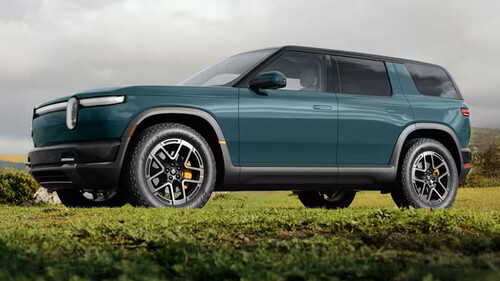
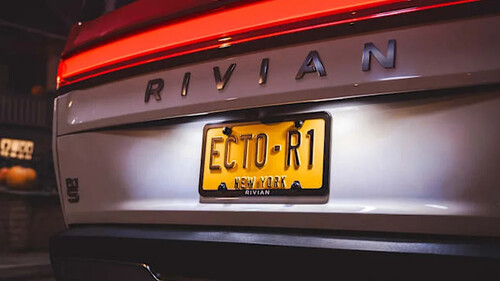
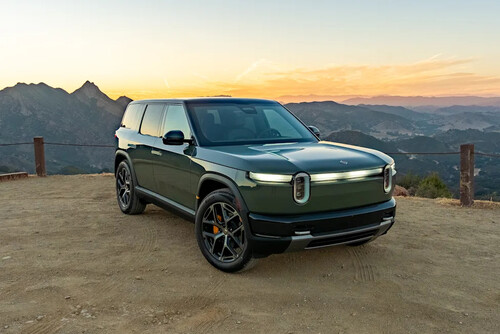
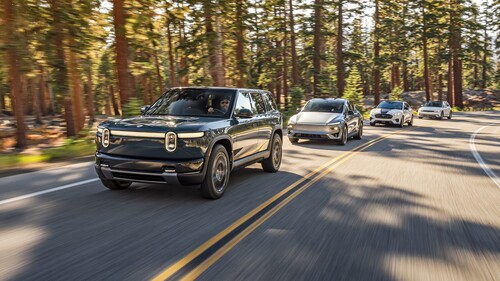
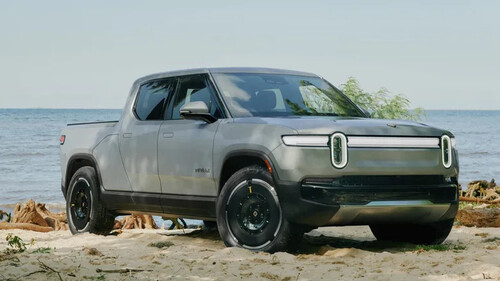
Park City, Utah – If the early 20th-century auto revolution was sparked in Detroit by entrepreneurs like Ford, Dodge, and Sloan, the early 21st century has brought a new, digital auto revolution on America's West Coast right out of a science fiction novel.At its forefront are entrepreneurs like Sergei Brin of Google, Tesla's Elon Musk, and Rivian's RJ Scaringe."I think it's the most exciting time in human history," Scaringe said at the media launch of his Tesla Model Y fighter, the electric R2, in Utah's Wasatch Mountains. "We happen to be alive at this moment in human history, where we are creating intelligence that can do tasks humans can do."AdvertisementAdvertisementWith rapid advancements in artificial intelligence, computer chips, and electronics, these entrepreneurs envision a robot-driven future that will not only transform the automobile, but also the workplace in which they are made."There's going to be thousands of people collaborating alongside these robots," Scaringe said. "They're going to take a picture: 'Hey, check this out. My coworker's name is Phil, and he's a robot.'"Brin pioneered the Waymo robot car ferrying passengers on U.S. streets. Musk brought point-to-point hands-free driving to his Tesla model lineup and is transforming his factories to build humanoid robots.Scaringe, who has raised over a billion dollars for his company, Mind Robotics, said robotics is transforming Rivian. Not only will the R2 drive itself, but an AI-driven revolution is at our doorstep.Park City, Utah - Rivian CEO RJ Scaringe introduced the Rivian R2 (background) while talking with reporters about a variety of topics including his new Mind Robotics company.Detroit News auto columnist Henry Payne sat down with Scaringe and other media representatives at a recent roundtable to discuss.AdvertisementAdvertisementDetroit News: You started a robotics company?Scaringe: Yes. The company was formed late last year ... focused on developing extremely capable robots with human-like skills to do manufacturing. We've raised a little over $1 billion dollars (the company is valued at $3.4 billion). We haven't shown anything yet, so we're very stealth.I think it's the most exciting time in human history where you really take a step back. We are creating intelligence that can do tasks humans can do. This is the first in the history of our planet — certainly the first in the history of our species.The rate at which AI is moving is ... an order of magnitude faster than the average person in society understands.AdvertisementAdvertisementThat's going to be a particularly big challenge, in the short term, to have the average person .... realize how fast the models are learning and how capable they are at doing almost everything.I'm seeing it first-hand in the case of a car. Like training robots to do hard tasks around manipulation, or plugging in wiring harnesses, or manipulating things like carpet sets. All these things that we used to think would be impossible for robots are very much not science fiction.This is going to be reality - and not in 10 years. In a couple of years.Inc.: One of the big things automakers have struggled with is getting robots to, say, plug in a wire harness, because that is a fine motor skill that neither cameras nor sensors can actually handle. With the advancements in AI moving as quickly as they are, are you seeing that change when it comes to the manufacturing line?AdvertisementAdvertisementScaringe: Go into any manufacturing plant — whether Rivian, Toyota, GM, or Tesla — you'll see thousands of robots doing ... geometrically repeatable tasks. In the vast majority of body shops, there are no humans doing any of the welding. In contrast, if you go into general assembly — let's say putting trim into the vehicle or seats or wiring harnesses — you have (tasks) that are highly repeatable, but they're not geometrically identical. So (humans are) picking an object out of a bin (and) putting it into the car in a slightly different way each time.There's zero AI. To move to a robot that has both high capability for decision-making and the ability to do dexterous manipulation, it requires a different type of model.NORMAL, ILLINOIS - Workers build Rivian R2 SUVs at the manufacturer's assembly plant on in Normal, Illinois. The company plans to bring humanoid robots to the line in the future.(Along comes) this idea of ... large neural nets or foundation models. Large Language Models took very broad knowledge — all the embodied knowledge of the Internet — and converted it into foundation models that could interpret the world through the written word. Very similar to how a human would.You can use it to drive a car, so we've approached our self-driving platform that way. But, importantly, you can also use it to operate a robot.AdvertisementAdvertisementCNBC: When are you going to be ready to show what you're working on?Scaringe: Less than a year. It's different than a car, because you can work on it for a long time and ... use proving grounds and camouflage.In the case of a (Mind) robot ... we're going to be deploying inside Rivian's production plant. The moment we start to deploy there's going to be thousands of people collaborating alongside these robots. They're going to like take a picture.'Hey, check this out. My coworker's name is Phil, and he's a robot.'I think there's also a big perception, like jobs are going to be lost. We've got the messaging upside down on this as a country because there is an extreme lack of like labor.AdvertisementAdvertisementIt's not like there's a line of people ... waiting to work in manufacturing. We don't have enough people, especially if we want to bring any level of manufacturing back into the United States. We're competing with hospitality that pays half of what we pay — and people still prefer to be in hospitality, because it's a lot easier.(If) you worked in manufacturing, you stood all day doing a highly repetitive task, five days a week, 50 weeks a year. We didn't, as a species, evolve to do that type of work.Inc.: There is a lack of skilled workforce that can go into a manufacturing line. Do you think that that's more of an educational function? What is the mechanism you think should be supporting that, so that we're not replacing jobs with AI robots?Scaringe: When I created Mind, I set aside a portion of the equity to answer that question.AdvertisementAdvertisementThe honest answer is we, as society, have not yet honestly acknowledged how much needs to change — in particular with our education systems. We talk about this in the context of manufacturing, but this is true for every job. There's not a single job in our economy that doesn't have an impact from AI. The nature of the work — whether you're an accountant, attorney, medical doctor, automotive technician, whether you're working in a manufacturing plant — all those jobs are going to change fundamentally because we have these extremely powerful tools.This is like going from a typewriter to computer on steroids.Our policymakers need to get serious about this and recognize we can't ignore that AI is coming. It's going to have enormous impacts on the fabric of society, and we need to prep our kids, we need to prep our existing workforce.The Verge: In the autonomy race, investors seem far more excited about investing in autonomy than in batteries. What's your take on the value of autonomous vehicles?AdvertisementAdvertisementScaringe: Autonomy is going to represent one of the biggest shifts in how we think about a vehicle.We're deploying a disproportionately large amount of capital into that. The rate at which things are progressing is far faster than our own mental models have been built to think. Thirty-six months ago, the prevailing way to approach (autonomy) was a rules-based approach. Twenty-four months ago, most folks (realized) that moving to a neural net-based approach to drive the vehicle was the winning technical approach.We're going to see a very different rate of progress for autonomy between 2026 and 2031 than we've seen between 2021 and 2026. For so long, since the DARPA challenge years ago, we've been saying: 'oh, autonomy is a few years away.' (The) big technology inflection point of shifting from rules-based models (to) foundation models ... now unlock capabilities that seem like science fiction. By early 2030, buying a car that doesn't have Level 4 (Ed. Note: L4 is full-self driving, no human needed. Rivian's current, hands-free Level 2 requires driver attention) will be a pretty foreign concept. It'll be like buying a car without a steering wheel.The Verge: Level 4 functionality for your company?AdvertisementAdvertisementScaringe: Yeah, we've said 2028 for full Level 4.The Rivian R2 self-drive on Level 2 with human attention. CEO RJ Scaringe says it could be Level 4 full-self-driving by 2028.The idea that the country is going to move away from car ownership is unlikely. The vast majority of miles are going to be owned. Whether that's 70% or 90%, I don't know. But the reason that's important is I think owned Level 4 will become very important. The idea that your car can drop you at the airport, then pick up your kids from school, (then) run to the grocery store and pick up things for you — that's a very real outcome.We'll have new choices owning Level 4. Do I need more cars in my household? Do I just use a robot taxi service? Does my car go out and work for me during the day?Henry Payne is auto critic for The Detroit News. Find him at hpayne@detroitnews.com or Twitter @HenryEPayneThis article originally appeared on The Detroit News: Q&A: Rivian CEO RJ Scaringe on how AI will transform autos