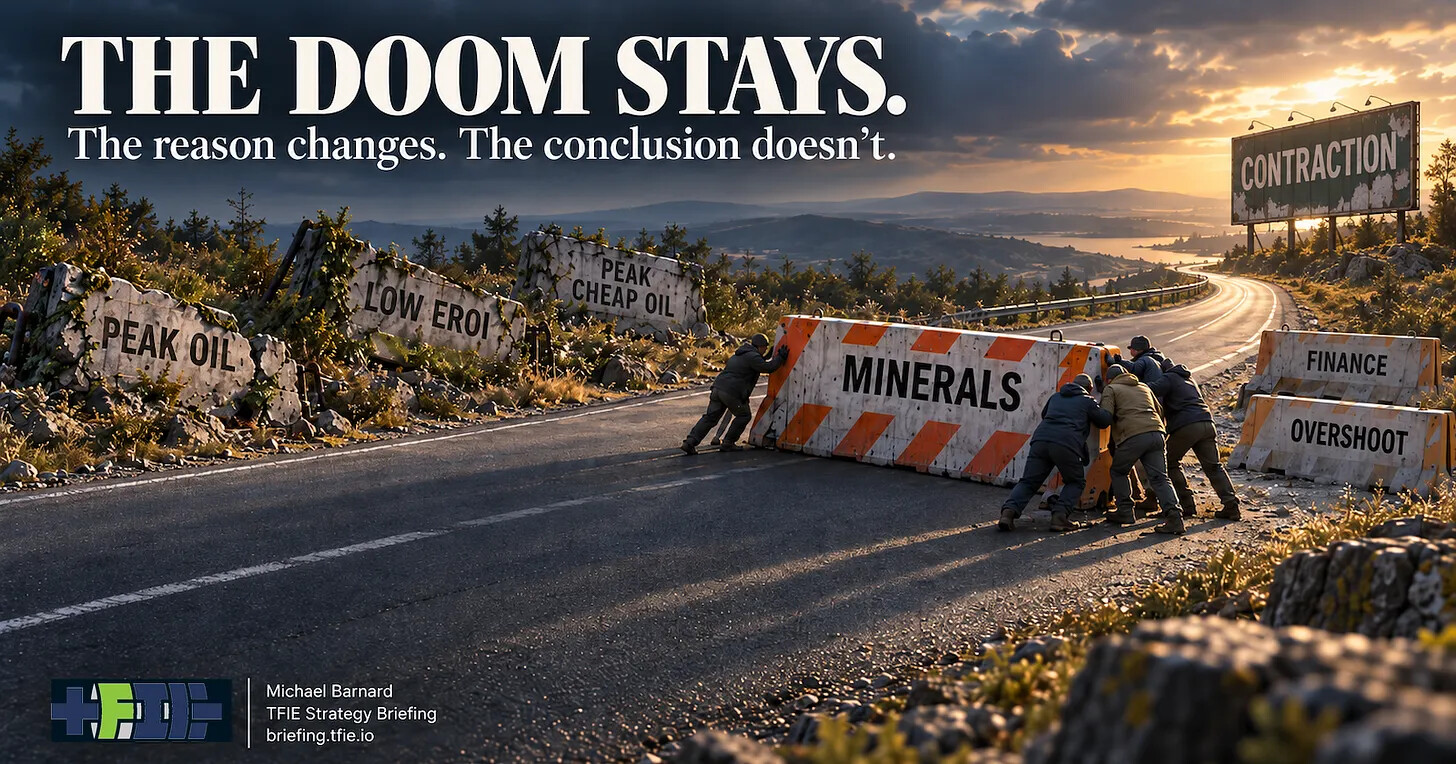
Nate Hagens has spent most of his intellectual career inside a forecasting tradition that expected physical resource constraints to force industrial societies into contraction. He was a major contributor to The Oil Drum and eventually its managing editor, while the nonprofit that now produces The Great Simplification grew directly from that same institutional ecosystem. The interesting question is no longer whether Hagens sincerely believes modern economies face energy, resource and ecological limits. It is whether a forecasting framework that got its original bottleneck wrong has learned enough from that failure. Peak oil was supposed to do the work. Richard Heinberg wrote in 2003 that global oil production would peak within a few years, with progressively less net energy forcing industrial societies toward contraction. By 2010 he was arguing that conventional economic growth was effectively finished. Hagens was making related arguments at the same time, writing that the world was already years past its annual oil-production peak and linking declining petroleum energy availability with approaching economic contraction. Oil supply subsequently rose substantially and global economic output continued expanding. Hagens deserves credit for later acknowledging that some of his earlier conclusions were wrong. In particular, he revisited both his confidence in an early petroleum peak and the inference that declining petroleum net energy would translate fairly directly into declining GDP. That is genuine updating. But it did not lead to abandonment of the broader expectation that the material basis for continued economic growth was running out. Instead, the oil argument became less dependent on a simple volumetric peak. In conversations with petroleum geologist Art Berman, whom Hagens has hosted repeatedly, attention shifted toward oil quality, depletion of conventional supply, shale decline and what Hagens himself explicitly called “Peak Cheap oil”—the idea that even if headline liquids production kept rising, the economically and energetically attractive resource base was deteriorating. Hagens was not merely hosting that phrase neutrally: in his own framing he continued to describe oil as the economy’s “master energy resource” and argued that once its supply ceased growing, the financial system would have difficulty sustaining existing claims on future growth. EROI and net energy then provided a broader way to preserve the physical-constraint argument without relying on a particular peak-oil date. Here the attribution needs care because Hagens is more nuanced than some of the low-EROI collapse advocates he platforms. In his 2023 Perils of EROI episode, he warned that EROI is often abused as a supposedly precise way to rank technologies and can produce misleading conclusions when system boundaries differ. At the same time, he continues to treat declining net energy as central to the economic predicament, arguing that society is devoting a growing share of its effort to obtaining energy and repeatedly returning to whether renewables, storage and other substitutes deliver enough surplus energy to sustain a complex economy. The Great Simplification has also repeatedly platformed stronger versions of that argument, including Pedro Prieto’s expansive EROI accounting and Berman’s emphasis on deteriorating oil quality. So it would be too strong to say Hagens simply replaced “peak oil” with “low EROI”; it is supportable to say that net-energy deterioration became one of the successor mechanisms through which the same contraction concern continued to be expressed, while his platform gave substantial room to people making the harder version of that case. The Great Simplification What did not undergo anything like the same visible revision was Hagens’ confidence in the destination. In September 2022 he said that growth ending within roughly the next decade was a “mathematical certainty.” Four years later, in his 2026 What Would Change My Mind episode, the working thesis was still that civilization was moving toward a deflationary depression driven by resource constraints, ecological overshoot and the widening gap between financial claims and material reality, followed by a more localized and materially simpler economy. Those forecasts are conveniently long-dated enough that they cannot yet be scored the way his earlier peak-oil expectations can. But the continuity is striking: first an imminent oil peak, then greater emphasis on the end of cheap oil and declining net energy, then minerals, finance, overshoot and human behaviour. The explanatory machinery has become broader and more resilient while the expected destination has remained comparatively stable. The full TFIE Strategy Briefing traces that continuity through Hagens’ own forecast record, The Oil Drum, Richard Heinberg and Simon Michaux, then asks why a minerals model riddled with elementary energy-system errors became recurring evidence on The Great Simplification rather than a case study in bad modelling. Simon Michaux is where the pattern becomes difficult to dismiss as normal model revision. His established professional background is mining engineering, geometallurgy, blasting, rock fragmentation and mineral processing. His PhD examined fines generated in blasting. There is nothing wrong with that expertise, and mining specialists are obviously relevant to mineral supply. What is extraordinary is the leap from those domains to a bottom-up model of essentially the entire global energy system: electricity, transportation, heating, shipping, rail, storage, hydrogen, power generation and their replacement technologies, followed by a global minerals model whose demands are calculated from that first model. The problem would be merely interdisciplinary ambition if the energy model were good. It is not. Michaux constructed a transition system in which major transport categories were pushed toward hydrogen, transmission and geographic balancing were badly undervalued, pumped hydro was effectively excluded from playing the role demonstrated by real systems, renewable assets were given unnecessarily short lives, storage requirements were grossly inflated and electricity suffered losses completely unlike those of actual modern grids. Those choices drive the size of the replacement energy system upward before the minerals calculation even begins. The second model then multiplies the first model’s errors. If an energy model says civilization needs vastly too many wind turbines, vastly too much storage specifically in the form of lithium ion grid batteries and inefficient hydrogen pathways for applications already moving toward batteries and direct electrification, multiplying those assets by tonnes of lithium, nickel, cobalt and copper will inevitably produce alarming mineral totals. The arithmetic can be correct while the answer is nonsense because the denominators being multiplied are nonsense. This is why Michaux’s conclusion that “minerals will become the new oil” is less impressive than it initially sounds. A model can discover an enormous minerals shortage by first constructing an enormously material-intensive energy system while ignoring mineral resources, substitution and recycling. The shortage then becomes evidence that the transition cannot happen, even though much of the shortage was created upstream by the modeller. Reality has already moved away from several of those assumptions. Lithium iron phosphate batteries removed nickel and cobalt from a rapidly expanding share of the EV market. Sodium-ion is becoming another commercial option. Heavy trucks are scaling with batteries far faster than hydrogen. Battery-electric rail is operating where full electrification is inconvenient. Maritime batteries are advancing into increasingly long routes. High-voltage direct-current transmission moves large quantities of electricity over thousands of kilometres with losses nowhere near the values embedded in Michaux’s global model. Wind farms are being extended to 40 year lives or repowered with old turbines going to secondary markets. Solar farms and EV batteries are lasting far longer than anyone expected. Recycling of batteries is already a big business. None of this means copper, lithium, grid equipment or mining capacity cease to matter. It means technological systems adapt precisely where a static scarcity model assumes they will not. Michaux is an interesting psychological case study of what can go wrong when someone with a deep doomer bias arrogantly crosses too many disciplinary boundaries at once. What makes him important to the Hagens story is what happened next. Hagens did not bring Michaux onto The Great Simplification once for a forensic examination of a controversial model. Michaux received three solo episodes in less than a year and then joined the programme’s first electric-vehicle Reality Roundtable. The sequence moved from “Minerals Blindness” into discussions of an alternative “Arcadian” society and eventually an “Arcadian Blueprint.” Questions were asked about recycling and alternative chemistries, but the central scarcity conclusion was repeatedly carried forward rather than being rebuilt after its assumptions were very lightly challenged. That is the tell. A programme that claims to be devoted to serious systems thinking should have treated Michaux’s model as a good stress-test candidate. Before accepting its conclusions, Hagens should have checked whether its electricity losses resembled actual grids, whether its storage requirements resembled credible power-system studies, whether heavy transport really required hydrogen, whether pumped hydro and transmission had been represented properly, whether technology lifetimes were realistic and whether mineral substitution was allowed to occur. Those are not obscure disputes deep inside a sophisticated model. They determine the answer. Instead, Michaux’s work fitted the existing Great Simplification narrative almost perfectly. Peak oil had failed to impose the expected contraction. The failure of oil to become radically expensive with a negative EROI failed to impose the expected contraction. Minerals could become the next hard limit, and Michaux arrived with hundreds of pages of calculations saying that they were. Repeated appearances then gave a deeply flawed model the appearance of accumulated authority. That is different from independent corroboration. Four discussions of the same model do not make its assumptions four times stronger. A network of people who already share expectations about physical limits can repeatedly cite and interview one another without creating independent evidence for those expectations. Dave Murphy provides a useful comparison because he came from the same peak-oil intellectual environment and responded differently when reality failed to cooperate. His later work caused him to reconsider estimates of petroleum energy return and renewable-energy performance, and the evidence weakened his confidence in the mechanism and therefore in the outcome. He did not conclude that resource constraints were imaginary. Like Keynes, when the data came in that disproved his thesis, he changed his mind. That is what makes Hagens’ repeated promotion of Michaux consequential. The problem is not that The Great Simplification discusses scarcity. Scarcity is worth discussing. I spent a long time looking at mineral supplies, including a lengthy conversation with Gavin Mudd, head of critical minerals intelligence for the British Geological Survey. The problem is that an obviously deeply flawed model of the transition was unusually congenial to an existing contraction worldview, and instead of being dismantled or ignored it became recurring supporting evidence. A forecasting culture reveals itself by what it does with a failed prediction and with evidence that confirms what it already expects. Peak oil failed to produce the contraction anticipated by this intellectual lineage. Hagens revised pieces of the mechanism while retaining much of the destination. Michaux then supplied another mechanism, despite work that should have triggered far more skepticism than endorsement. Hagens reveals himself with his repeated predictions of doom while the mechanisms of doom change beneath him. He brings no solutions, just despair. It clearly has an audience, but there’s no evidence that anyone except Hagens, his guests and perhaps pharmaceutical companies selling antidepressants are benefiting from it. The full TFIE Strategy Briefing goes through the forecast history, Michaux’s modelling problems, his repeated appearances on The Great Simplification, the institutional continuity from The Oil Drum, Dave Murphy’s contrasting update, and the media incentives that can make a coming simplification remain permanently just over the horizon.