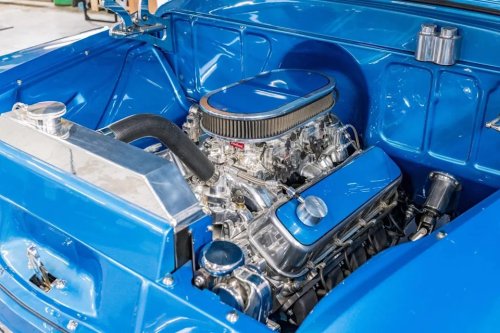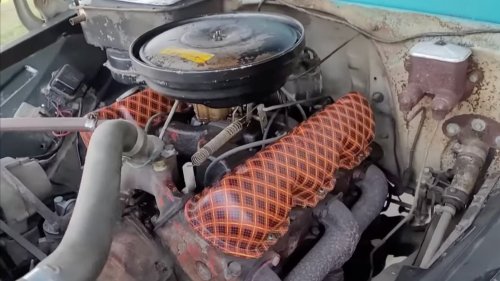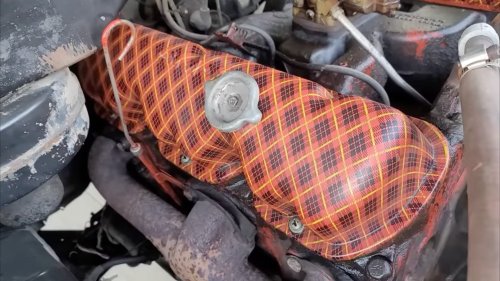



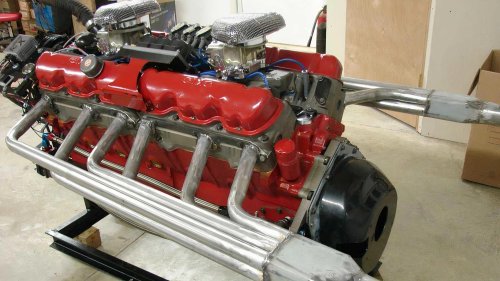



















V12 engines aren’t anything new, especially in European exotic supercars. When you hear that a vehicle has a V12 engine, you immediately think of brands like Aston Martin, Lamborghini, Ferrari, and Bugatti, expecting one of these high-end brands to house such a big engine in a top-level performance car. Although massive V12 engines have made their mark in the sports car world, there was one such engine that had a completely different use. GMC had an incredibly large V12 engine back in the day. So far back that it was offered in the early 1960s and first appeared in a commercial-grade GMC pickup truck. This huge engine powered the workhorses of a decade where fuel mileage be damned and work needed to get done. The Thunder V12 wouldn’t have survived into the 1970s with the fuel embargo, but it provided incredible gasoline-fed power while it was around. The GMC Thunder V12 Is Pure Madness ThunderV12.com How Big Is Big? The Thunder V12, which was also called the “Twin Six,” was one of the biggest engine blocks ever put into a truck. This big piece of metal provided 702 cubic inches of displacement. In modern terms, that’s 11.5 liters, which made this engine one of the largest engines of its time. For comparison, the W16 engine used in the Bugatti Veyron, which has four additional cylinders, only measures 8.0 liters of displacement. It measured roughly 53 inches in length and weighed in at around 1,485 pounds, nearly matching a small car of the era. Ultimate Hot Rod Swap During the early 1960s, there truly was no replacement for displacement, which meant hot rodders were looking to get their hands on the Thunder V12, not for its horsepower, but for the torque it delivered. Production of this massive monster only lasted until 1965, which makes the 702 a rare engine today. Twin Six Was Confusing AutoevolutionContrary to what its appearance might suggest, the Twin Six was not two V6s welded together. Instead, GMC engineered a single, cast-iron block with its own unique crankshaft and camshaft, albeit borrowing some parts like cylinder heads from the 351 V6 for parts commonality.Some engines appear to be nothing more than two smaller models joined together, but that wasn’t the case with the Thunder V12. It had four cylinder heads, four exhaust manifolds, two intake manifolds, and two distributor caps on the same distributor drive.This was caused by the need for parts standardization within GMC, which meant it borrowed parts such as the cylinder heads from the 351 V6, allowing for parts interchangeability, easy maintenance, and lower cost. A Forgotten Engine That Defied Power Norms The Thunder V12 wasn’t made for speed and massive horsepower. In fact, it reaches peak horsepower of only 275 ponies, and it does so at 2,400 rpm, which is the redline for this engine. That redline seems extremely low until you realize that torque and pulling power are what matter in the massive 702 cu-in engine.When it came to towing, the 702 reached 630 lb-ft of torque just off its idle, which is enough power to pull up to 60,000 pounds up a mountain. That is where this massive engine truly shines. Forget Gas Mileage Although some people have joked that large commercial engines return several gallons of fuel for each mile driven, it was almost true for the Thunder V12. The engine was rated at two miles per gallon. That’s right, two, and it was a running joke that it could get three if you had a downhill tailwind. Thankfully, most commercial trucks have 120-gallon fuel tanks, but that still only means 240 miles of driving from full to empty. It’s a good thing gas was cheap in the 1960s. Vehicles With The Thunder V12 Under The Hood The Twin Six found its way into commercial trucks, fire trucks, military missile transporters, airport tow vehicles, farms, and stationary generators, wherever reliable low-end torque was critical.One company, called Thunder V12 LLC., out of Evansville, Indiana, is going in search of massive 702 cu-in engines to rebuild them, sell off parts, and has made a small business out of doing this. According to Hot Rod, a turnkey engine costs nearly $18,000. Built for some hot rodders, it’s worth the cost. The company claims there might only be 200 of these engines left from the original 5,000 that were built.Despite the original low rpm of the GMC models, the retuned versions of the Thunder V12 can reach as high as 5,000 rpm. This means the engines continue to be low-rpm torque machines with the retuned models reaching 425 horsepower at 4,200 rpm. The torque figure remains the same, 630 lb-ft, which is reached at 1,800 rpm. The Blastolene B-702 Michael Leeds and Randy Grubb created the B-702, which is a modern interpretation of a prewar French car. This vehicle is a bespoke machine powered by none other than the 702 cu-inch Twin Six from GMC. The pair used a restored version and became a fascinating project that was shown off in 2017. Long Haul Trucking Made The V12 Make Sense Bring A TrailerCommercial trucking hasn’t always been the easiest way to get a load of goods from one coast to the other, but it's been used for decades. The Twin Six was one of the most durable and useful engines for semi-trucks in the early 1960s, meaning truckers could dependably bring large loads across several states. Fire Department And Aircraft Support This massive V12 engine was installed in GMC 7000-series fire trucks, which became popular with several American fire-truck manufacturers. This engine layout became the foundation of the engines for American LaFrance aircraft engines, which eventually led to a modified Pierce-Arrow V12 engine.The GMC Twin Six engine didn’t catch on as well as GMC had hoped. Despite the engine’s reliability, the fuel mileage wasn’t enough to make this engine useful. It was a powerful monster that could pull a heavy trailer, but it could only pull it a few miles. During its production, nearly 5,000 engines were built, and they were sold in heavy-duty vehicles or as stationary units that could be used as generators and pumps.Diesel engines were on the rise during the 1960s, and that meant the right kind of power and much better fuel mileage for long-haul trucking. This eventually killed off the massive V12, but it was a good answer for a short time. Unexpected Smoothness In The Thunder V12 Power Delivery GMC One of the V12’s inherent strengths is its smoothness. Unlike V8s (combustion every 90°), the V12 delivers combustion every 60°, contributing to exceptionally refined and vibration-free operation. The Thunder V12 Was Also Reliable GMCThe Thunder V12 wasn’t efficient, but it was advertised to be a reliable engine for commercial trucking. GMC advertised this massive beast to be capable of 200,000 miles without a major overhaul. This was an impressive claim in the 1960s when some engines would give out and leave drivers on the side of the road.Models that are still running today are still pretty good. The high-output oil pump helps keep this engine lubricated extremely well, pumping a flow of 17 gallons of oil per minute. The water pump circulates 118 gallons of coolant each minute. These two items are why the Thunder V12 was such a reliable engine from the 1960s.Sources: Hagerty.