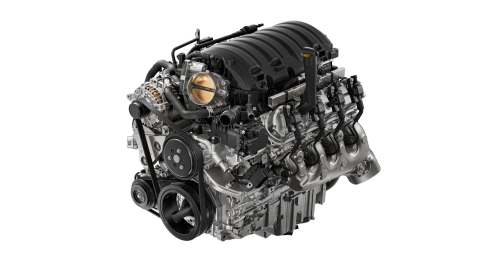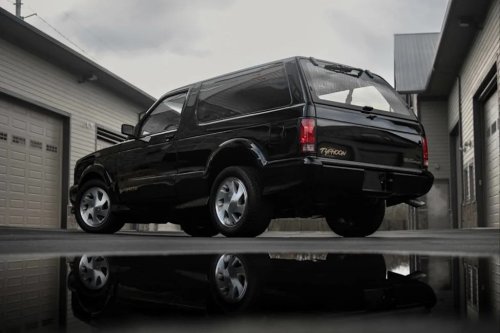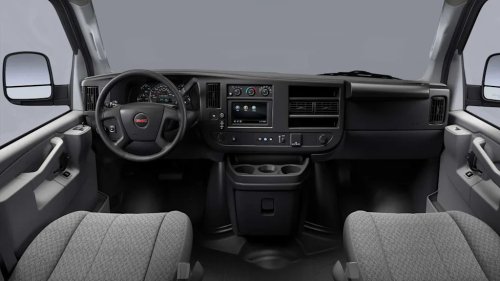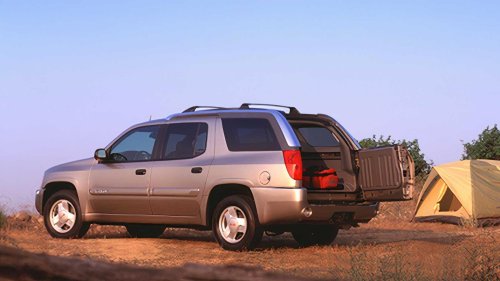
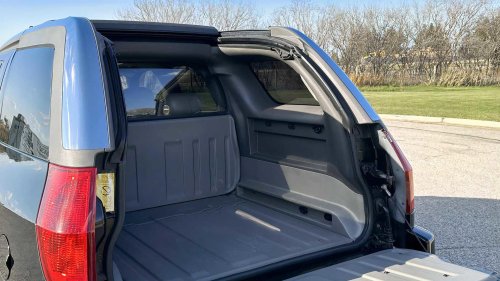
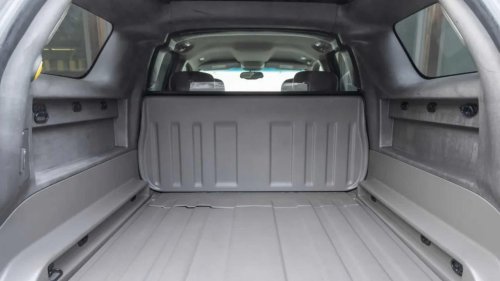
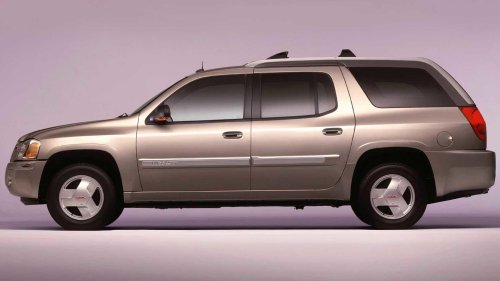
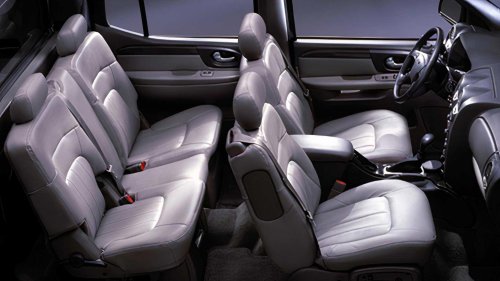



















When it's time to dust off the back patio and get ready for outdoor season, some people decide to invest in a brand-new super-grill. They see one on sale in their local home improvement center and head off in their midsize SUV to pick it up. However, as many in this situation invariably discover, that super-efficient grill simply won't fit in the back.And after pushing and shoving for quite some time, the wannabe chef may drive home with their hatch half latched and a bungee cord or two trying to support things. Back in the early 2000s, GMC was aware of such problems playing out every day in suburban America and decided to try and solve them. It went on to create an oddball Envoy XUV, a mutant with certain modifications that would allow people to change it into more of a truck than a comfy family SUV when needed. What GMC Was Trying To Build GMCThe Envoy XUV started out as an ordinary body-on-frame midsize SUV that sat on GM's GMT platform. There was nothing particularly inspiring about the Envoy, and it performed the same kind of role as the Oldsmobile Bravada or the Chevy Trailblazer, which also relied on the same platform family. Beneath the hood, most XUVs had the company's 4.2-liter Vortec 4200 inline-six, which turned out 275 hp and 275 lb.-ft of torque. These vehicles featured a four-speed automatic, and you could choose between rear or four-wheel drive. Meanwhile, GMC also offered a 5.3-liter V8 with more meat and around 290 hp with 325 lb.-ft. Drivers who wanted to tow their boat down to the lake on a weekend tended to favor this variant of the vehicle.Fuel economy was not particularly special, but remember that this was a 2.5-ton brick-shaped vehicle. You might get somewhere in the mid-teens combined if you were lucky, but back then gas prices were much lower than they are today and so this wasn't the biggest deal.The XUV would also seat five comfortably, and it measured around 208 inches long, with a 129-inch wheelbase. This made it roughly the length of a modern three-row SUV, although there was a trick section in place of the third row where things started to get interesting. This was where GMC had realized that, while its Envoy was mostly fit for purpose, it couldn't really cart your new grill home when needed. The Sliding Roof And The Mid-Gate Party Trick Bring A Trailer To equip the XUV with its novelties, GMC grafted pickup-like functionality onto the back of this SUV. Now you had a power sliding rear roof panel over the cargo area that you could fold back and expose the rear part of the vehicle to the elements. This created a 32-inch by 32-inch opening above the cargo bay and crucially opened up a world of possibilities. As, while you might not think that the aperture by itself was particularly significant on paper, you could now stand tall items in the back rather than lay them out lengthways. This was great for pieces of furniture, big boxes, small trees, or that essential new grill. And these items would no longer stick out of the back with the tailgate tied down, with all the risks that might otherwise entail.Behind the rear seats of the XUV was the mid-gate, which was basically a wall that incorporated the power window and sat between the passenger cabin and the cargo area. If you folded the second row down, you could then drop that mid-gate and make the XUV into an even bigger hauler. You'd now have a long and continuous load floor that stretched all the way from the front seats to the tailgate, increasing your total volume from roughly 49 cubic feet to about 95. All of a sudden, you had a vehicle with pickup truck capability but still wrapped in an SUV body.GMC went even further with its utilitarian theme. The company installed drains on the floor of the cargo area and made sure that the surfaces themselves could handle getting wet. So, if you went down to Home Depot to get some soil or landscaping rocks, you could hose the interior of your XUV down as soon as you'd finished unloading.GMC clearly hoped that buyers would take full advantage of the XUV's dual personality. On weekdays, they’d drive it just like a normal Envoy, with an enclosed cargo area, rear glass, contained roof, and normal service. But on Saturday morning, they could transform their vehicle into a mini pickup so they could be as productive as possible. The XUV And Everyday Driving Bring a Trailer There wasn't too much difference between a conventional Envoy and an Envoy XUV when it came to everyday use. The vehicle had a predictable body-on-frame construction, which made it feel confident enough over broken pavement. But while it did soak up potholes quite well, it did tend to roll through the corners. And in that respect, it was nothing like the cross-over of today, which tends to drive just like a conventional car, as the XUV tended to float along the road instead.Most people seemed satisfied with the 4.2-liter inline-six engine as it was smooth and reasonably strong, even if it did complain a bit if carrying a full load. Those who expected more tended to go for the optional V8, with added muscle, and this gave those owners some good towing capacities of between 5,200 and 6,500 lbs.On board, you'd encounter clear analog gauges, big buttons and knobs, and, to all intents and purposes, a typical early-2000s GMC environment. Meanwhile, higher-spec SLT models also had available leather seats, automatic climate control, dual power front seats, and the latest navigation system.GMC seemed to be marketing this vehicle to those who were more energetic and lived their lives with purpose. While many people might simply rent or borrow a trailer for the odd times that they might need something with heft, GMC tried to split the difference with its XUV. It clearly thought that these people needed to move small furniture, tools, or home improvement supplies to such an extent that a simple and conventional SUV wouldn't cut it. Why The XUV Didn't Catch On And Why It Matters Now GM The Envoy XUV was a short-lived experiment, arriving in 2004 and disappearing after 2005. As it turned out, Americans were starting to pivot towards car-based crossovers at that time and seemed to want something that handled more like a sedan with good practicality and better fuel economy. The XUV was certainly more like a classic SUV, with that full-frame construction and inline-six or V8 engine. And while those fuel economy figures were certainly not the XUV's strongest point, the bigger issue is that GMC simply overestimated the market.The majority of buyers might have thought that such functionality was cute and possibly valuable, but hardly a priority as they only occasionally hauled tall or bulky items. If they did live their lives adventurously, then they may have opted for a full pickup instead to address that problem head-on. Where The Envoy XUV Might Work Today GMC If you look closely, you might come across a clean Envoy XUV on the used market and, if you are the right type of person, it could make perfect sense as a used purchase. Prices now are easily swallowed too, with most examples netting somewhere between $5,000 and $10,000, although finding a clean survivor could be a tall order.If you're looking for an old-school SUV that has occasional truck capability, even though it's not particularly maneuverable and has sketchy fuel economy, then it could be perfect. Still, you would need to be realistic about maintenance as remember that this vehicle also comes with power roof hardware, seals, and additional complications that are all more than twenty years old. A prospective buyer would also have to be comfortable driving a vehicle that has a level of safety and tech reflecting the early 2000s rather than the standards of today.But there again, you'd never find yourself wishing that you had a truck, and you could impress other shoppers in the Home Depot parking lot with the answer to your hauling problem. You'd also have a vehicle with a proper transformer attitude and, as your neighbors looked on with envy, they'd be adding your phone number to their speed dial list.