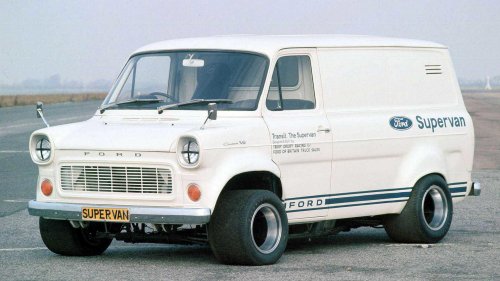
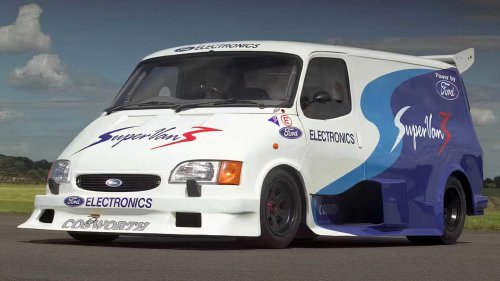
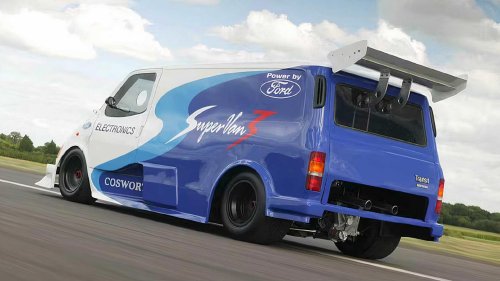
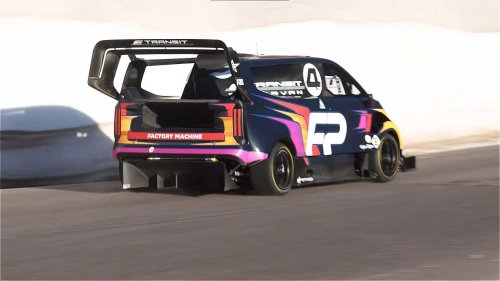
Performance cars come in a wide variety of shapes and sizes. Supercars and sports cars tend to come in coupe or drop-top form of some kind to help make them lighter and look more purposeful, while sleepers such as sedans, SUVs, and station wagons combine blazing speed with the practicality needed for a family-orientated gearhead.Even some pickup trucks have got the performance treatment, like the beastly Ford Raptor R, though one breed that tends to get left alone is vans. Ford was interested in changing this, a decision that ultimately led to an unusual creation called the Supervan. The Supervan First Originated During The 1970s (Ford) The Supervan moniker first originated in the early 1970s, as Ford wanted to show off its immensely popular Transit in a different light. Legend has it that the Mk.1 Transit van body was placed on a Ford GT40 chassis, while a potent racing-tuned 302 cubic-inch V8 engine was used to power the vehicle. The Supervan was afforded 435 horsepower courtesy of the powerplant, which was enough to push it to 60 mph in just seven seconds.It was first shown to the world at a race meeting at the Brands Hatch circuit in the United Kingdom in 1971, where it paraded around the track. The van wowed onlookers and ultimately proved to be an ultra-successful PR exercise for the brand. Despite its success, the experiment wasn't repeated until over a decade later.Wanting to give the first-generation Transit a decent send-off, the Supervan was resurrected on the facelifted Mk.2 body of the model. It was built on the chassis of a Ford C100 Group C prototype, where it was gifted a Cosworth-developed DFL V8 engine. It was even quicker than its predecessor as a result, though it soon went out of date as the second generation of the van, which is one of Ford's most successful models, landed in 1986.After another pause, Ford decided to use the Supervan to promote the facelifted version of the gen-two Transit, which was set to arrive in 1994. This was the first time it had been used at the start of a model's life, rather than at the end. Determined to take advantage of the good press, Supervan 3 was made to be more commanding and long-lasting than its forerunners. The Supervan 2 Was Sacrificed To Create A Worthy Successor Blue Transit Supervan 3 front 1994 Ford Supervan 3 (Hagerty)Rather than start from a fresh sheet of paper, Ford decided to utilize the lightweight aluminum C100 chassis from the Supervan 2 to begin work on the Supervan 3. The older Transit body was ripped away and replaced with a fiberglass replica of the upcoming model, while the same mechanical hardware was utilized.This included the suspension and braking systems, though an all-new engine was introduced for the latest variant. Gone was the DFL, and in came a Formula 1-derived Cosworth-Ford HB V8. The 3.5-liter unit was the exact same one used in the 1993 F1 season. Cars such as the Ayrton Senna-driven McLaren MP4/8, the Brazilian ending up second in the driver's standings that year and the Michael Schumacher-piloted Benetton B193 used it.This meant the Supervan 3 had an amazing 650 hp at its disposal, the engine capable of revving all the way up to 13,000 rpm. Due to the complexity of the six-speed semi-automatic gearbox normally twinned with the powerplant, a five-speed manual unit was used instead for the Supervan 3. This made it more powerful than the legendary McLaren F1, which only made 618 hp courtesy of its 6.1-liter S70/2 BMW V12.The finished article made its debut at the Birmingham Motor Show in 1995 and was subsequently used at a range of events to show off the Transit. The Supervan 3 Produced More Power Than A McLaren F1 Bridgend Ford As the Supervan 3 had been built at the start of its base vehicle's life, it remained on the scene significantly longer than its ancestors. Over the years, the van made high-profile appearances at a range of events like car shows, as well as taking on the iconic Goodwood Hill Climb. The vehicle was utilized until 2001, when it was finally retired from active service.Part of the reason was that the third-gen Transit was unleashed in 2000, rendering the gen-two-based Supervan 3 out of date. Another was the extreme cost of getting the thing running, seeing that it was essentially an F1 car with a fiberglass body on top. A whole team of engineers needed to be on hand to ensure it ran smoothly, while the highly strung V8 needed constant maintenance to keep running optimally.Its last official appearance in its F1-engine spec came at the 2001 National Van Show in the UK, where it was repainted in a bright red Royal Mail paint scheme. This was to celebrate Ford getting the contract to supply the Royal Mail, the UK's main postal service, with all its vans. It also got a run out at Brands Hatch, where fans could revel in the V8's scream one last time. Supervan 3 Was Reborn With a New Engine FordHaving been placed into storage following its appearance as a Royal Mail van, the Supervan 3 was brought back out as part of the Transit's 40th anniversary celebrations in 2005. The Cosworth V8 had long been taken back by Cosworth though, so a 3.0-liter V6 designed by the company was used instead.While power was way down at 300 horsepower, the simpler powerplant at least meant the Supervan could be run much cheaper and simpler than the previous version. Modern Day Supervan Is An EV Powered Monster Larry Chen Via YouTube 2023 Ford Supervan 4.2 (Ford)After another extended break, Ford resurrected the Supervan nameplate once again in 2022. Making its debut at that year's Goodwood Festival Of Speed, the Transit featured four motors and a 50 kWh battery, which powered all four wheels.With an insane 1,972 horsepower on tap, the Supervan 4 could reach 60 mph in under two seconds.Having been built as more of an exhibition piece, Ford decided to develop it further for an attack on the famed Pikes Peak Hillclimb in the US. Built in cooperation with Austrian engineering company STARD, the Supervan 4.2 made its debut in 2023. A lighter tri-motor powertrain was developed, with 2,040 now on hand, while the 600 kWh electric regen system was also revised.The vehicle was also lightened up significantly, partly due to a redesigned chassis. A purposeful aero package was also brought to the party, which gave it the 4,400 pounds of downforce needed to carry ridiculous corner speeds. The modifications worked a treat, as the Supervan 4.2 claimed second overall in the 101st Pikes Peak Hillclimb in the hands of two-time overall 24 Hours of Le Mans winner Romain Dumas.The Frenchman managed a time of 8:47 up the hill, claiming victory in the invitational class. He went on to secure a popular victory in the 2024 Goodwood Festival of Speed Hillclimb, the blazing van reaching the finish in a blistering 43.98 seconds. Keep an eye out for it, as it'll likely make another appearance to claim another scalp very soon.




















 +9 others