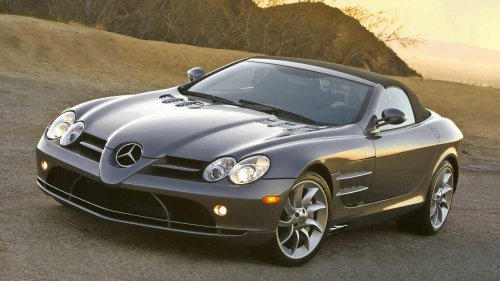
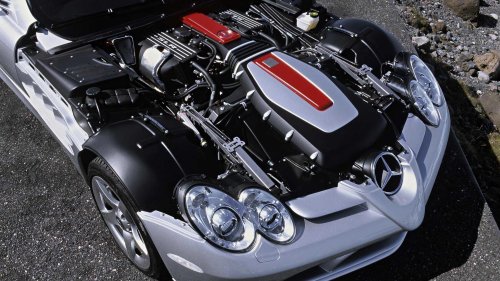
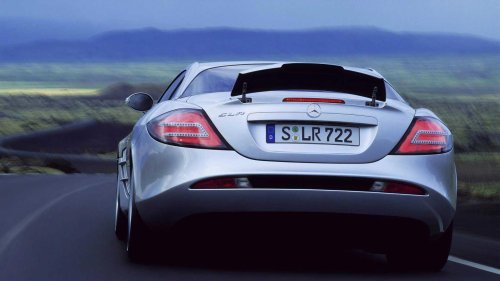
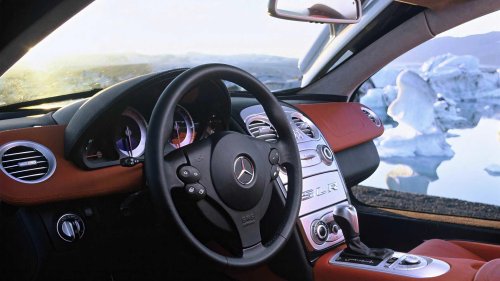
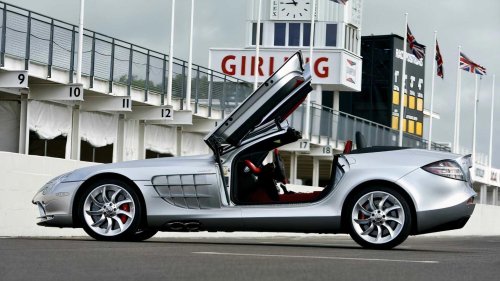
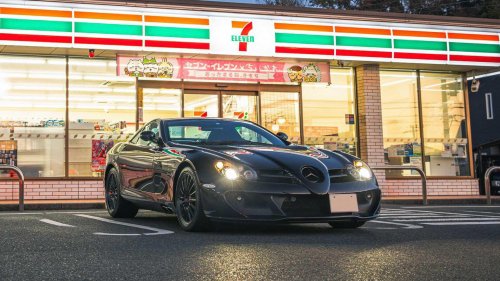
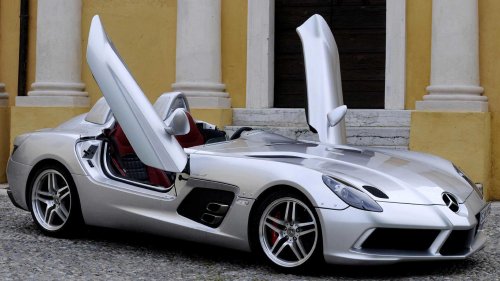
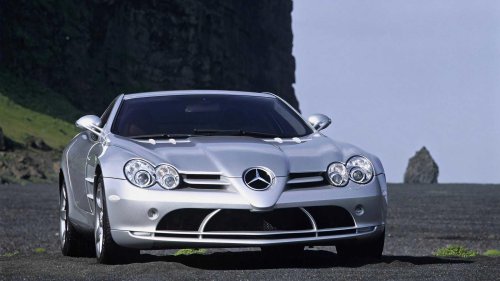
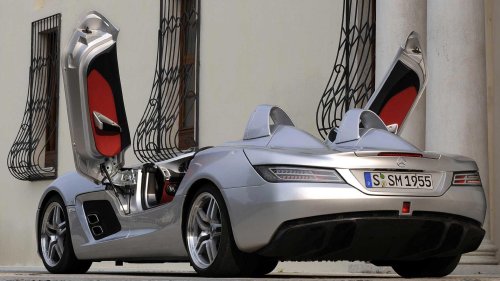
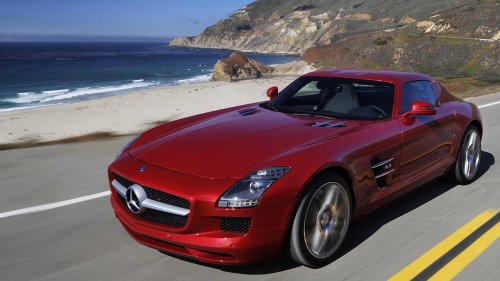
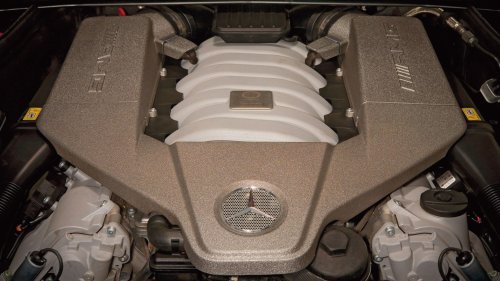
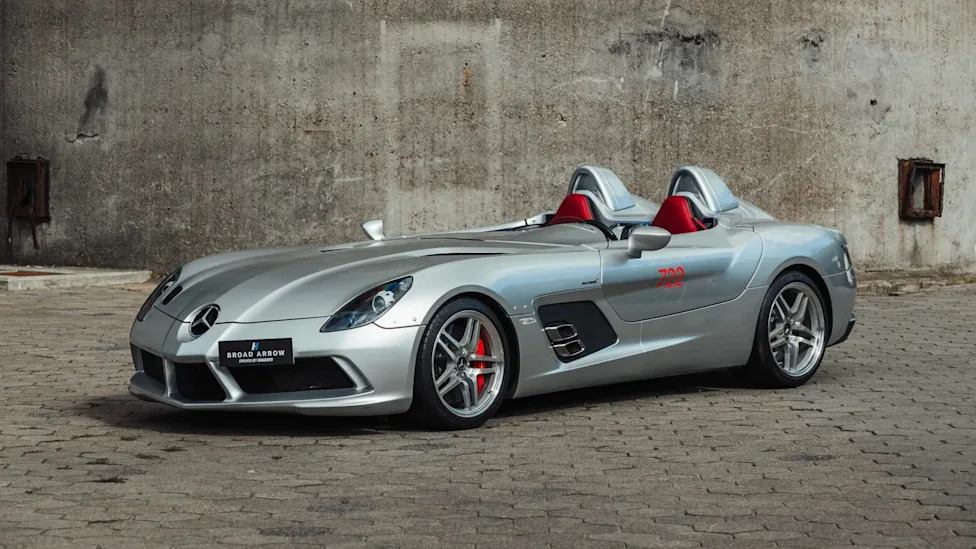
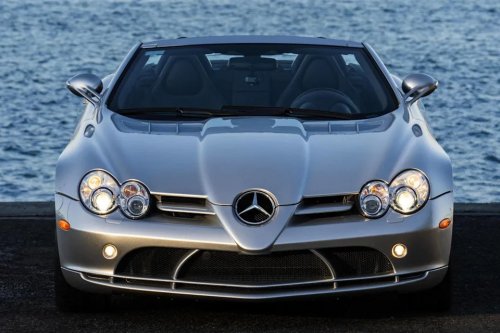
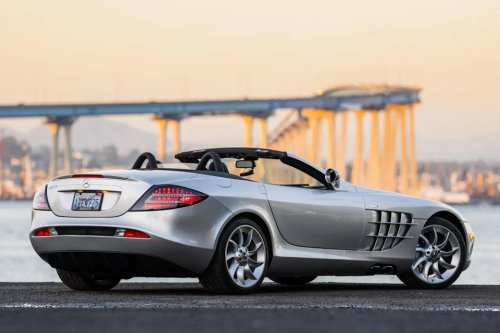
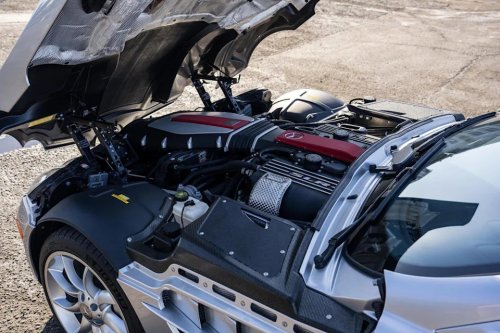
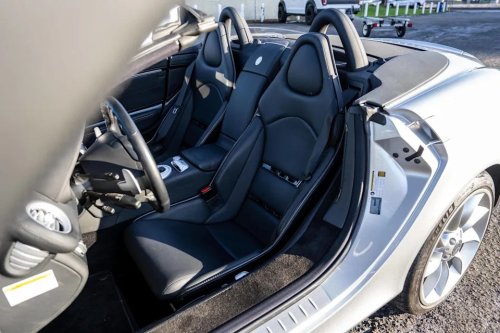
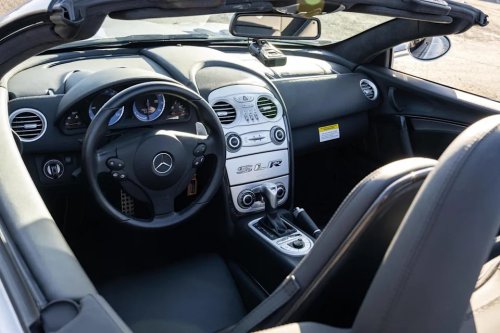
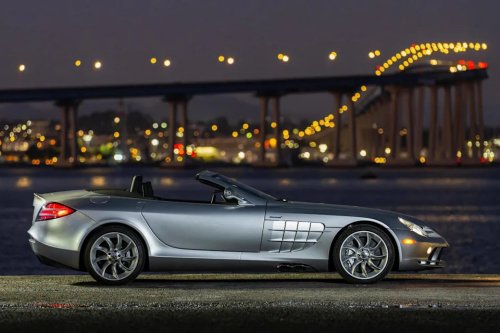
When heritage and corporate marriages collide, weird, wacky, and occasionally wonderful things can happen. By the late-1990s, Mercedes-Benz had a 40% ownership stake in McLaren, building on its F1 engine supply deal with the team that had been in place since 1995. At the 1999 Detroit Auto Show, Mercedes-Benz showed off the Vision SLR Roadster concept that paid homage to the Mille Miglia-winning 1955 300 SLR piloted by Stirling Moss in one of motorsport's most famous victories.Mercedes' vision was to relive that nostalgia with a supercar that fused their engine know-how with McLaren's engineering skill and knowledge of composite materials; after all, SLR translates from German to "Sport, Light, Racing". And hot on the heels of two F1 driver’s championships in 1998 and 1999, what stronger pairing could take on the likes of Ferrari and the Williams team?Mercedes-BenzThus, the awkwardly-named Mercedes-Benz SLR McLaren was created. Already, its clumsy designation — and gawky styling — tells of a challenging birth process fraught with compromise. Beyond the boardroom, it worked: Mercedes would be solely responsible for the styling and engine, and McLaren everything else, from engineering to crash-testing and assembly, painting and pre-delivery sign-off, which included hot laps around the nearby Dunsfold test track famously used on Top Gear.It was unprecedentedly cool for Mercedes — then still perceived as a pipe-and-slippers brand — risky and exciting all at the same time. And certainly not without looming existential peril. That the car’s press release of the time waxed lyrical with fantasies of “classical styling elements... blended with the sophisticated avant-garde design language” was another red flag signaling a hodgepodge of ideas and a clash of cultures.Still, despite compromise and struggle, the resulting product was a supercar that went past what was typical of the segment at the time. The SLR McLaren was instead an early hypercar, and more impressively was the fact it did not need to languish in heated garages until the perfect day arrived. Rather, it could be relied upon to perform every single day, just as any other Mercedes-Benz product could be. So, while considered flawed and forgetful to many, the SLR McLaren was actually something really rather special, and it owes everything to its most difficult and complicated birth. Too Many Cooks Mercedes-Benz Gordon Murray, vehicular design god and father of the McLaren F1, GMA T.50 and T.33, was brought in to represent McLaren on the SLR project. In his book, One Formula: 50 years of car design, he recalls being less-than-enthusiastic about the direction Mercedes fancied. “It was very bling, very Hollywood Boulevard-cruiser type of thing. Didn’t remind me much of the ’55 SLR... And it looked very wrong aerodynamically.”The reason behind that wrongful inelegance is that Mercedes underestimated the engineering challenges of creating a benign-handling GT car. Murray had to convince them to move the engine almost a full meter back to create a better-balanced front-mid layout, as well as ditch the proposed heavy pneumatic suspension and lower the fuel tank's placement.!!!MODEL TAG!!! Listing Carousel MP4-12C Coupehttps://carbuzz.com/cars/mclaren/12c/Whatever little visual identity it ever had, was sacrificed at the altar of design necessity – and the SLR ended up looking miles apart from the Vision concept. Yet it bore several industry firsts. There was the first hand-built AMG engine — a 5.4-liter supercharged V8 delivering 617 horsepower and 575 lb-ft, channeled by a five-speed push-button automatic transmission to the rear wheels — and brake-by-wire-operated carbon-ceramic brakes paired with an active airbrake for anchors.The front crash structure was all-carbon and the monocoque a four-piece carbon-fiber arrangement that was bonded together (the gluing bit also took some convincing as Mercedes had initially insisted on screws being used). Despite extensive use of lightweight composites, somewhat disappointingly the SLR weighed 3,898 lbs, underlining that it was more of a GT cruiser than a track bruiser. The Resulting Product Was A Surprisingly Approachable Silver Arrow Mercedes-Benz Starting at $450,000 in 2004 when it hit showrooms in the US, it was the fastest and most expensive Silver Arrow ever built. It accelerated from 0 to 60 mph in 3.5 seconds (some publications recorded different times) and could reach an electronically limited top speed of 208 mph. With squishy suspension and an uncomplicated automatic transmission (a dual-clutch was intentionally avoided), the Mercedes-Benz SLR McLaren was no more challenging to drive daily than an SLK, only that it happened to have 617 HP.That removed any doubt over the SLR being a very fast albeit comfort-biased grand tourer, although in the exalted company of the 217 mph Ferrari Enzo and race-focused, manually shifting Porsche Carrera GT, it wasn’t fast or hard enough. On the other hand, Mercedes' level of plushness was barely a match for incumbent cross-continental kings such as Bentley in that class, leaving the Mercedes dangling in no-man's land, offering too little McLaren for speed hunters and too little Mercedes for luxury lovers.Mercedes-Benz And when the Bugatti Veyron, a car that truly encapsulated velocity (and arguably coined the phrase "hypercar") and amenity by virtue of its own encyclopedia of superlatives — turned up in 2005 as the performance benchmark of the century, the game was over for the SLR. Still, the scissor-doored Mercedes with its side-exist exhausts didn’t fail to attract its own army of followers or get assimilated into popular culture and video games. Mercedes And McLaren Continued To Develop The SLR Mercedes-Benz In 2006, a marginally more athletic interpretation of the SLR, the 722 Edition, was released. With marketers never shy to squeeze the last drop of blood from the minutiae of unrenowned heritage, 722 refers to the number and morning start time that Stirling Moss and navigator Denis Jenkinson set off on the 1955 Mille Miglia.Outputs were hiked to 641 hp and 605 lb-ft, while lightweight wheels, stiffer suspension, and larger diameter brake discs were fitted, and revisions made to the front airdam and diffuser. The changes knocked 0.1 seconds off the original SLR’s time and added 2 mph to its top speed. In all, 150 units were built.RM Sotheby's / Ken Saito One year later, a roadster version was launched. Power levels were unchanged against the base model, although weight gained through the addition of chassis reinforcement was a necessary by-product of going roofless.In 2009, a production-limited 722S roadster was revealed, with only 150 units made. Unusually and out of character for the genre, regardless of their triple-digit price tags, both al fresco versions of the SLR required their ragtops to be manually unlatched before electrically folding away.Mercedes-Benz In the same year, completing the trio of available SLR body styles was the Stirling Moss Edition speedster. It featured a helmet-mandating sliver of glass for a windscreen (although no other occupant needed side or head protection, apparently), dropping its weight to 3,400 lbs. Its mechanicals were borrowed from the 722 Edition, and just 75 examples — sold at $1.1 million each to existing SLR owners only — were ever made. Buying And Owning An SLR McLaren In 2026 And Beyond Mercedes-Benz An asking price of $450,000 some 20 years ago now is a clear indicator that the SLR was something really rather special indeed, and while prices have dipped and jumped since then, the SLR remains a very desirable model, and current prices reflect that. Generally speaking, getting hold of an SLR will command an investment of roughly $300,000 to $400,000, so prices are still somewhat south of what a new model demanded before we even factor in inflation. Contemporaries like the Carrera GT and Enzo have long since exceeded their original MSRPs and continue to rise, which perhaps clearly demonstrates how the SLR's awkward arrival and sometimes confusing demeanor has affected long-term desirability.Getting behind the wheel of a 722 or 722 S will demand an extra $200,000 or so, with exquisite examples sitting north of $700,000. For those with seriously deep pockets and a desire to truly stand out, the Stirling Moss Edition is really the only way to go, although exclusivity comes at a cost. Expect to pay north of $3 million to find yourself at the helm of the ultimate SLR, but even if you do have the cash at the ready, you'll have to be patient, as these rarities don't cross the auction floors all too regularly. A Lasting Legacy Mercedes-Benz Ultimately, timing and execution counted against the SLR in reaching the upper echelons of supercar greatness. Mercedes targeted a total production run of 3,500 units, or 500 units per year, although only 2,157 were manufactured. It called time on the car in 2009 on the back of the financial crisis.Looking back, merging the skill sets of an F1 team with an established automotive giant was an optimistic idea sunk by politics and practicalities. The relationship ceased as Mercedes started selling its shares back to McLaren in 2009, after which the two companies’ supercar aspirations diverged.Mercedes-Benz The Germans bounced back in 2010 with the SLS; this time a sole effort by AMG that was sprightlier and more competition-ready in execution than the SLR. The company’s next crowning glory would be the AMG-One, the first road-going production car to lap the Nürburgring in under 6 minutes and 30 seconds.For their part, McLaren launched the MP4-12C in 2011, its first in-house supercar since the F1. It adopted many of the learnings gleaned from working with carbon fiber during production of the SLR, notably applying it to the speed with which its monocoque was made – from 3,000 hours for the F1, to 500 for the SLR to just four for the 12C.The latter heralded the establishment of McLaren cars as a credible, viable supercar maker against established favorites and offered a variety of ranges for most (deep) pockets and applications. Both Mercedes and McLaren – and indeed, the broader supercar maker category – have the SLR with its usage of space-age materials to thank for leading the transition towards the digital supercar.Mercedes and McLaren may have gone their separate ways, but both can look back at the collaborative energy that birthed the SLR. Fierce but flawed, yet each flourishing in its own lane today; proving that ending a chapter can lead to the writing of a better story for both.