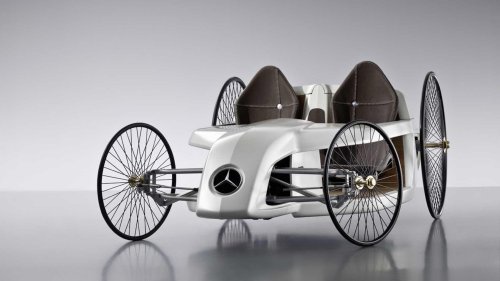
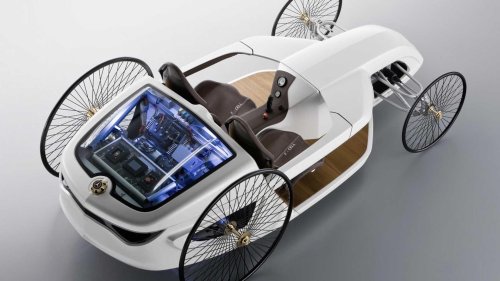
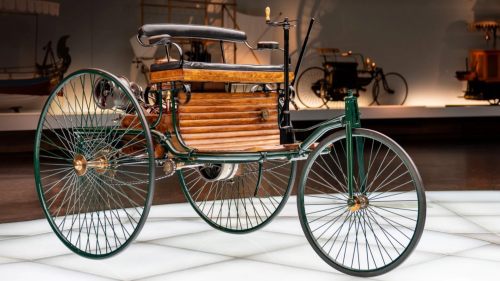
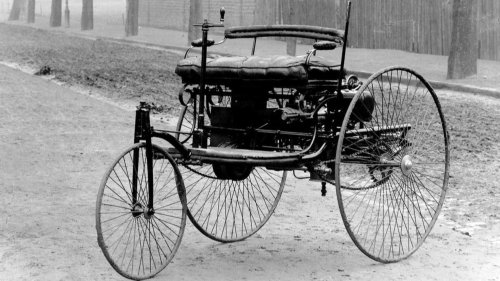
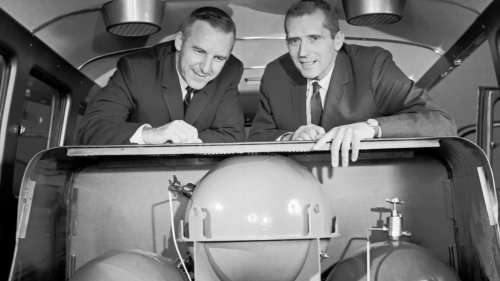
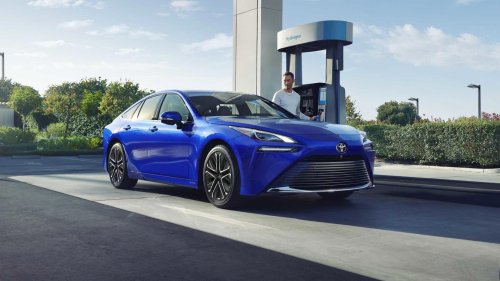
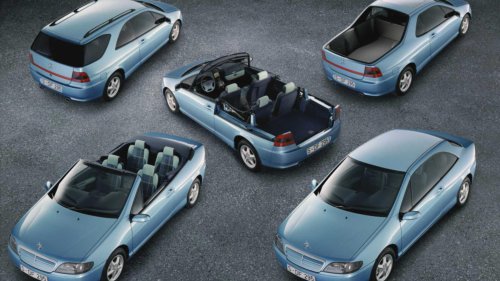
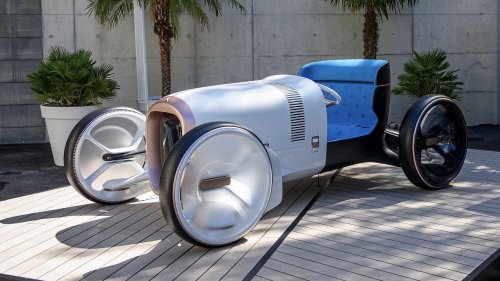
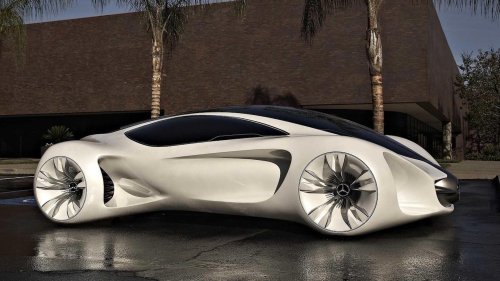





















The origins of Mercedes-Benz go back as far as those of the car itself. The company’s history can be traced back to, among others, German engineer Karl Benz, widely considered to be responsible for building the first ever car. His creation was called the Benz Patent-Motorwagen; this three-wheeled car also became famous for completing the first ever long-distance drive, with Karl’s wife Bertha behind the wheel.Over a century after Karl Benz had unveiled his prototype, the company that still bore his name created a unique concept car: a sort of “modern Motorwagen”, which took some of the original’s core design elements and adapted them for the present day. The concept was called the F-Cell Roadster, as a nod to the hydrogen fuel cell that powered it. The F-Cell Roadster drew a line between the very start of automotive history and the future of motoring. Let’s take a closer look at this innovative concept car. The Mercedes-Benz F-Cell Roadster Concept: Retro Looks, Modern Soul Mercedes-BenzThe Mercedes-Benz F-Cell Roadster is a one-off concept car unveiled in 2009. A curious blend of ancient and modern, it combines the design elements of the historic Benz Patent-Motorwagen with those of a modern, futuristic concept car. The large spoke wheels are one of the most striking features; they are the last kind of wheels you would expect to see attached to the F-Cell’s sleek fiberglass body.Mercedes-Benz The interior is fairly spartan, with carbon fiber bucket seats upholstered in hand-stitched leather. The steering wheel is replaced by a joystick, a design choice that may seem ultra-modern, but actually has a connection with the past (the Motorwagen did not have a steering wheel either; that particular automotive invention would not make its first appearance until a few years later). The F-Cell Roadster is also equipped with drive-by-wire technology.One thing that the F-Cell has in common with its ancestor, however, is its low power output and speed. While the Motorwagen only produced two thirds of a horsepower, the F-Cell isn’t much further ahead, with an output of 1.6 hp. The top speed is just 15 mph, or approximately 5 mph above that of the original Motorwagen. The F-Cell, however, does well for itself in terms of range thanks to its powertrain: according to Mercedes, it has a maximum range of 219 miles. The Car That Inspired It: The Benz Patent Motorwagen And The Dawn Of The Car Monochrome Watches The source of inspiration behind the F-Cell Roadster was the Benz Patent-Motorwagen, generally considered to be the first ever production car. The Motorwagen was built by Karl Benz in 1886; it had three wheels and a single-cylinder engine, which produced two thirds of a horsepower.In 1888, just two years after Karl Benz had introduced his creation, his wife showed the world what the Motorwagen was truly capable of with a history-making achievement. With her teenage sons Eugen and Richard in tow, she set off on the first ever long-distance automobile journey. She set off from the family’s home in Mannheim with the intention to reach her parents’ home in Pforzheim, a town 66 miles away.Saforrest/Wikimedia Commons Bertha had to stop at pharmacies to buy ligroin, the petroleum solvent on which the Motorwagen ran. She also had to perform several repairs on the go, such as unblocking a fuel line with a hat pin and using her garter as insulation material. She also had to request the assistance of a blacksmith to fix a chain, and of a cobbler to install leather on the failing wooden brakes (creating the first ever set of brake linings).Bertha’s trip was instrumental in the rise of the car, showing that automobile journeys were a viable way to get from A to B even over long distances. Over the years that followed, Karl Benz introduced new prototypes (such as the Benz Velo, which had four wheels rather than three like the Motorwagen). The automotive world exploded into life, giving rise to countless more prototypes and production models all the way into the present day. The Heart Of The F-Cell Roadster: The Evolution Of The Hydrogen Fuel Cell General MotorsThe technology at the core of the F-Cell Roadster, and the origin of its name, is a hydrogen fuel cell that powers its single electric motor. Hydrogen is a somewhat niche area of the automotive world, but it still has a very long history. Automakers explored the possibilities of hydrogen propulsion as far back as the 19th century. Initially, hydrogen was considered a potential combustion source in ICE vehicles. It wasn’t until much later that the concept of the fuel cell began to take shape (hydrogen combustion is still around, but is much less popular).In the early 20th century, as gasoline became the fuel of choice for combustion vehicles, hydrogen lost the attention of automakers and engineers for decades. In 1966, however, GM came up with a unique prototype called the Electrovan which had a very important title to its name: it was the first ever vehicle to be powered by a hydrogen fuel cell.Toyota Due to its high costs and poor practicality, the Electrovan project was quickly abandoned and never made it to the production stage. However, the seed was planted for other automakers to explore the potential of the hydrogen fuel cell. In the decades that followed, Mercedes, Toyota, and BMW (among others) released concept cars with similar technology on board.The hydrogen fuel cell really came into its own in the 21st century, with the release of models such as the Honda FCX, the Honda Clarity, and the Toyota Mirai. The latter is still being sold today, and despite its low production numbers and geographical limitations (in the US, it is only available in California due to infrastructure constraints) it is still successful enough to remain in production.Although electrification and hybridization are currently taking up most of automakers’ efforts, hydrogen fuel cell technology has nevertheless carved out a small place for itself in the automotive world and is still the subject of research and development work. Other Mercedes Concepts With A Quirky Character The F-Cell Roadster was not the only time Mercedes used its own past as a source of inspiration for unique concept cars. The company’s rich history has been echoed multiple times in modern concepts, blending motoring’s past with its future. Other Mercedes concepts were not based on the past, but had unique and highly innovative design features. Here are three Mercedes concept cars that stand out from the crowd. VRC Mercedes-Benz ClassicThe VRC, short for Vario Research Car, is a multipurpose vehicle unveiled in 1995. It was characterized by its unique, interchangeable bodywork. Thanks to cleverly designed and lightweight panels, the concept car could transform into a sedan, wagon, convertible or pickup truck in as little as 15 minutes. No details were ever published regarding its engine, but we know it had a CVT transmission and a front-wheel-drive drivetrain. Vision Mercedes Simplex Mercedes-BenzThe Vision Mercedes Simplex is another concept that calls back to a very early Mercedes design. In this case, inspiration came not from the Motorwagen but from the 35 PS, a racing car built in 1901. The 35 PS was revolutionary for its time; its design was reincarnated in modern form in the Vision Simplex, which was unveiled in 2019. This concept car, however, had no powertrain, but was simply a design exercise. Biome Mercedes-BenzThe Biome is another concept car that focused primarily on design rather than propulsion, as it had no engine. The key concept behind the Biome was, as the name suggests, sustainability. The car was built from a material called BioFiber, which is fully recyclable and could be turned into compost. The material is, according to Mercedes, stronger than steel but lighter than metal or plastic: the Biome weighed less than 900 lbs.Sources: Mercedes-Benz