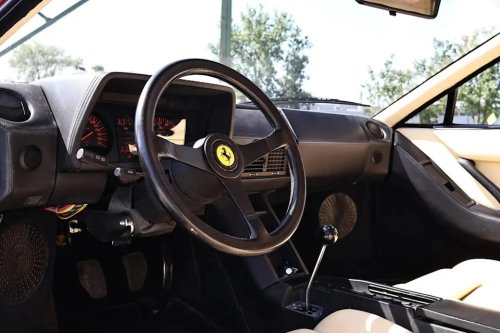
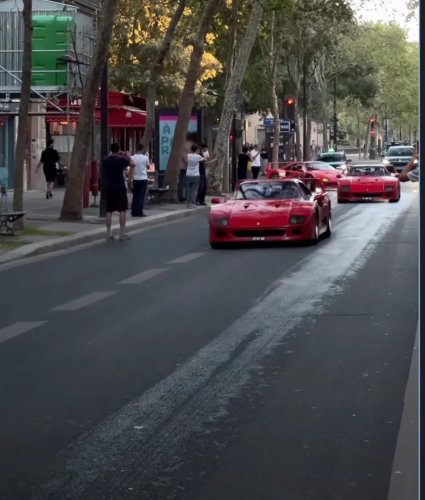
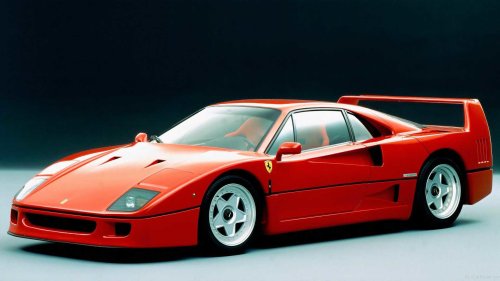
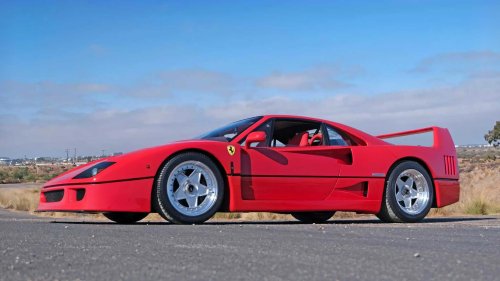
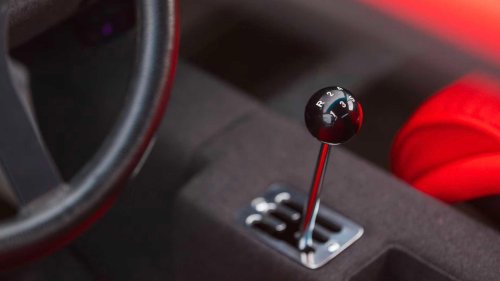
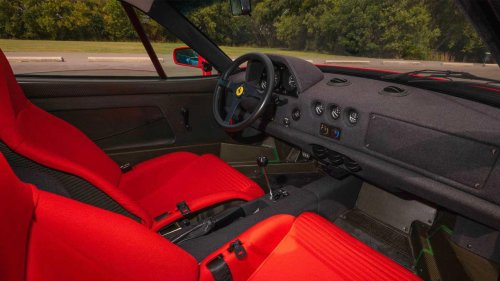
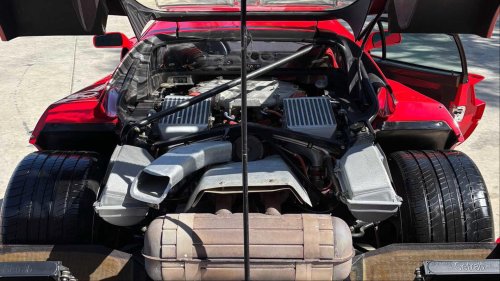
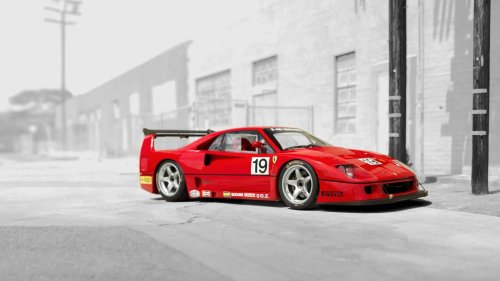
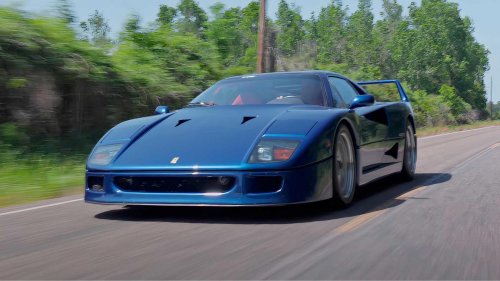
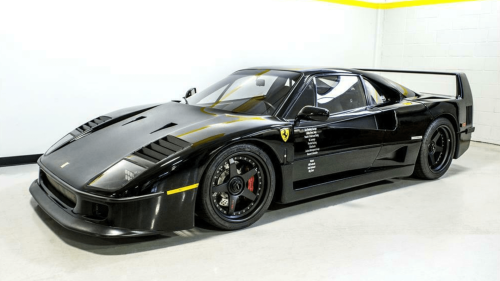
In the modern automotive landscape, speed has become very accessible. If you step into any modern supercar or hypercar, you are essentially entering a moving mega computer on wheels. Complex torque-vectoring systems, hybrid motors that fill in torque gaps, and sophisticated traction control units calculate grip thousands of times per second to keep the car on the road. It is impressive, but it is also a bit like playing an arcade racing game; the computer does the heavy lifting to ensure you don't end up into a wall or, as a viral crash example on Instagram and TikTok.But in 1987, the world was a very different place. There were no safety nets, no reset buttons, and certainly no clever computer chips to help you slide gracefully. In this era, Ferrari dropped a car that felt less like a product and more like a declaration of war. It was the first production car to ever crest the 200-mph barrier, and it did so with nothing but raw mechanical power and the sheer will of a man who had the guts to extract every ounce of performance this car could deliver. The Ferrari F40 Was Enzo Ferrari's Last Wish Ferrari By the mid-1980s, Enzo Ferrari was approaching ninety. He had built a successful racing career and one of the most respected supercar companies in the world. At this point, we all know old man Enzo loved his race cars more than his road cars, but this time, he wanted his company to build the ultimate road car. He felt Ferraris were becoming soft, too comfortable, and too far removed from the racetrack. He wanted one final masterpiece to mark the company's 40th anniversary, a car that would return to the brand's core identity.The result was the F40, and it wasn't built to be a daily driver or a luxury grand tourer; it was the ultimate race-car-for-the-road. Under the leadership of the chief engineer at the time, Nicola Materazzi, the development team was given a radical mandate: make this car as fast, raw, and engaging as possible. This lightweight philosophy was taken to an extreme that would be unthinkable today. To save every possible gram, Ferrari used carbon fiber and Kevlar materials that were incredibly exotic at the time; they stripped the interior to the bone.Bring A TrailerOther extreme weight-saving measures included:No Door Handles: Just a simple pull-cable located in the door pocket. No Carpets or Stereo: Sound deadening was non-existent; you heard every pebble that hit the wheel well. Sliding Lexan Windows: On the first 50 units, the windows didn't even roll down; they were plastic panels that slid horizontally to save the weight of a heavy window regulator. Visible Weave: The Rosso Corsa paint was applied so thinly to save weight that you could actually see the carbon-Kevlar weave of the body panels through the finish. The F40 was the final car Enzo personally approved before he died in 1988. This car fulfilled his dying wish, a reminder that a true Ferrari is defined not by its gadgets, but by its soul. A Textbook Analog Supercar Via: Mecum Auctions To understand how radical the F40 was, you have to look at its primary rival: the Porsche 959. The Porsche was a rolling laboratory, featuring all-wheel drive, adjustable suspension, and an onboard computer that managed almost every aspect of the drive. It was the car that previewed the future of fast sports cars.The F40, by contrast, was a prehistoric predator. It lacked electronic driver aids, there was no ABS to help you brake, no traction control to manage the rear wheels when they spin, and certainly no power steering. It was a mid-engine, rear-wheel-drive monster that demanded total concentration.Via: Mecum AuctionsThe driving experience of the F40 is often described as an exercise in timing. Because it relied on two massive IHI turbochargers, it suffered from legendary turbo lag. Below 3,500 RPM, the car felt almost civil. But once those turbos spooled up, the power didn't arrive in a curve; it arrived like a physical assault. Without computers to "smooth out" the delivery, the driver had to anticipate the explosion of torque or risk being sideways pretty quickly, or worse. It was a pure, unadulterated link between the driver’s right foot and the road. It Was A 200-MPH Twin-Turbo V8 Supercar US Federal Court Central District of CaliforniaWhen the Ferrari 488 GTB was launched, purists complained that it lacked the pure sound of the previous naturally aspirated engine in the 458. But this Ferrari had done this before. The F40 was powered by a 2.9-liter twin-turbocharged V8, an evolution of the engine found in the 288 GTO. This engine made 471 horsepower and 426 pound-feet of torque, sending power to the rear wheels via a five-speed manual transmission.The F40 made history as the first production car to officially hit 201 mph, snatching the title of "Fastest Car in the World" away from the Porsche 959, which could hit 197 mph. In the late '80s, 200 mph was a mythical number similar to how 300 mph was a barrier for modern hypercars today, until the Bugatti Chiron SS broke it, a barrier that separated mere sports cars from legends. The F40 didn't just cross that line; it smashed through it with a massive rear wing to keep the lightweight frame pinned to the ground. There Was a More Powerful F40 RM Sotheby's As if the standard car wasn't terrifying enough, Ferrari and their partner Michelotto produced even more extreme versions for competition: the F40 LM (Le Mans) and the Competizione. These were dedicated race versions with upgraded turbos, larger intercoolers, and a reinforced chassis. While the road car made 471 hp, the LM versions could crank out a staggering 720 horsepower.Weighing in at just about 2300 lbs, these rare beasts had a power-to-weight ratio that rivals modern hypercars, reaching top speeds of nearly 229 mph. Only about 19 LM/Competizione models were ever produced, making them some of the most sought-after vehicles in automotive history. The Ferrari F40 Is Easily a $3 Million Car The Gentleman's Garage YouTube If you were lucky enough to buy an F40 new in 1987, you would have paid roughly $400,000, which was five times more expensive than the previous 288 GTO. While that was a fortune at the time, it looks like the deal of the century today. As of early 2026, the market for an F40 has moved into the stratosphere.Recent auction results from early 2026 show that a "standard" F40 in good condition now easily clears $3 million. Exceptional, low-mileage examples, or those with unique provenance (like the early "Non-Cat, Non-Adjust" models), have been known to approach the $4 million to $6 million mark. In January 2026, a pristine 1992 model with only 458 miles on the clock sold for a record-breaking $6.6 million, proving that collectors value the F40 not just as a car, but as blue-chip fine art. It's Still A Legend Today Barrett-JacksonThe F40’s successor, the F50, arrived in 1995 with a Formula 1-derived V12 and more sophisticated technology. Yet, in the eyes of many enthusiasts, the F50 never quite stepped out of the F40's shadow. The F50 was a more refined, smoother machine, but it lacked the sheer, visceral nature that made the F40 famous.The F40 remains the definitive "poster car", the last of the great analog supercars. It stands as a monument to a time when speed was a daring feat rather than a calculated software output. It didn't have electronics to save you; it had a steering wheel, three pedals, and a pair of turbos that promised to change your life, or end it, if you weren't paying attention. That raw, dangerous purity is why the F40 will always remain a legendary car in the automotive hall of fame.Sources: Ferrari, Road and Track, Classic.com,



















 +32 others