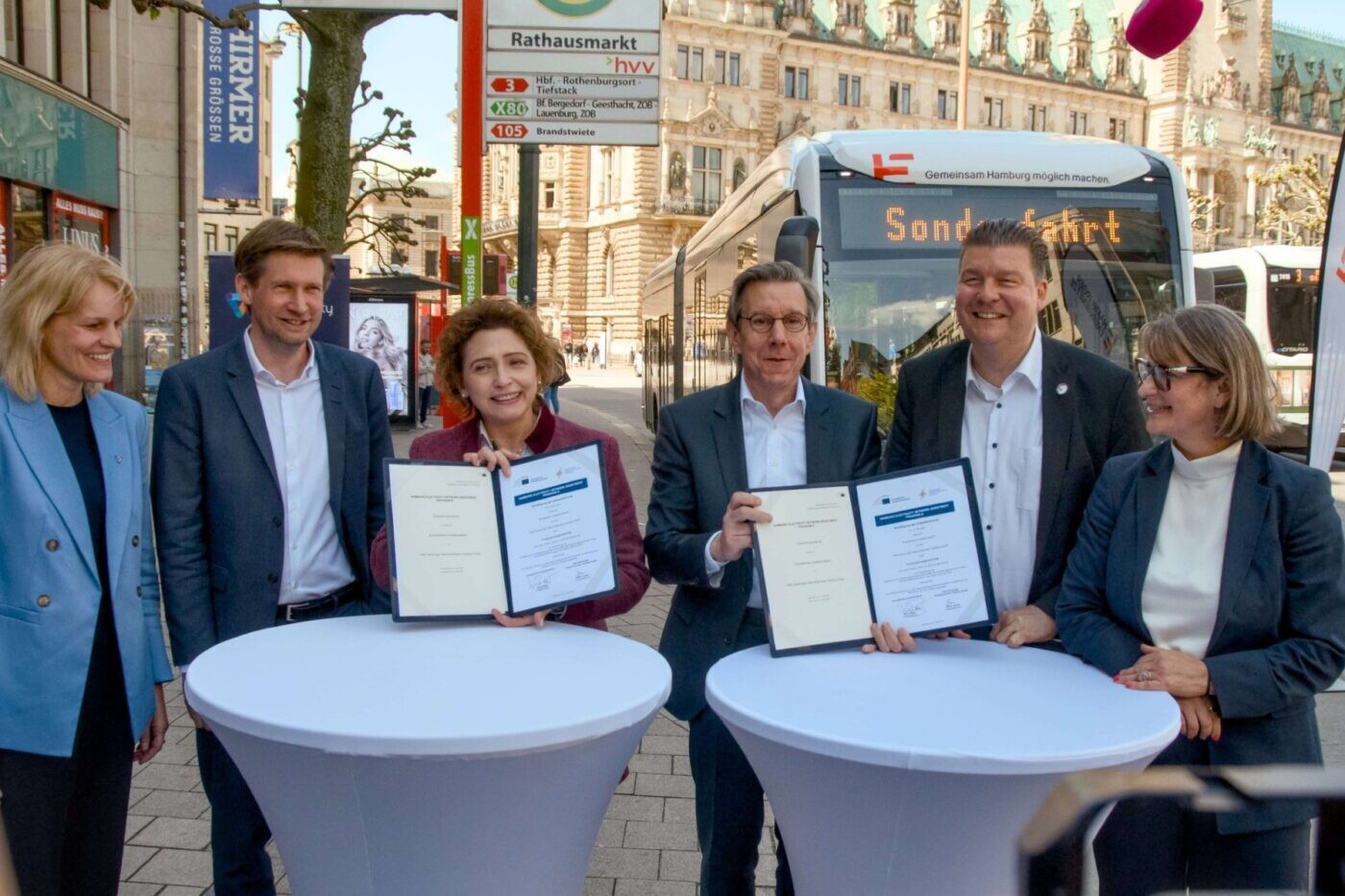
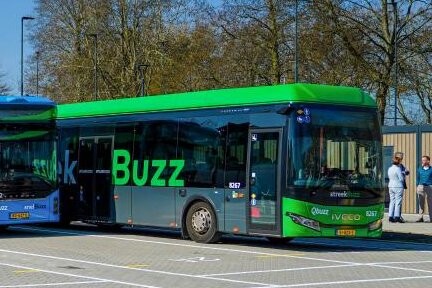
Image: Hamburger EnergienetzeTwo companies in Hamburg’s municipal economy can celebrate securing strategic financing: Hamburger Energienetze (Hamburg Energy Networks) and Verkehrsbetriebe Hamburg-Holstein (Hamburg-Holstein Transport Services, VHH) will both receive funding from the European Investment Bank (EIB). While the grid operator plans to use the majority of the EIB financing to modernise the city’s distribution networks, VHH will also procure 188 new battery-electric buses and use the funds to redevelop and expand the Schenefeld depot.Currently, around one-third of VHH’s fleet of approximately 800 vehicles operates electrically. Since 2020, the company has exclusively purchased zero-emission buses for Hamburg. The new battery-electric buses will significantly increase this share. Of the 188 planned electric vehicles, 120 will be standard buses, 52 articulated buses, and 16 minibuses.VHH’s electric bus programme and Hamburger Netzgesellschaft mbH’s (HNE) power grid programme are closely linked. The project partners emphasise that the ramp-up of the electric bus fleet is only possible if the power grid is designed to accommodate the growing charging infrastructure. Both companies are subsidiaries of HGV (Hamburger Gesellschaft für Vermögens- und Beteiligungsmanagement mbH), the holding company of the Free and Hanseatic City of Hamburg. Under its leadership, the EIB financing has now been finalised.The loan agreements were officially signed by the municipal companies and the EIB on 19 May. The financing complements the municipal companies’ own financial contributions. For instance, HNE plans to invest around €2.9 billion in the expansion and modernisation of the city’s electricity distribution grid by 2029. The EIB’s billion-euro loan accounts for approximately 28% of the total financing. Hamburg authorities have announced that the funding will be disbursed in several tranches, the first of which was already made available in October 2025.The HNE investment programme includes the following:Around 1,500 kilometres of new and renewed cables for low, medium, and high voltageRenewal and construction of new substations, as well as the expansion of digital control technology120 new switchgear baysDigitalisation of the grid infrastructure to integrate renewable energiesThe project partners note that the growing power grid is the material foundation of Hamburg’s energy and mobility transition and their projections indicate that by 2040, the grid’s peak load is expected to at least double.For VHH, investments of up to 337 million euros in the expansion of electromobility are planned over the coming years. The EIB is contributing to this project with a framework financing agreement worth 125 million euros, corresponding to around 37% of the project’s total volume. Both investments are coordinated and strategically aligned through the HGV holding company.Nicola Beer, Vice-President of the European Investment Bank, commented: “Hamburg demonstrates how Europe’s cities can holistically transform their infrastructure: with robust power grids and electrified public transport. The EIB supports precisely this integrated approach — with targeted financing for grids and clean bus fleets.” The EIB’s financing underscores the European dimension of both projects. As the EU’s climate bank, the EIB primarily supports infrastructure projects that contribute to achieving European climate goals and implementing the European Green Deal.“The partnership with the European Investment Bank is a strong signal for us: it confirms that Hamburg is on the right track in building a sustainable infrastructure, as the EIB carefully assesses before approving loans whether projects contribute to the energy transition,” emphasised Oliver Jensen from HGV’s management. HGV, HNE, and vhh.mobility were able to provide all necessary evidence in close and constructive coordination with the EIB. “This is precisely the strength of a holding structure like HGV: we think infrastructure holistically—power grids and public transport, energy and mobility transition—and can ensure long-term, coordinated financial planning beyond individual subsidiaries.”Gabriele Eggers, Managing Director of HNE, commented: “The modernisation of Hamburg’s electricity infrastructure is the prerequisite for the success of the energy transition, emission-free heating, and mobility. Our grid will continue to stand for grid stability and security of supply in the future. To ensure this remains the case, we must invest. And with the European Investment Bank, we have a strong and fair partner by our side to make this possible!”Britta Oehlrich, Managing Director of vhh.mobility, added: “This loan gives us the opportunity to make Hamburg a more liveable city for all passengers. Every new battery-electric bus on the streets of the Hamburg metropolitan region means less noise, cleaner air, and a visible sign of a city taking responsibility — for the climate, people, and mobility. We want to show that sustainable public transport is not just a goal on paper but a lived reality that tangibly improves the daily lives of our passengers.”eib.org, vhh-mobility.de, hamburger-energienetze.de