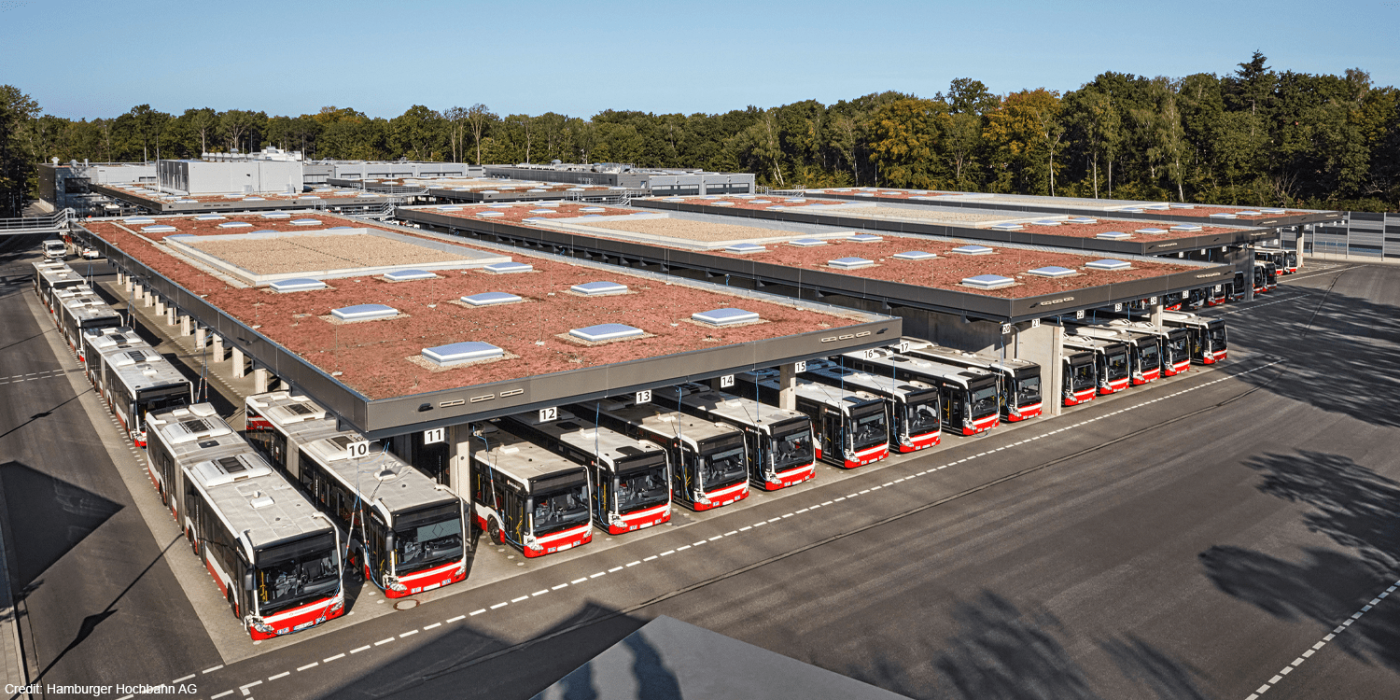
Archive imageTransport Minister Patrick Schnieder (CDU) already announced at the BUSKON 2026 specialist conference in February that Germany would launch another funding programme in 2026 with a budget of up to 500 million euros. Previous funding rounds since 2021 had already supported the procurement of around 3,000 battery-electric buses. The new programme is intended to help public transport operators purchase climate-neutral buses.The ministry has now published the new ‘Guidelines for the Promotion of Alternative Drives for Buses in Passenger Transport,’ officially launching the funding call. The programme focuses on the procurement of buses with alternative drive systems, including battery-electric, battery-overhead line and fuel cell technologies. Funding is also available for converting conventional buses to battery-electric or fuel cell powertrains.Federal Transport Minister Patrick Schnieder stated: “We have already invested around 1.5 billion euros in more than 5,300 climate-friendly buses. We are consistently continuing this successful path: with the budget available in 2026 alone, we aim to deploy a further 1,500 battery-electric buses across the country. This strengthens public transport, accelerates the market ramp-up of innovative drive technologies, and paves the way for climate-friendly mobility.”In addition to funding the vehicles themselves — with the federal government covering the additional costs compared to diesel buses — the programme also subsidises the procurement and installation of charging infrastructure and hydrogen refuelling stations. Investment aid remains capped at 30 million euros per company and investment project.However, the funding rates will change. Previously, operators could receive funding covering 80 per cent of the additional costs compared to a comparable diesel vehicle. Under the new directive, the government will now cover up to 70 per cent for operators with a low level of electrification and otherwise up to 55 per cent of the additional costs. The federal government continues to provide funding of up to 40 per cent for charging, refuelling and maintenance infrastructure.The ministry justified the new distinction between operators with high and low levels of electrification by stating that it wants to ensure the ‘efficient and effective use of funding resources.’ The ministry thus plans to allocate funding explicitly ‘across different funding areas, taking into account electrification levels and operational contexts, with technology-specific distribution.’The two categories are officially divided into an ‘activation programme’ and a ‘scaling programme.’ The ministry will continue to select projects through a competitive process, while also assessing implementation prospects as well as operational and energy concepts.The directive states that the first implementation phase aims to bring at least 1,500 buses with alternative drive systems onto German roads and support up to 150 transport operators. Interested bus operators can submit funding proposals from 26 May 2026, with the submission deadline set for 21 July 2026. NOW GmbH and Projektträger Jülich (PtJ) will administer the programme. To mark the launch, the organisers will host an online seminar with additional information on 28 May at 1:00 pm.The new directive became necessary because the previous ‘Directive for the Promotion of Alternative Drive Systems for Buses in Passenger Transport,’ which had formed the basis of the subsidy scheme since 2021, expired at the turn of 2025/2026. The transport ministry thus needed a new legal framework for the latest funding round.A few months ago, Nikolaus Oberkandler, Head of the Electric Mobility and Charging Infrastructure Division at the Federal Ministry for Transport, stated that applicants should not expect major changes: “We have a programme that works, that transport operators have accepted well and that manufacturers also support effectively. We do not intend to change everything. We want to continue operating within the existing framework.”However, Oberkandler already indicated in February that adjustments to price caps and funding rates could follow ‘to broaden the reach of the funding programme somewhat further.’In summer 2025, the then newly formed CDU-SPD coalition government quickly launched a funding round under the previous directive, ending a prolonged funding gap triggered in 2023 by the Constitutional Court ruling on the Climate and Transformation Fund and the resulting budget shortfall. In that final funding round, 151 companies received a total of 417 million euros. The programme supported the procurement of 1,887 new electric buses.bmv.de, ptj.de (applications), bundesanzeiger.de (funding guidelines; all links in German)


















 +9 others


![Battery, Watt's up, doc? Huddig hybrid loader gets a big battery boost [video]](https://cdn.topcarnews.net/thumb/id/aHR0cHM6Ly9pMC53cC5jb20vZWxlY3Ry-ZWsuY28vd3AtY29udGVudC91cGxvYWRz-L3NpdGVzLzMvMjAyNi8xMC9odWRkaWct-aHlicmlkX21haW4uanBnP3c9MTUwMCZh-bXA7cXVhbGl0eT04MiZhbXA7c3RyaXA9-YWxsJmFtcDtzc2w9MQ/ea51c544798341190a5eed718aab1ee3.jpg?t=20261010&post_id=67784)
![Battery, Watt's up, doc? Huddig hybrid loader gets a big battery boost [video]](https://cdn.topcarnews.net/thumb/id/aHR0cHM6Ly9lbGVjdHJlay5jby93cC1j-b250ZW50L3VwbG9hZHMvc2l0ZXMvMy8y-MDI2LzEwL0hlcm9iYW5uZXJfVGlnb25f-MS1jbG9zZS1jb3B5LmpwZw/d26fab6fabc13bc13692cf5d41542493.jpg?t=20261010&post_id=67784)
![Battery, Watt's up, doc? Huddig hybrid loader gets a big battery boost [video]](https://cdn.topcarnews.net/thumb/id/aHR0cHM6Ly9lbGVjdHJlay5jby93cC1j-b250ZW50L3VwbG9hZHMvc2l0ZXMvMy8y-MDI1LzAzL0RFUy0xMDM4X0VsZWN0cmVr-LUJhbm5lcnNfRVZzXzA3OTdjMi5wbmc/e850e929e3168f8c7ff73cd888e54add.png?t=20261010&post_id=67784)







![Not sold on Tesla Powerwall? There are great battery alternatives out there [update]](https://cdn.topcarnews.net/thumb/id/aHR0cHM6Ly9pMC53cC5jb20vZWxlY3Ry-ZWsuY28vd3AtY29udGVudC91cGxvYWRz-L3NpdGVzLzMvMjAyNi8wNy9ob21lLXNv-bGFyLWJhdHRlcnkucG5nP3c9MTUwMCZh-bXA7cXVhbGl0eT04MiZhbXA7c3RyaXA9-YWxsJmFtcDtzc2w9MQ/18e81f395a77dbb42269ab5e106fea41.png?t=20261010&post_id=68280)