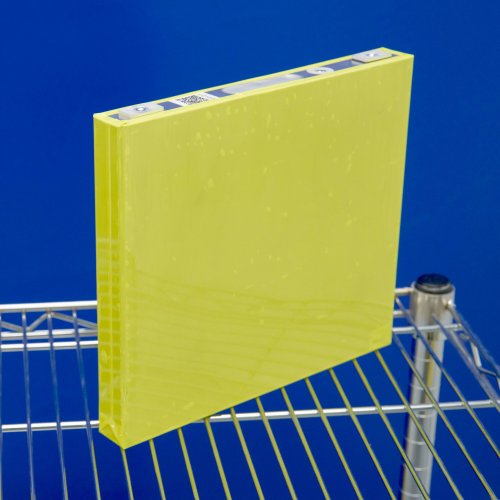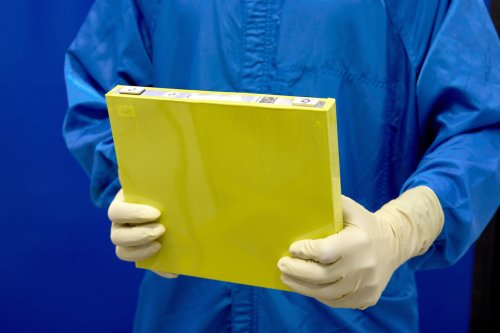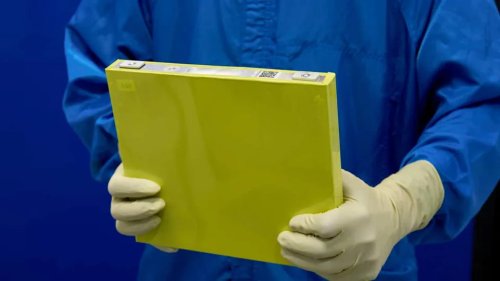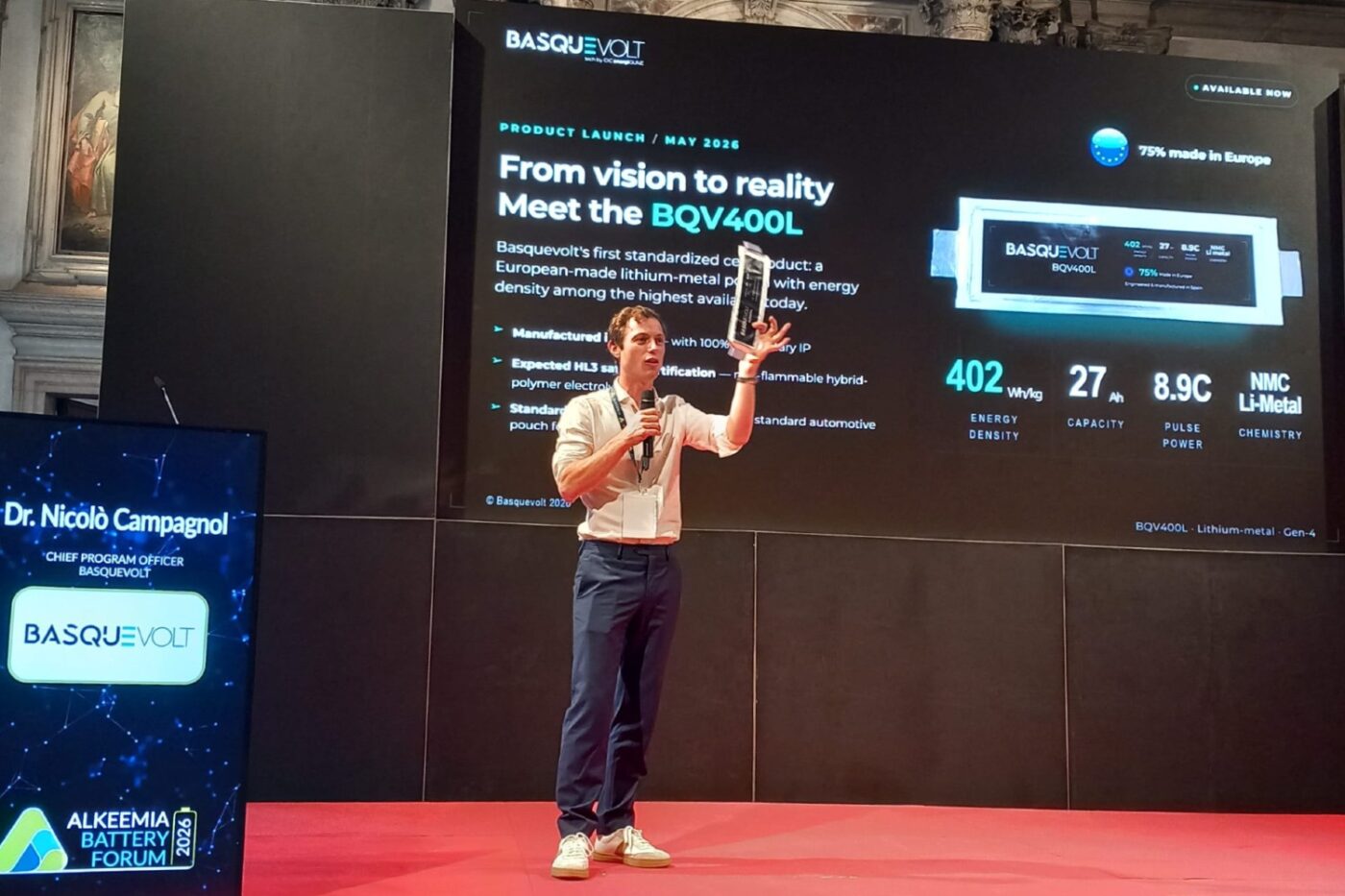



















Basquevolt is an initiative founded in 2022, focused on the research and production of solid-state batteries. Based in the Basque Country, the company describes itself as a European technology leader in next-generation battery technologies. Basquevolt is supported by the Basque Government, as well as companies such as Iberdrola, CIE Automotive, Enagás, EIT InnoEnergy, and CIC energiGUNE.The company has now commercialised its BQV400L cell, which features an NMC cathode, a lithium-metal anode, and a polymer electrolyte. However, it is unlikely to be a solid-state cell in the strictest sense. On LinkedIn, Basquevolt states that the technology is based on a proprietary hybrid electrolyte, though it has not provided further details at this stage. Basquevolt has not yet responded to an enquiry from electrive, but we will share the information as soon as it becomes available.One point is clear: manufacturers often view the combination of an NMC cathode and a lithium-metal anode as a promising approach for solid-state batteries. The BQV400L at least represents a precursor to this technology.Basquevolt says the cell marks the fourth generation of its lithium-metal technology and the first to reach commercial maturity. The company adds that the cell is standardised and available immediately.Gravimetric energy density of 402 Wh/kgRegarding the technical specifications: the BQV400L offers, according to Basquevolt, a gravimetric energy density of 402 Wh/kg with a capacity of 27 Ah. This positions it among the most powerful cells available from European production. It is manufactured in Spain and comprises 75% European components. Basquevolt specifies the cell’s pulse power capability as 8.9 C, a value that indicates the cell’s ability to deliver or absorb high currents in a short time. All data provided are company figures, though the performance results are currently being validated by an independent external battery testing laboratory.Basquevolt is particularly proud of its proprietary hybrid polymer electrolyte, which is designed for a wide range of industrial applications. Against this backdrop, the company states that it collaborates with OEMs from the automotive, aerospace, and aviation sectors. In parallel, management reports the company ‘continues to advance its solid-state battery technology toward industrialisation.’Compatible with existing cell manufacturing facilitiesAnother key aspect for the battery specialist is that the BQV400L is designed as a ‘drop-in’ solution, making it ‘fully compatible with existing cell gigafactory infrastructure.’ Consequently, manufacturing the cell should not require significant additional investments. According to Basquevolt, this market launch marks the ‘transition from deep-tech development to industrial deployment, and a new phase of ambition for European energy storage.’Nicolò Campagnol, Basquevolt’s Chief Programme Officer, commented: “Reaching over 400 Wh/kg in a commercially available, European-made cell is something we have worked toward for a long time — and it feels significant to finally be here. What drives us now is the knowledge that this is not our ceiling. The technology roadmap ahead of us is the most compelling it has ever been, and the partnerships we are building give us real confidence in the path forward.”Speaking of partners: in February, Basquevolt presented Renault’s subsidiary Ampere as a development ally. Both parties emphasised their joint efforts to accelerate the development and validation of lithium-metal batteries for future electric vehicles.“Basquevolt is already demonstrating that its technology can achieve very high energy density while significantly reducing the overall battery pack costs,” the Renault Group stated at the time.The declared goal of the development partnership was to develop and validate pre-A sample cells for electric vehicles. A-samples are typically prototypes in an early phase of the development process. They serve as initial functional or design models to evaluate components within the overall product, even if not all details are finalised. Pre-A samples, therefore, represent even earlier stages of development—far from the technology that could later be integrated into vehicles. This suggests that the Renault partnership is indeed focused on battery cells with a fully solid electrolyte.Renault anticipates lighter battery packsRenault officially stated: “By combining the advantages of polymer electrolyte with advanced anode, the technology has the potential to enable compact, lightweight battery packs with superior thermal stability and fast-charging capabilities.”Furthermore, the lithium-metal cells are expected to be produced using a simpler and more efficient manufacturing process thanks to the polymer electrolyte. This competitive advantage is said to result in approximately 30% lower capital investment per GWh in a conventional gigafactory and a 30% reduction in energy consumption per kWh produced, as Renault stated in February. These are critical factors in establishing cell production.One point is clear: lithium-metal batteries have so far suffered from limited lifespans, often lasting only a few dozen charge cycles. Despite their higher energy density, this has prevented the technology from achieving commercial success.The main issue is the formation of dendrites—metallic lithium deposits that form on the anode. If these sharp structures grow large enough to pierce the separator film, they can damage the cell and trigger an internal short circuit. Ampere and Basquevolt did not explain in their February partnership announcement how they plan to solve this issue.Meanwhile, Basquevolt reports that it has also launched a joint initiative with EDF. Together with ‘a leading OEM,’ EDF is conducting safety and performance tests on lithium-metal NMC cells with an energy density exceeding 400 Wh/kg. This process reflects ‘the shared interest of major industrial organisations in advancing next-generation battery solutions,’ the company stated.Source: Information via email, linkedin.com