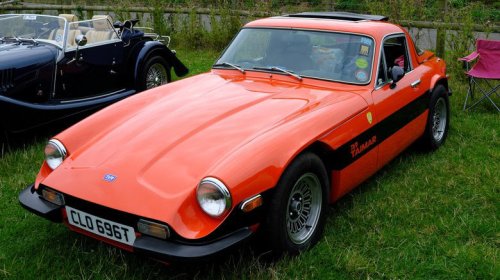
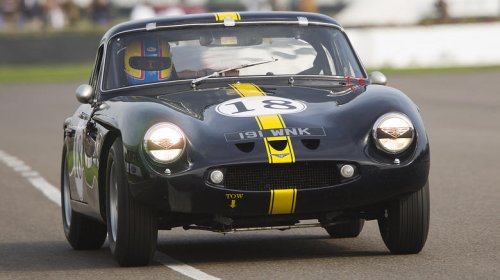
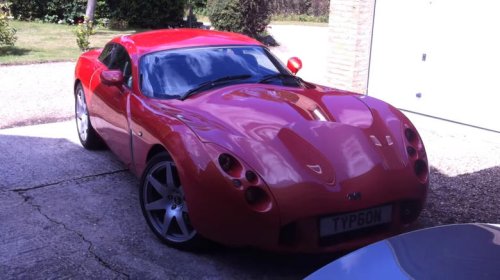
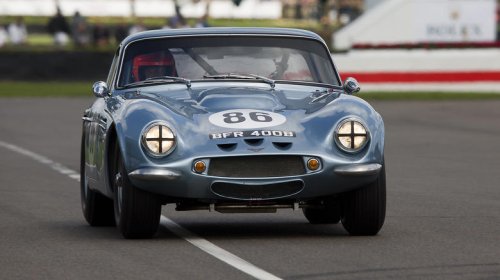



















TVR Taimar TurboTurbocharging has become increasingly common across all segments of the car industry as manufacturers attempt to reduce emissions without compromising on power, but in the early '70s, the technology was still in its infancy. A number of British manufacturers were then experimenting with turbos, with one of the earliest being TVR. The first TVR to receive the turbo treatment was the Taimar, an M-Series model that was based on the 3000M. The biggest difference between the two was that the Taimar featured a rear glass hatch to make it easier to load luggage in and out of the car, rather than having to wedge it over the seats as with the 3000M.The more practical model proved to be a hit, with 395 examples sold, and so TVR contracted tuning specialist Broadspeed to develop a more powerful Turbo version. In total, 33 Taimar Turbos were built, including three Turbo SE models with additional equipment. The Turbo reportedly produced 230 horsepower and boasted a top speed of 145 mph, considerably faster than the 121 mph top speed of the naturally aspirated Taimar.TVR GranturaThe Grantura was not only the first TVR production model but it gained the fledgling sports car maker its first real publicity on the international stage. Trevor Wilkinson's company had been selling cars in kit form for a few years prior, including some in the U.S. Ray Saidel, one of the brand's American importers, pitched the idea of redesigning the TVR kit into a more conventional road-going sports car. At the time, the company was undergoing the first of what would turn out to be many financial rough patches, and Wilkinson eventually left the company and handed control to Keith Aitchison and Bryan Hopton.The two men continued to develop the Grantura and expand their clientele. While only around 100 examples of the MkI Grantura were built, the MkII, unveiled in 1961, saw around 400 orders. The car continued to be developed until 1967, albeit with a brief pause in production when the company went bankrupt again in 1965. It was rescued by Martin and Arthur Lilley, two TVR owners and company investors who went on to helm TVR for the next 15 years.TVR TyphonDepending on whom you ask, there are either four TVR Typhons in existence, three of them, or just one. The model evolved from the Tuscan R, which was a road-going version of the Tuscan Le Mans race car. From there, the car was developed further and renamed the T400, and order books were opened to customers. A later T440 model added two small rear seats, and finally, the factory-designated Typhon added a supercharger and a six-speed sequential gearbox. Confusingly, the T440 and T400 models have also been rebadged as Typhons by their respective owners, even though they're less powerful and weren't originally given that designation by the factory.What's certain is that the one official factory-badged Typhon was brutally fast, with a reported 550 horsepower on tap. Thanks to its entirely carbon-fiber body shell and stripped-out interior, it weighed less than 2,400 pounds with an estimated top speed well north of 200 mph. However, it's thought that problems with heat build-up during development were the reason that so few examples of the car were ever built, with TVR's precarious financial position meaning the project eventually got shelved even though customer deposits had already been taken.TVR Griffith 200/400The original Griffith of the '60s was essentially a Grantura modified slightly to accommodate a Ford 289 V8 engine, in the same style that Carroll Shelby had done a few years earlier with the AC Cobra. In fact, the Griffith was reportedly so fast that it could actually beat a Cobra in a straight line, although questionable build quality and handling meant that achieving high speed in the car would have been a potentially terrifying experience. That build quality was in part a result of TVR's need to quickly ramp up production while having access to limited funds, leading to inconsistencies between cars.The cars were then shipped to America without engines and had their Ford V8s fitted by Jack Griffith, the auto dealer from which the car took its name. The combination of a small car and a large engine meant the original Griffith had some niggling issues which never got resolved: one of them was heat build-up in the cabin, which made the car unpleasant to drive for any length of time. Another was the overly sensitive steering, which would twitch and send the car in a random direction at the slightest hint of a bump in the road. Despite their inherent flaws, the early Griffiths developed a reputation as some of the fastest cars on the road, and today, they're a highly sought-after collector's item.