

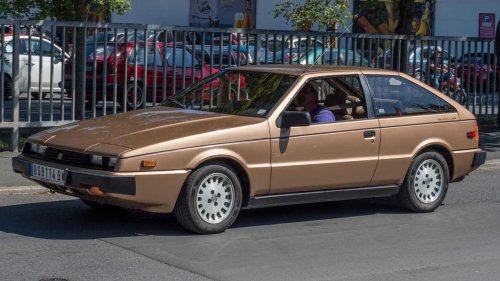





















If you know anything about car designers, you'll know who Giorgetto Giugiaro is. Once the head of legendary design house Italdesign, Giugiaro is responsible for designing some of the coolest and most-loved cars ever made. Alfa Romeo, Ferrari, Fiat, and Lancia are just a few automakers who commissioned Giugiaro to design their cars. He's still very much active as a designer today, too, working alongside his son Fabrizio as part of GFG Style.There are plenty of cars around that we all know that Giugiaro was the chief designer for. But, there are some others out there that you may not know were designed by him. These range from concept cars to fairly ordinary hatchbacks and sedans. There's even one car in here that was incredibly important for the car industry of an entire country. AMC AMX/3 The AMC AMX/3 has to be one of the most famous concept cars ever built by an American automaker. It was a proper 2-seater sports car, powered by a 6.4-liter V8 engine that produced 340 hp and 430 lb-ft of torque. AMC wanted to compete with the De Tomaso Pantera in the US market, and thought that a futuristic-looking sports car with a big V8 could do the job. But, it never went into production after being shown to the press.The AMC AMX/3 is the only car on this list that wasn't directly designed by Giugiaro. The futuristic styling was actually done by Dick Teague. But, Italdesign did have a role to play in the car's development, and Giugiaro would have definitely had a hand in some things that made it to the version of the car we ended up seeing. So, although it strictly isn't a Giugiaro design, it's still got his fingerprints on it! Aston Martin Twenty Twenty Chelsea Jay, via Wikimedia CommonsHave you ever wondered what people in the 2000s thought that we might be driving in the 2020s? Well, this Aston Martin is your answer! The Twenty Twenty is a concept car based on the Aston Martin DB7, and it was a collaboration between Giorgetto and Fabrizio Giugiaro. The Twenty Twenty was powered by the same 5.9-liter V12 as the DB7 Vantage, with the power boosted up to 493 hp from the 420 hp the DB7 Vantage had from the factory.The Aston Martin Twenty Twenty's looks definitely aren't to everyone's taste. It's a very striking roadster, with some features that might make it look a bit guppy-mouthed. But, there's no denying that it's an eye-catching car, and it's interesting to know that Giugiaro (and his son!) were behind those looks. The cars we drive now may look quite different from what was envisaged over 25 years ago, but it would definitely fit in on today's roads. Audi 80 (B2) Charlie, via Wikimedia CommonsThe Audi 80 was once a very common sight all around the world. Produced from 1966-1996, it was Audi's compact executive model. The spirit of the Audi 80 still lives on to this day, as the Audi A4 carried on from where it left off in the mid-'90s. There were several different generations of the Audi 80, and every one of them had a different design. The one Giugaro designed was the B2, which was produced from 1978-1986 (with a facelift in 1984). The B2 Audi 80 was available in coupe and sedan body styles, and had a large variety of engine options. This included several inline-4 and inline-5 petrols, an inline-4 non-turbo diesel, and a turbo diesel inline-4.The B2 Audi 80 may have been a fairly ordinary premium sedan back in the '70s and '80s. But, it's one that still looks great to this day, thanks to Giugiaro's ability to create timeless designs for even the most ordinary cars. Eagle Premier If you're from the US and you're of a certain age, you may remember the Eagle Premier very clearly. This was the result of one of the oddest joint ventures ever, and it ended up being plagued by all sorts of problems. AMC (the owner of the Eagle brand) had a partnership with Groupe Renault back in the 1980s. This was due to the French company actually being a majority shareholder of AMC at the time.Instead of developing its own brand-new compact sedan for the Eagle brand from scratch, AMC decided to use the chassis from the Renault 25 instead. That wasn't the only thing AMC borrowed from the French, either. The suspension was heavily based on the Renault 21's suspension system, and one of the engine options was the 3-liter PRV V6. This version of the PRV was used in the Citroen XM, the Peugeot 605 and the Alpine A610 sports car.While it might be weird to think of Giorgetto Giugiaro being the man behind the styling of the Eagle Premier, when you look at it, it does actually make sense. Its very '80s boxy sedan design isn't that far off the aforementioned B2 Audi 80. In fact, it's got a lot of design similarities with other Giugiaro sedans and hatchbacks from the same time. Like the B2 Audi 80, the Eagle Premier is a fairly ordinary car with looks that have aged better than most of its contemporaries. FSO Polonez A car made for communist Poland is perhaps the car you would least expect a celebrated Italian designer to work on. But, that's exactly what Giugiaro did when FSO tapped Italdesign to help them create the Polonez. Based on a licence-built Polish version of the Fiat 125, the FSO Polonez was supposed to be a modern-looking family car for the masses. It definitely looked contemporary for its time, hiding its 1960s Fiat origins very well. First-generation Polonezes were powered by a variety of petrol and diesel engines, several of which were carried over from the Fiat 125p that came before it. If you were a government official, you could get access to the 2-liter Fiat twin-cam-powered Polonez 2000, which had 110 hp. The original 5-door hatchback bodystyle was later joined by a 4-door sedan, a 3-door coupe, a cargo van, and a pick-up truck.The Polonez had an incredibly long production run. It first went into mass production in 1978, and you could buy it as a new car right up until 2002. The Polonez had lost most of its Fiat origins by 1991, though, and by 1997 it was an entirely different car. Hyundai Pony Damian B Oh, via Wikimedia CommonsHyundai might be a very well-known car brand now, with a solid reputation for producing high-quality premium cars. But, back in the 1970s, things were very different. Hyundai was a South Korean upstart, producing licence-built versions of the Ford Cortina. Things changed, though, when it hired former British Leyland man George Turnbull to develop its first proper car. Turnbull brought a group of British engineers along with him, and Hyundai tapped Italdesign to design it. As a result, Giorgetto Giugiaro ended up designing the first proper South Korean car.This became the Hyundai Pony, and it became successful very quickly in its home market. The Pony was also the first South Korean car to be exported to the rest of the world, appearing in markets all over Europe and South America as well as in Australia and New Zealand.The first-generation Hyundai Pony may have been a car born and bred in South Korea, but it still used a lot of parts from cars made outside of the peninsula. The engines and transmissions came from Mitsubishi, and it shared some parts with the Ford Cortina. Hyundai was already used to producing under licence.The Pony was an ordinary hatchback, designed for commuters and families. But, its design ended up being so iconic that Hyundai brought it back as an electric concept car in 2021. Giugiaro is the master of cars that age gracefully, and you can't get any better proof of a more timeless design than that. Isuzu Impulse (First Generation) Ermell, via Wikmedia CommonsIf you're into Japanese cars from the '80s, you'll definitely know about the Isuzu Impulse. Called the Isuzu Piazza in many markets, the first-generation Impulse was a sporty yet practical coupe with angular styling. That styling was the result of Giorgetto Giugiaro (via Italdesign), and that's something a lot of people don't seem to talk about! Isuzu already trusted Giugiaro (he had designed the car that the Piazza/Impulse was supposed to replace), and allowed him full control over what the car would look like. That was clearly the best option, as we got a car that still looks fantastic today.The first-generation Impulse was sold in North America from 1983-1990 and was available with multiple engine options. Early models had a 2-liter naturally aspirated inline-4 that produced 90 hp and 108 lb-ft of torque. A turbocharged version of it was added later, rated at 140 hp and 166 lb-ft of torque. The 2-liter non-turbo engine was replaced by a 2.3-liter unit later on, which produced 110 hp and 127 lb-ft of torque. While these may not have been impressive numbers even back then, people still enjoyed these cars thanks to them being fun, practical, and reliable. Lexus GS (First Generation) LexusCreating the Lexus brand has to be considered as one of the best decisions Toyota has ever made. Adding a luxury brand for markets outside of Japan finally helped Toyota go toe-to-toe with traditional luxury brands like Audi, BMW, Lincoln, Mercedes-Benz and Cadillac. While the Lexus LS was the brand's first and easily most important car, the Lexus GS has to be mentioned too for what it achieved. Slotting into the compact executive segment, the first-generation GS achieved the same kind of market disruption as the LS and shared its bigger brother's reputation for bulletproof reliability. That reliability was thanks to its tried-and-true Toyota mechanicals, which included using the legendary 3-liter 2JZ inline-6 engine.What you may not have known before now about the first-generation GS is that it was a Giugiaro design! Toyota tapped Italdesign to create its new, fancy executive car, and Giugiaro definitely delivered. It's rounded sedan shape still looks great, and thanks to that incredible reliability, there are still plenty of those first-generation GSs around today. Maserati Quattroporte III RM Southeby'sThe Maserati Quattroporte is easily one of the most underrated cars ever. That's often due to its perception of not being as great as its rivals in the luxury sedan market. But, the Quattroporte has always been great to drive, and it's always looked great too. What might surprise some people is that Giugiaro actually had a hand in the legacy of the Quattroporte always being one of the best-looking sedans on sale.The design of the Quattroporte III, produced between 1979-1990, was done by Italdesign. It was a return to rear-wheel drive for the Quattroporte after the Quattroporte II, which shared a platform with the Citroen SM, and it's got that classic '80s Giugiaro boxy sedan look. It does have a bit more flair in the Quattroporte III, however, likely thanks to the influence of the then-new owner De Tomaso.As you might expect from a Maserati launched at the tail end of the '70s, the Quattroporte III was powered by the Ferrari Tipo V8. This was available in 4.2 and 4.9-liter formats, producing 252 and 276 hp, respectively. The 4.2 was phased out in 1981, and the more luxurious Quattroporte Royale version that was launched in 1986 got a power bump that took the 4.9-liter engine up to 295 hp. Saab 9000 Mr.choppers, via Wikimedia CommonsIf any of you spent any time in middle-class suburbia in Europe or North America in the '80s and '90s, there's a chance that you will have seen many of these. The Saab 9000 was one of the more left-of-centre choices in the compact executive market, and in many ways it was all the better for it. Produced from 1984-1998, it was available in two distinctly wedgy body styles (a sedan and a hatchback) that were both designed by Giugiaro in conjunction with Saab's in-house designer Björn Envall.The Saab 9000 came with a variety of engines. This consisted of multiple naturally aspirated and turbocharged inline-4s and a 3-liter V6. It also had two different transmissions, a 5-speed manual and a 4-speed automatic. The coolest versions of the 9000 are definitely the Aero and Carlsson models, which are powered by turbocharged 2.3-liter inline-4s. The Carlsson (also known as the Talladega) produced 217 hp and 246 lb-ft of torque, pretty good power for a sports sedan at the time.