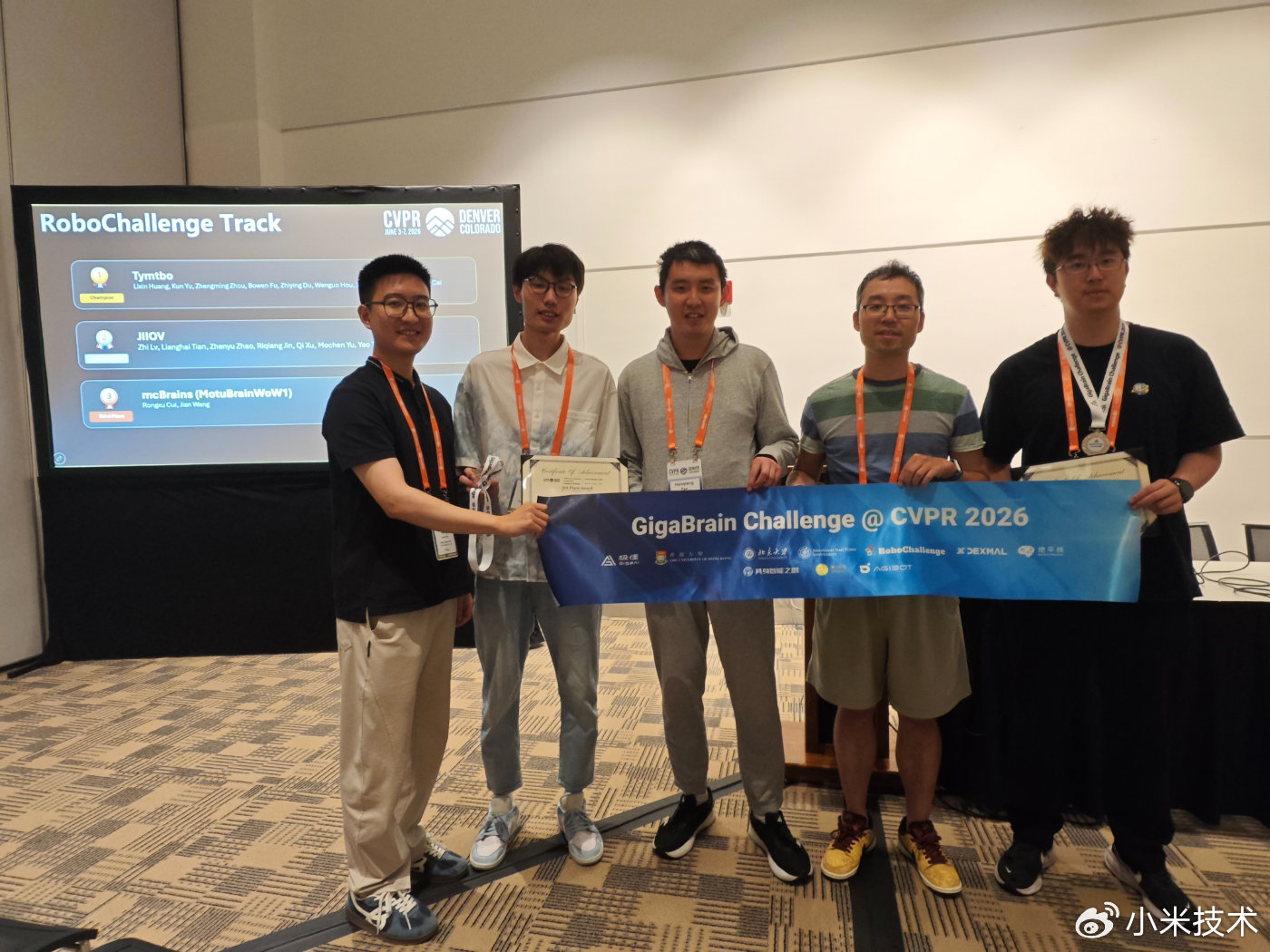



















Gasgoo Munich- On June 5, Lei Jun took to Weibo to outline Xiaomi's robotics strategy. The company's robotics team, he announced, has secured top honors in two recent international competitions — finishing well ahead of the runner-up in both.Image Source: Xiaomi TechnologyLei Jun listed the achievements:1. At the CVPR 2026 Workshops, Xiaomi's anonymous entry, "my16," claimed the top spot on the overall leaderboard with a 40.89% success rate — the only model to breach the 40% threshold this year.2. In the ICRA 2026 WBC, Xiaomi's robotics effort notched a composite score of 99.2 — near perfection — with an overall success rate of 94%. That put the team 10 percentage points ahead of the second-place finisher.Lei Jun emphasized that Xiaomi's robotics strategy is clear: get robots out of the lab and into the physical world to handle real-world tasks.The CVPR 2026 Workshops-GigaBrain Challenge-RoboChallenge Track featured 30 extremely difficult real-world tasks. These ranged from dual-arm dexterity and flexible object manipulation to causal reasoning with tools and cross-platform robustness. Participants had to run 10 consecutive, uninterrupted tests using a single unified multi-task model — a rigorous assessment of a system's generalization capabilities.The "my16" model is a proprietary World Action Model (WAM) designed for real-world robotics scenarios, built on a "large and small brain + long- and short-term memory" architecture. In the RoboChallenge CVPR 2026 hardware evaluation, it achieved a 40.89% success rate — a significant lead over rivals and the only model to clear the 40% hurdle, securing the top overall ranking.By integrating an "S1/S2 dual system + long- and short-term memory + cross-embodiment pre-training" architecture, the model fuses three core strengths into one unified system. It combines the cognitive depth of large models, the execution precision of controllers, and the long-term stability of a memory system.The ICRA 2026 WBC challenge track simulates a supermarket environment. Robots must identify and retrieve specific drinks from a shelf — chosen from 16 major categories and 20 sub-categories — and place them in a shopping cart based on voice commands. While the task sounds mundane, the full workflow spans environmental perception, autonomous navigation, full-body posture adjustment, and single- or dual-arm grasping and placement. It is a comprehensive test of a robot's ability to operate in the real world.In this evaluation, Xiaomi's team achieved a composite score of 99.2 — near perfection. Its overall success rate hit 94%, making it the only solution on the leaderboard to exceed 90% and outpacing the runner-up by 10 percentage points. Specifically, it recorded a 100% success rate on simple tasks and 90% on complex ones.