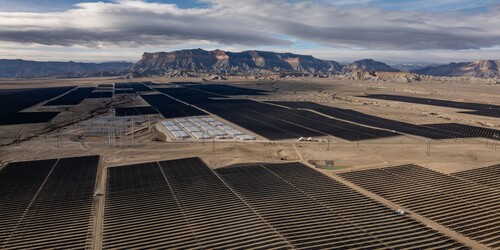
The Philippines has taken another major step in its clean energy transition with the inauguration of the first phase of the MTerra Solar project, a massive solar and battery storage development that President Ferdinand Marcos Jr. described as proof that the country can deliver world-class energy infrastructure while reducing its dependence on imported fossil fuels. Phase 1 of the massive MTerra solar project in Nueva Ecija, Philippines. Photo by Presidential Communications Office from a helicopter inspection with President Marcos. Marcos led the inauguration ceremony Tuesday in Gapan City, Nueva Ecija (about 4 hours from the capital Manila), less than two years after breaking ground on the project. The first phase marks a significant milestone for what is expected to become the world’s largest integrated solar and battery energy storage facility once construction is completed. First reported by CleanTechnica in 2024 and then in 2025, the hybrid facility, which spans borders all the way to Bulacan (just two hours from Manial), has energized 1,373 megawatts of photovoltaic generation alongside 825 megawatts of battery energy storage with a total storage capacity of 3.3 gigawatt-hours. Once the entire project is completed, MTerra is expected to reach 3.5 GW of solar generation paired with 4.5 GWh of battery storage, placing it among the largest solar-plus-storage developments ever constructed. “Today, as we gather once again for the inauguration of Phase I, we demonstrate our will and determination to ensure that our plans are coming into fruition,” Marcos said during the ceremony. He added that the project comes at a time when strengthening the country’s energy sector has become increasingly urgent as the Philippines works to diversify its electricity supply and reduce its exposure to volatile global fuel markets. President Marcos congratulates MGen Chairman Manny V. Pangilinan. Beside him is Emmanuel Rubio, MGen President and CEO. Photo from Presidential Communications Office. For his part, MGEN Chairman Manuel V. Pangilinan said: “what we inaugurate today will be the world’s largest integrated solar and battery storage facility located in a single site. And it rises not in Texas, not in the Gobi Desert, but right here in Gapan, Nueva Ecija,” Pangilinan commented. Although the solar arrays and battery systems have been energized, power exports to the Luzon grid are currently limited to 750 MW while final transmission upgrades and grid integration work are completed. Once these are finished, the facility will begin supplying electricity under a 600 MW mid-merit power supply agreement with Meralco. Phase I is now about 91 percent complete and is expected to reach full commercial operation by August 2026. Construction of Phase II began earlier this year and remains on schedule for completion in 2027. When fully completed, MTerra will deliver up to 3.5 gigawatts of solar generation supported by 4.5 gigawatt-hours of battery energy storage. The facility is expected to supply electricity to more than 2.4 million households while avoiding an estimated 4.3 million metric tons of carbon dioxide emissions each year. Marcos said the project’s battery systems are just as important as its solar panels because they will improve grid stability while allowing renewable electricity to remain available after sunset. “These capabilities will help strengthen the stability of our power system while expanding the role of clean energy in our power generation mix. Equally importantly, its impact will be felt in the daily lives of our people,” he said. The administration also expects the development to deliver broader economic benefits. Government estimates project nearly Php23 billion (about $400 million) in economic value over the next decade through tax revenues, local government income, employment, and community development programs in the project’s host provinces. “MGEN has always believed that the energy transition must deliver not only cleaner power, but also reliable and affordable electricity for Filipinos. MTerra Solar demonstrates what is possible when vision, innovation, and collaboration come together. Beyond building one of the world’s most significant renewable energy facilities, we are helping build a stronger and more resilient Philippine energy system capable of supporting the country’s long-term economic growth,” Emmanuel V. Rubio, President and CEO of MGEN told the media present at the event. For CleanTechnica readers, MTerra represents a significant evolution in Philippine renewable energy development. Utility-scale solar projects in the country historically focused on daytime electricity generation. MTerra instead was designed from the outset as a fully integrated solar-plus-storage facility, allowing excess daytime generation to be stored and dispatched during the evening peak when electricity demand remains high but solar production disappears. That approach addresses one of the Philippines’ biggest energy challenges. The country continues to rely heavily on imported coal, liquefied natural gas, and oil for electricity generation, leaving consumers exposed to global fuel price shocks. Large battery installations paired with renewable energy can reduce that dependence while improving grid reliability. The inauguration also comes as the Marcos administration accelerates renewable energy deployment nationwide. Between July 2022 and May 2026, the Department of Energy awarded 605 renewable energy service contracts covering solar, wind, hydroelectric, geothermal, and other clean energy technologies. Earlier this year, the DOE launched its 10-Year Green Energy Auction Program, which aims to bring 25 GW of additional renewable generating capacity online between 2027 and 2035. Energy storage has expanded just as rapidly. Government figures show installed battery energy storage capacity increased from only 93 MW in mid-2022 to 845 MW by May of this year, reflecting the growing recognition that batteries will play a central role in integrating larger amounts of renewable generation into the national grid. Transmission infrastructure is also being upgraded through the government’s Smart and Green Grid Plan, which seeks to expand the network’s capacity to accommodate new renewable energy projects while improving overall system reliability. CleanTechnica has previously reported on MTerra’s steady progress as one of Southeast Asia’s flagship renewable energy developments. The project reflects a broader shift occurring across the region, where developers increasingly view battery storage as an essential component of utility-scale solar rather than an optional add-on. As renewable generation grows, dispatchable clean electricity is becoming just as valuable as installed solar capacity itself. Marcos credited the private sector, local governments, and surrounding communities for helping bring the project to fruition, saying the development demonstrates what can be achieved through public-private collaboration. “Indeed, the MTerra Solar Project is proof that the Philippines is capable not only of envisioning world-class infrastructure, but also of delivering it,” the president said. President Marcos said that MTerra Solar Project is proof that the Philippines is capable not only of envisioning world-class infrastructure, but also of delivering it. Photo by author for CleanTechnica.