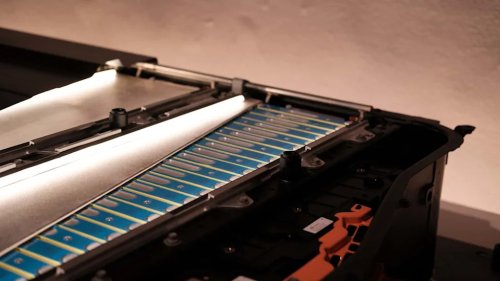
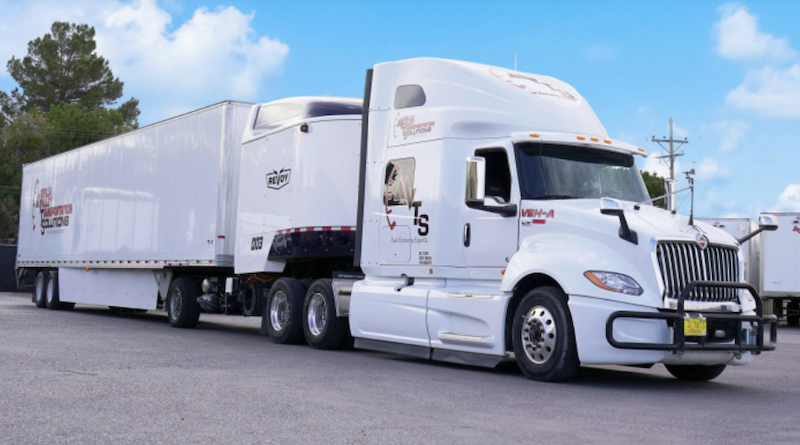
The Intertubes are buzzing with word of a new EV battery on wheels that can seamlessly swap in and out of a Class 8 diesel truck. While Tesla CEO Elon Musk famously dismissed the idea of EV battery swapping long ago, swapping has become commonplace in some markets overseas and the freight hauling business could be among the first to crack open here in the US. EV Battery Swapping, Class 8 Truck Edition The potential for battery swapping to seep into the US market is already apparent in the low-hanging fruit of delivery e-bikes. Passenger cars would be next up the scale, considering that Tesla trialed a swapping system all the way back in 2015. However, that experiment quickly slid into the dustbin of Tesla history, and other swapping attempts in the US eventually followed it down the memory hole. Now the California battery swapping firm Revoy (formerly SixWheels) is gearing up to skip right over the passenger car market and zero in on Class 8 heavy-duty trucks. Instead of full electrification, Revoy is pitching a swap-able solution that delivers substantial savings on diesel fuel for existing trucks, without the expense of an all-electric retrofit, let alone investing in a new electric truck. The startup has been in the news this week after Bloomberg reported that Revoy has raised $27 million in Series A financing, bringing its total fundraise more than $41 million. The Revoy website is currently thin on detail, but a quick tour around the Intertubes uncovers a substantial overview of the swap-in, swap-out solution. Ventureburn, for example, describes how the battery unit sits between the cab and trailer of a Class 8 truck, clipping onto standard equipment and making use of existing wiring to power its own axle with a 575 kilowatt-hour battery, thereby pushing the truck forward as needed. That leaves some key questions open. Of particular interest is the location of the battery swapping facilities. Revoy’s business model calls for the company to own the battery units, as is common in the EV battery swapping industry. Revoy could establish bespoke facilities to make the swap, recharge the batteries, and perform any needed monitoring or maintenance tasks, which is also common practice. Alternatively, fleet owners could use equipment at their own depots. The new electrification option could also be of interest to independent drivers who own their rigs individually, though that remains to be seen. Putting A Plug-In Truck Battery To The Test If you have other questions, drop a note in the discussion thread. I’ve reached out to Revoy for more details and will follow up when they reply. As for fuel savings, Ventureburn had this to say about the new Revoy EV: On a full charge, it can carry a loaded 36-tonne rig more than 200 miles while cutting diesel use by up to 95% and emissions by up to 85%, according to the company. Regenerative braking recovers energy on the way down and, as a side effect, shortens stopping distance by as much as 30%. If that sounds like an optimal use case, it is. Still, as a retrofit solution, battery swapping can yield substantial fuel savings under sub-optimal conditions, too. Last August, the leading third-party, independent testing firm Mesilla Valley Transportation Solutions (a branch of MVT) ran the numbers on the fuel savings that fleet owners can reasonably expect from Revoy’s swap-able EV battery under different elevation conditions. “The Revoy EV units are universal, quick and easy to change between tractors, and require zero hardware installation by the fleet — they connected seamlessly to the MVTS test tractor and trailer,” MVTS noted. More to the point, MVTS did report a diesel fuel savings of 90.4% on flat terrain, though the total savings also reflects diesel fuel economy over flat ground in addition to the EV battery boost. In another finding of interest, MVTS also ran the Revoy EV on a 123.3-mile route with five acceleration/deceleration cycles. While the route consumed 58.8% of battery capacity, MVTS calculated that the Revoy EV could “easily” make a range of 250 miles on that route. “This makes it possible to conduct 500-mile routes with a midway exchange of the Revoy EV,” MVTS noted. Drilling into the details, MTVS reported average fuel savings substantially below 90% over hills and valleys, though overall the firm reported a healthy 65.2% savings on a 41.1-mile test loop, which took place on an interstate highway in New Mexico. Selected to reflect typical real-world conditions, the total route covered two inclines requiring fuel-consuming accelerations and decelerations, as well as rolling hills. With the inclines reduced to one, the average savings rose to 68.2% over a route of 38.7 miles. Under an even smoother, “rolling-hills” route of 36.6 miles, fuel savings rose to 69.7%. “Acceleration and deceleration segments recorded efficiency improvements of 27.9% and 74.7%, respectively, suggesting the Revoy EV was able to manage power delivery and recovery effectively across transitional driving conditions,” MTVS summarized. “These outcomes reflected a consistent trend of reduced fuel consumption across a variety of terrain types under the test conditions. MVTS further emphasized that while actual savings will depend on individual fleets, its tests demonstrated diesel fuel savings in the range of 65.2% – 69.7%, which translates into a savings of 14.79 mpg (miles per gallon) to 19.12 mpg (the full report is available here). By way of comparison, in a separate article on diesel fuel economy MVTS notes that the national average for Class 8 fleets is just 6.9 miles per gallon, though an MVT truck achieved almost 12 mpg during a recent three-week fuel economy competition. The firm also notes that aerodynamic retrofits — trailer skirts, mud flaps, roof fairings and the like — can measurably level up fuel economy at a relatively low up-front cost, providing fleet owners and independent truckers with a quick fix compared to investing in a new electric truck or all-electric retrofit. The Iran War Factor That particular article does not mention the Revoy EV, but it does suggest that fleet owners can maximize the Revoy savings by investing in additional retrofits. “Tire-inflation systems, lubricants, solar panels, and low-rolling-resistance tires are some of the other technologies that a fleet can invest in if they are looking to improve fuel economy,” MVTS also noted. Given the date of the article — May 28, 2026 — that guidance should probably be in the form of when, not if, considering the impact on fuel prices after US President Donald Trump (this guy) decided to launch a full-on war in Iran. May 28 marked the first full three months of Trump’s war. Now the six-month mark is approaching with no end in sight — for profit-taking, that is. “American oil and gas giants raked in massive spring profits while fighting between Iran and the U.S. impeded petroleum shipments and consumers around the world paid more for fuel and confronted shortages,” summarized PBS on July 31. “Exxon Mobil on Friday reported that its second quarter profits doubled to $14.53 billion, boosted by record diesel production. The oil giant, based in Spring, Texas, brought in $116.02 billion in revenue, up 42%,” PBS added. “Chevron, based in Houston, nearly quadrupled its profits to $12.07 billion and revenue jumped 56% to $70.06 billion.” Too bad none of that has trickled down into the price of fuel at the pump. The price of diesel here at home has spiked 63%, and freight stakeholders are not the only stakeholders facing the music. Farmers are also reeling under the impact of the Iran war on diesel prices, with a surge in the cost of fertilizer adding to the hurt. Photo: EV battery swapping — in one form or another — could finally come to the US, if the startup Revoy succeeds in pitching its swap-in, swap-out retrofit for Class 8 diesel trucks with the potential for up to 90% savings on fuel depending on the terrain and route (screenshot courtesy of MTVS).



















 +17 others