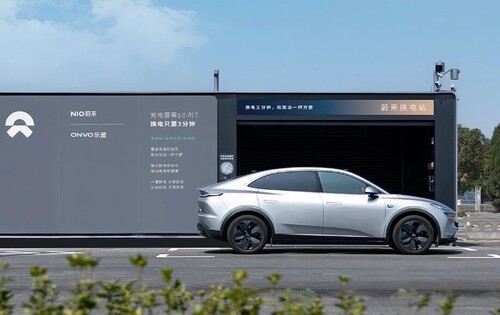
Gasgoo Munich-On September 28, NIO and Geely Holding Group jointly announced a comprehensive strategic partnership in charging and battery swapping.Geely Holding will contribute its 100% stake in Yiyi Power, plus 640 million yuan in cash, to invest in NIO Energy. Once the deal closes, Geely targets a 30% stake in NIO Energy. In exchange, NIO will take a 10% stake in Geely's Haohan Energy Energy.Cross-shareholdings, asset consolidation, shared standards, interconnected networks. This isn't a simple "networking" deal — it's a deep merger of the two automakers' energy replenishment operations. Once their networks connect, coverage will jump by an order of magnitude.Battery Swapping Consolidates Under NIO, Charging Networks Bridge with GeelyThe partnership splits along two tracks — battery swapping and charging — each with its own logic.In battery swapping, Geely is contributing its entire Yiyi Power stake to NIO Energy. Yiyi Power, a Geely subsidiary, serves the commercial vehicle market — mainly taxis and ride-hailing fleets. Post-merger, NIO Energy will operate both consumer and commercial swapping networks. NIO Energy aims to build 10,000 swapping stations cumulatively by 2030, when annual power demand is expected to exceed 10 billion kWh.Image Source: NIOMore crucial is standardization. The two sides will co-develop unified consumer swapping tech and standards. Geely will build passenger cars tailored for this ecosystem, backed by NIO Energy's swapping service. That means future Geely EVs can pull straight into NIO stations — no parallel network required.On the charging front, NIO's 10% stake in Haohan Energy Energy unlocks full interoperability between their resources. Haohan Energy, Geely's charging platform, plans to build over 22,000 stations by the end of 2027. Add NIO's existing 5,300-plus stations, and the combined network approaches 30,000 locations.Valuing NIO Energy at roughly 16 billion yuan — based on the 30% stake matching Yiyi Power's full equity plus 640 million yuan in cash — signals the market's recognition of swapping networks' long-term worth.NIO founder and CEO William Li said the partnership will accelerate network expansion. Consumer swapping stations will scale up faster, with NIO ensuring seamless adaptation and service for Geely's passenger cars. "For commercial vehicles, we'll also scientifically lay out the B2B swapping network based on the needs of our partner, Geely's Caocao and Robotaxi operations," he added.The two companies will also integrate swapping services for Geely's Robotaxi business — spanning R&D, supply chain, manufacturing, and operations.One industry insider — and NIO ES6 owner — offers a clear-eyed take: the heavy-asset model is a near-term drag but a long-term moat. His reasoning? NIO's highway swapping network spans a 9-vertical, 11-horizontal grid, covering 16 major metropolitan clusters and over 550 cities. No other automaker can match that footprint — which is exactly why so many rivals and CATL are lining up to partner with NIO.Unlocking the BaaS battery-as-a-service model is another win-win. Buyers get cheaper cars, while NIO secures a steady cash flow — making it only a matter of time before the swapping business turns profitable.Partnerships with local state capital are also easing the asset-heavy burden. In August, NIO Energy and Wuhan Optics Valley Transport Group completed the asset transfer for an initial 36 co-built charging and swapping stations. All existing swapping stations in Wuhan are now state-owned, though NIO Energy continues to handle daily operations.Local state entities hold the real estate; NIO Energy runs the day-to-day. The stations look and function exactly as before, so the user experience remains unchanged — only better, as the total network grows. A NIO staffer says this "state-owned assets plus NIO professional operations" model is now rolling out nationwide.The Era of Going It Alone Is OverNIO has been in the swapping game for eight years.It built its first station in Shenzhen in May 2018. Today, the nationwide count stands at 4,126, with over 200 million cumulative swaps and charges. Over those eight years, NIO has poured more than 10 billion yuan into the network.Yet the model has always drawn skepticism. Heavy capital, slow paybacks, and fragmented standards are the three big hurdles. Construction costs vary by generation, ranging from 1 million to 2.5 million yuan per station — and that's before factoring in battery reserves and maintenance crews. Relying solely on NIO's own sales volume, hitting breakeven is a steep climb.Geely faces similar constraints. Yiyi Power focuses on commercial swaps — high frequency, steady demand, but a limited ceiling and razor-thin margins. Haohan Energy, meanwhile, competes against charging giants like TELD, Star Charge, and State Grid. Going it alone is a tough fight.Bringing the two together is essentially an admission that the go-it-alone model has hit a wall. NIO needs more vehicles to spread its fixed costs; Geely needs mature swapping tech and an existing network to support its passenger cars. Pooling resources directly improves the charging experience and cuts redundant construction.Policymakers are pushing in the same direction. The MIIT and the National Energy Administration have repeatedly urged infrastructure interoperability and unified swapping standards. The 2025 auto standardization roadmap explicitly calls for an EV swapping standard system to prevent fragmented, siloed ecosystems.Image Source: NIOThe Geely-NIO tie-up marks a turning point: the charging and swapping industry is shifting from a land-grab to consolidation and optimization.Until now, automakers have largely built walled gardens. NIO built for NIO, Tesla for Tesla, XPENG for XPENG, Geely for Geely. Each poured billions into infrastructure, yet the user experience barely improved relative to the spend.The waste is obvious. A swapping station covers roughly a 3-kilometer radius. If two automakers each build one in the same area, both sit underutilized. Connect the networks, and a single site can serve both brands — doubling utilization overnight.Standardization matters even more. The biggest barrier to scaling swaps is the lack of universal battery packs, interfaces, and protocols. If Geely and NIO's unified consumer standard attracts more automakers, swapping could finally go mainstream.Multiple automakers have signed framework agreements on swapping standards before. Yet without strong commercial incentives, cross-brand standards have struggled to move from consensus to production.This partnership breaks the deadlock. Through cross-shareholdings and asset consolidation, Geely and NIO are co-building a unified consumer swapping standard. Geely's upcoming passenger cars will adopt it and plug into NIO Energy's network — finally providing a viable commercial pathway for cross-brand interoperability.Announcing a partnership, however, is the easy part. Execution is the real test.The first hurdle is technical. NIO stations use proprietary battery packs. Adapting Geely vehicles to NIO's standard will require extensive chassis, battery, and interface redesigns — a process that takes time.The second is profitability. NIO's fifth-generation stations have lowered the breakeven threshold to roughly 45 swaps per day. Yet the current network averages just 30 — still below the line.Whether Geely's consumer models will generate enough volume to close that gap remains an open question.The third is dividing the pie. Under a cross-shareholding structure, aligning on network operations, revenue splits, and tech contributions will require constant fine-tuning.Still, the direction is clear. EV charging networks can't remain closed loops forever. Interoperability and resource sharing are inevitable. The Geely-NIO alliance is simply the first step.Will more automakers join this swapping consortium? Will charging interoperability expand from two players to the entire industry? The answers will shape the future of EV infrastructure.