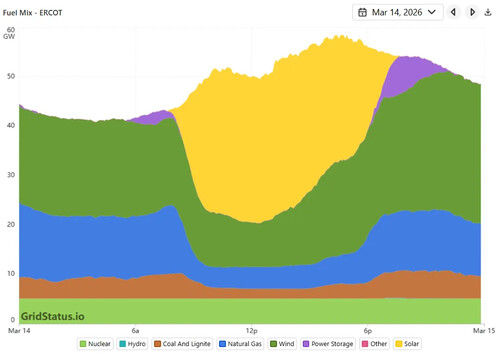
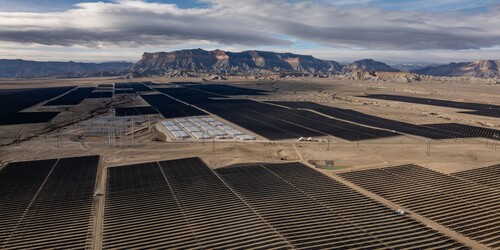
In the summer of 2026, demand for electricity in Texas broke the previous record of 85.5 GW, set three years ago: 45 times. On July 22, 2026, ERCOT, the Texas grid operator, recorded an all time high peak demand of 91.1 GW. On August 20, Houston, Texas experienced its first 100 degree day of the year, yet kept the grid running above its 2023 benchmark for seven hours straight from 2 pm to 9 pm. Through it all, there were no blackouts. How could that be? The answer, according to the Houston Chronicle, was lots of solar, wind, and battery storage. When historic heat waves in 2023 stretched the state’s energy infrastructure to its limit, ERCOT issued nearly a dozen warnings asking Texans to conserve electricity. It even declared a brief grid emergency for the first time since Winter Storm Uri devastated the state in 2021. In 2026, none of that happened. Not a single conservation request was issued, and energy reserves comfortably exceeded demand. By July 2026, when the grid recorded its highest demand ever, there was still enough excess renewable energy available to charge energy storage batteries. “Routinely, we are operating at demand levels that would have been exceptional just a few years ago,” ERCOT CEO Pablo Vegas, told the ERCOT board of directors last week. “For customers, the grid simply worked the way it was supposed to.” ERCOT is different than most grid operators. It was structured from the beginning to take advantage of the cheapest sources of electricity available, which at the time were coal and methane. But, over time, the cheapest source of electricity became solar and battery storage, as prices for both have fallen dramatically over the past five years. In response, the Texas legislature, which is 100 percent controlled by the oil and methane industries, tried to pass SB 715, which would have required thermal backup generation for all renewable energy installations. These people know no shame. They wanted the cheapest electricity when it was to their advantage, but, now that it is not, they want to change the rules. Republicans have proven time and time again they are cowards who lock their scruples away as soon as they get elected. Solar And Jobs and a Functioning Grid, Oh, My What is happening in Texas is happening all across the US. According to Lemon.io, a software talent marketplace, solar power generation offers the best career outlook in the country. In its latest analysis, Lemon.io examined 40 US industries using employment growth data from 2022 through 2024. Using that data, it projected job creation through 2034, including anticipated job growth and median annual wages. Then it combined those measures into a Career Outlook Score to show which industries will offer the most attractive balance of job availability and remuneration. The resulting Top 10 list comprised solar power generation, computer systems design, software publishing, wind power generation, scientific research and development, cloud computing and data hosting, management consulting, assisted living facilities, elderly and disability services, and corporate management. The US Bureau of Labor Statistics supports the Lemon.io conclusion that solar skills will be in demand. It ranks solar photovoltaic installers as the second fastest growing US occupation for 2025 to 2035 and projects employment growth of 37 percent during that period. Oh, yeah. The median compensation should be about $53,140. $1.7 Billion Renewable Energy Project In Colorado Chalk Bluffs, ColoradoCC BY-SA 4.0 Enyo Energy is proposing a massive new wind, solar, and battery storage project in the Chalk Bluffs region of northern Colorado near the Wyoming border. When complete, the facility is expected to supply 805 megawatts of renewable energy from 2200 acres of solar panels and 79 wind turbines. In all, the Chalk Bluffs installation will cover 25,000 acres. The project was recently approved by the five member Weld County board of commissioners. The vote was 3 to 2, which illustrates precisely how great an impact politics can have on the future of clean energy in the US and how razor thin the margin of error can be. All politics is local, former House Speaker TIP O’Neill liked to say, and he was right. At the hearing on the Chalk Bluffs project, one objector identified himself as an Eastern Shoshone tribe member. He asked the commissioners to deny the permit on a cultural basis, saying an archaeological study conducted by Colorado State University “confirms our oral history and evidence that this is a sacred place and an important place to our people.” Is that a valid concern? Of course it is. The concerns of Indigenous people have been trampled on for more than 300 years. According to the Colorado Sun, the Chalk Bluffs are a rare geological escarpment lined with ancient fossils, unique trees found in mountain environments, and important bird habitats. The primary occupation in the area is ranching or farming, and, while the developer insists the facility will have minimal impact on either activity, the majority of those who spoke at the county commissioners’ meeting last week were dubious about that claim. Enyo Energy told the commissioners it had obtained approvals from all local land owners, who control 97 percent of the land. The other three percent of the land is owned by municipal, state, or federal agencies, all of whom have signed off on the proposal. The company said it had done extensive community outreach, but one landowner who owns a 6000 acre ranch next door said at the meeting the developer had no significant contact with him. Is he annoyed because some of his neighbors will be compensated while he will not be? Did Enyo avoid talking to him because they did not need his land to put the project together? Probably a little of both. Enyo Energy made a point of saying the Chalk Bluffs facility would “strengthen the local grid,” but what that means exactly is unclear. If you go to Google Maps and type in “Chalk Bluffs, Colorado,” you will see a whole lot of nothing until you scan out 20 miles or more. The question local people always ask is, “Why should my community be turned upside down so rich folks in distant cities can benefit?” That is a valid point. Parts of Australia are providing free electricity for three hours a day to their residents. Might people in northern Colorado see things differently if the Chalk Bluffs facility lowered their utility bills? That’s certainly a possibility. The opposition to renewable energy is well-funded and well-organized. All the chest thumping about “all of the above” energy solutions and energy emergencies is just an excuse to keep pumping oil and methane so the fossil fuel companies can continue making obscene profits. One wonders if people realize those Chalk Bluffs are likely to be remnants of a time when the central part of North America was a vast inland sea. The oil and methane we use today are the product of millions of years of aquatic creatures who lived in that sea, then died and drifted to the bottom, where their carcasses we compressed over eons by tons of pressure. The Permian basin in Texas and Oklahoma is another relic of that inland sea. Humans in less than 200 years have extracted almost all the stored energy that took millions of years to create, and no one is asking if doing so is a good for the long term health of the planet that sustains us. Humans think in terms of months and years, but the Earth is ruled by changes that take millions of years to occur. The political process involves short term thinking that focuses on the next election. Little thought is given to what might be best for the next century or the next millennium. We will pay a heavy price for our ignorance.