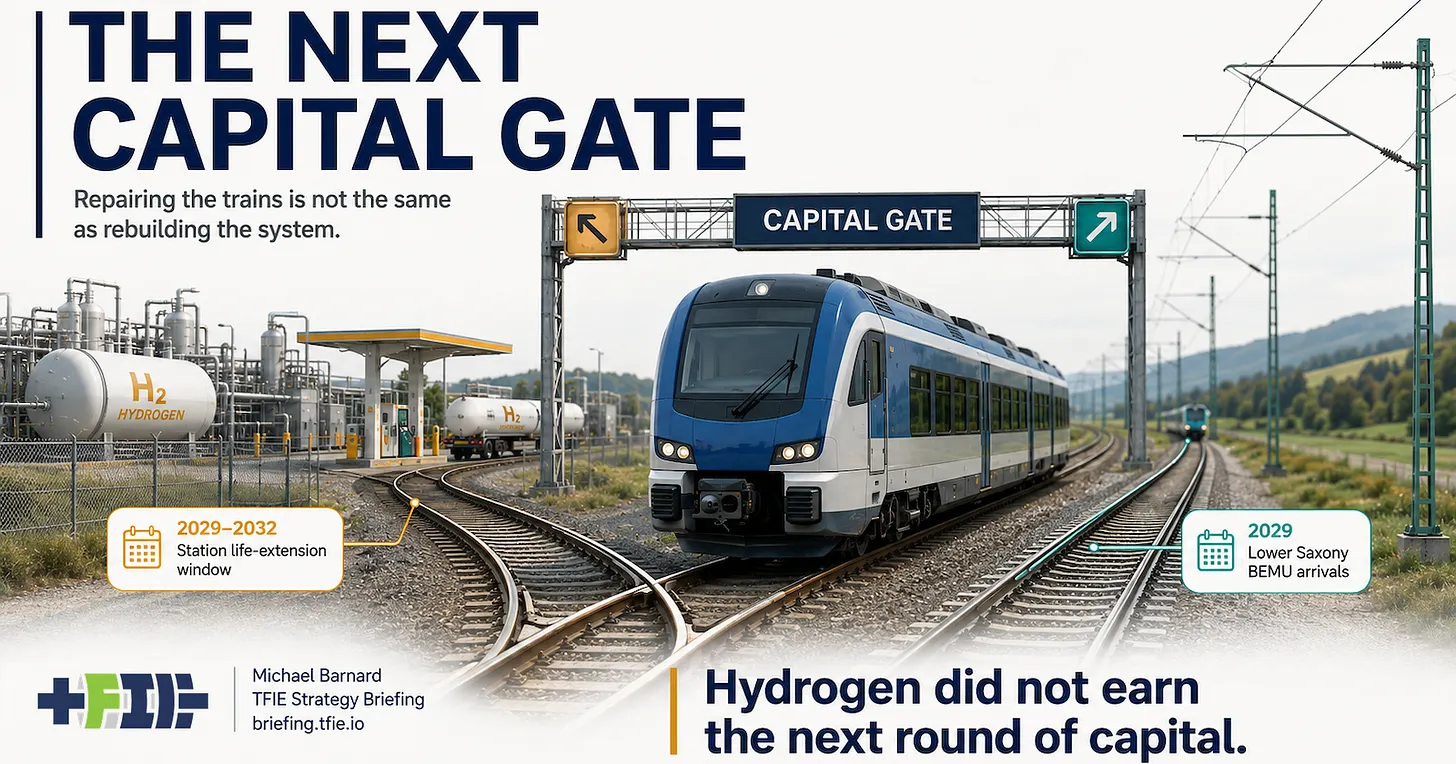
Lower Saxony’s hydrogen trains will probably not be retired because a politician announces that battery-electric multiple units were the better technology. They will be retired when the bill arrives for extending the life of an underused, specialized hydrogen system and the state has to compare that cost with buying the battery-electric future it has already selected. That decision point is approaching. The first major station recapitalization is likely to fall around 2029 to 2032. Lower Saxony’s first large battery-electric multiple-unit fleet is also expected from 2029. Those two timelines turn a technology argument into a capital-gate problem. The full TFIE Strategy Briefing assessment applies Richard Rumelt’s strategy kernel to the case: diagnose the central challenge, choose a guiding policy and take coherent actions that reinforce one another. The diagnosis is not simply that hydrogen trains have had reliability problems. Lower Saxony owns a tightly coupled and increasingly orphaned transport system in which trainsets, proprietary fuel-cell modules, a dedicated station, trucked industrial hydrogen and long maintenance commitments only have value when every link works. The latest fleet-specific public figure in the article is from August 2025, when EVB said only four of the 14 Coradia iLint trainsets were operating because replacement fuel-cell modules had not arrived. Diesel units were covering some, but not all, of the gaps. In April 2026, Alstom bought Cummins’ rail fuel-cell engineering, product and support activities. Alstom described the move in terms of reliability growth, installed-fleet support and completion of contracted programs in Germany, Italy and France. That is sensible liability management. It is not the profile of a propulsion platform attracting widening supplier support and repeat orders. The capital already committed is material. Lower Saxony committed €81.3 million to the trains, the federal government added about €8.4 million, and the original deal included 30 years of maintenance and energy supply. Linde built, owns and operates the dedicated refuelling station, estimated at €10 million and supported by federal funding. It was engineered to refuel 12 passenger trains with about 130 kg each per day, close to 1,600 kg daily capacity. Four operating trains require roughly 520 kg per day, meaning a system sized around 12 daily trains was operating at about one-third of intended throughput at the latest documented low point. That denominator matters. A hydrogen station’s economics do not improve because the trains are unavailable. Pressure vessels, redundant compressors, controls, safety systems and specialist inspection still have to be maintained. At full design throughput, the station burden may be manageable if the hydrogen price, maintenance cost and train reliability cooperate. At low throughput, fixed infrastructure costs are spread across too few kilograms and too few train-kilometres. The emissions story is also less tidy than launch publicity implied. EVB describes the hydrogen as an otherwise unused chemical-industry by-product, traced through Linde’s partners to Dow’s chemical complex at Stade. Dow produces chlorine and caustic soda through chlor-alkali electrolysis, with hydrogen as a co-product, and also uses hydrogen as an input to energy generation. Diverting the hydrogen to trains is not automatically the use of a waste gas that would otherwise be vented. It may displace another fuel or energy source inside the chemical complex. Without a disclosed allocation method and substitution case, “zero emission” describes the exhaust pipe, not the full energy system. A reasonable strategic answer is not to declare the project a fraud or pretend it was a success. Demonstrations are supposed to produce evidence. The evidence now says hydrogen did not earn the next round of capital. Lower Saxony’s guiding policy should be explicit: continuation must earn the right to exist at the next capital gate. No major station overhaul, onsite electrolyzer or energy-contract extension should proceed without a whole-system comparison against battery-electric replacement. Alstom and Linde should be required to submit binding continuation offers covering serviceable trains, module inventory, maximum repair times, station availability, life-extension capital and all-in cost per train-kilometre. They should also submit priced exit options covering residual train value, bridge operation and station decommissioning. Meanwhile, LNVG should engineer the BEMU end state now: route charging, depot changes, partial catenary, grid connections and vehicle procurement for a 2029 to 2030 transition. A credible alternative is not just contingency planning. It changes who has negotiating leverage. The cleanest path is a managed runoff. Alstom repairs enough trains and funds a spare-module pool to maintain bridge service. Linde operates the present station for a defined period without turning one troubled fleet into another decade of hydrogen infrastructure lock-in. LNVG procures standardized battery-electric trains and charging infrastructure. Federal support follows the zero-emission transport outcome rather than remaining attached to one energy carrier. Lower Saxony might have been right to test a first-of-kind option under uncertainty. It would not be right to recapitalize it after the evidence has moved. Read the full TFIE Strategy Briefing assessment for the station-throughput denominator, lifecycle emissions uncertainty and Rumelt-style strategy kernel for a managed battery exit.


















![Watt's up, doc? Huddig hybrid loader gets a big battery boost [video]](https://cdn.topcarnews.net/thumb/id/aHR0cHM6Ly9pMC53cC5jb20vZWxlY3Ry-ZWsuY28vd3AtY29udGVudC91cGxvYWRz-L3NpdGVzLzMvMjAyNi8xMC9odWRkaWct-aHlicmlkX21haW4uanBnP3c9MTUwMCZh-bXA7cXVhbGl0eT04MiZhbXA7c3RyaXA9-YWxsJmFtcDtzc2w9MQ/ea51c544798341190a5eed718aab1ee3.jpg?t=20261004&post_id=67784)