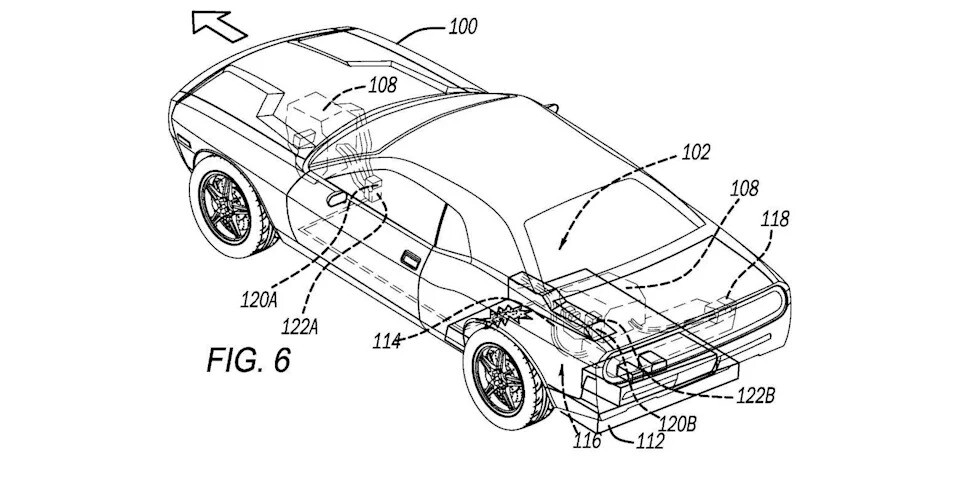
On June 2, the U.S. Patent and Trademark Office granted FCA US LLC, Stellantis's American arm, patent No. 12,643,407 for a system that cuts an electrified vehicle's high-voltage battery loose, lets it fall to the ground, and then uses the car's 12-volt battery to drive away from it. On Sept. 17, a follow-up application from the same three engineers went public, asking for broader rights to the same idea.The filing is candid about what it is trying to save. When a high-voltage pack overheats, the original application says, "the vehicle occupants can safely exit the vehicle." The problem it names is the car itself: because the battery is bolted in, some thermal events "can potentially lead to the vehicle being a total loss." I read the patent as a plan to keep a battery failure from becoming an insurance write-off. Getting people out is treated as already solved.Two switches, two ways to let goThe system, which FCA calls a high-voltage battery quick release, starts with a switch. The drawings show two: one in the cabin and one in the trunk. Either can be a lever, a physical button, a touchscreen button, or a toggle. The filing says the trunk switch can be used by the owner, a passenger, a bystander, or first-response personnel, so someone standing outside the car can trigger it.Pulling it sets off a sequence run by a controller, which the patent says can be the vehicle's existing vehicle control unit. The controller disconnects the wiring harness from the pack, tells a "high-voltage to low-voltage power change module" to feed the electric motor from the 12-volt battery instead, and then releases the pack mechanically.The patent describes two ways to do the mechanical part. The first uses a pair of castellated frames, shaped like the top of a castle wall, with alternating teeth and notches. One frame is fixed to the body and the other to the battery. An actuator slides one frame against the other until the teeth ride past each other and the assembly comes apart. The second uses pyrotechnic fasteners: a nut and bolt with a small charge inside that an electric current fires, breaking the fastener into pieces. Cars already carry this kind of hardware, since airbag inflators and seatbelt pretensioners work by firing small charges on command. This filing would use the same sort of charge to let go of a structural part.Once the pack is on the ground, the controller commands the motor, now running on the 12-volt battery, to move the car away. The example in the filing uses a 16-kilowatt-hour lithium-ion pack, a 12-volt battery mounted in the trunk, and a 12-volt feed that powers only the rear motor. According to the text accompanying Figure 6, the rear wheels may roll at least partly over the dropped battery on the way out.In Fig. 6 of the filing, the car pulls forward on 12-volt power while the released pack (labeled 112) sits under its rear wheels. (Image: U.S. Patent and Trademark Office)The drawings show a two-door coupe, and the text calls the example vehicle "a passenger car coupe." It also says the system could go on sedans, SUVs, trucks, light commercial vehicles, people movers, and racing cars. The filing never says how far "a predetermined distance" is. It also doesn't explain how a 12-volt battery sized for lights and computers will turn a traction motor normally fed by the high-voltage pack. Those are the details that decide whether this works on a real road.What the patent office granted, and what Stellantis still wantsThe grant covers less than the original application asked for. As filed on March 21, 2023, the first claim covered any mechanical decoupler. In the patent that issued, claim 1 requires the castellated-frame version specifically.The new application, filed May 6 and published Sept. 17, is a divisional of the 2023 filing. Companies usually file divisionals when a patent examiner rules that a single application contains more than one invention. Its first claim is a method: receive a request from a quick-release switch, cut the high-voltage connection, connect the low-voltage battery to the motor, and release the pack. That claim doesn't specify the hardware. Later claims cover the castellated frames and the pyrotechnic bolts separately, and claim 8 adds driving the car "a predetermined distance away from the decoupled high-voltage battery." Prosecuting a patent costs money, so filing a divisional more than three years after the first application means Stellantis still considers the idea worth protecting. Stellantis has not announced a vehicle that uses the system, and I found no mention of it in the company's press materials.Stellantis already tells some plug-in owners to park outsideStellantis knows the problem this patent addresses from its own recall filings. In February 2022, FCA US told NHTSA that 16,741 Chrysler Pacifica plug-in hybrids from the 2017 and 2018 model years could catch fire while parked, even with the ignition off (recall 22V-077). In November 2023 it recalled 32,125 Jeep Wrangler plug-in hybrids from 2021 through 2023 because the high-voltage battery could fail internally and cause a fire while parked or driving (recall 23V-787). In October 2025 came a much larger campaign covering 320,068 Wrangler 4xe models from 2020 through 2025 and Grand Cherokee 4xe models from 2022 through 2026, for the same failure (recall 25V-741). The interim advice in all three filings was similar: don't charge the vehicle, and park it outside and away from structures until it's repaired. The Wrangler 4xe has also been recalled for a stalling software bug.The patent application was filed 13 months after the Pacifica recall and eight months before the first Wrangler campaign. It doesn't mention either one, and nothing in the public record connects them. Still, the recall advice and the patent rely on the same idea: put distance between a failing pack and anything worth saving. The recall asks owners to create that distance ahead of time, and the patent tries to create it after the failure starts.That exposes the limits of a switch. The recalls warn about fires in parked cars, and a switch needs someone nearby to pull it. In a home garage, dropping the pack and driving off would leave the burning battery inside the garage, next to the house. The drawings show the car on open ground, and the filing doesn't discuss garages at all.A dropped pack is still an energized packReleasing a battery doesn't drain it. In a January 2021 safety report, the National Transportation Safety Board found that the shock and reignition risks responders face come from "stranded" energy left in a damaged battery. The board also reported that all three crash-damaged batteries in its case studies reignited after firefighters had put out the vehicle fires. A pack released under the quick-release system would carry that same stored energy. Under Stellantis's own figure, it might also have just been run over by the car it came from. Whether a pack lying in the open is easier or harder for a fire crew to cool than one still inside the floor is a question the filing doesn't take up. The next hazard would fall to tow operators and road crews, who already deal with lithium-ion fires in places they don't expect them.Federal rules would also affect how such a system reaches the street. NHTSA's FMVSS No. 305a final rule, published in December 2024, requires emergency response guides with vehicle-specific information on fire, submersion, and towing, formatted to the ISO 17840 standard for first and second responders. Compliance with that part of the rule began Dec. 22, 2025. A production car with a trunk switch that drops the battery would need that switch documented where firefighters look for it. It would also need protection against firing by mistake. The filing I read describes no speed or crash interlock. Patents often leave that to the engineers, but a production system couldn't.China's new rule says the pack must not burn at allRegulators are heading the other way. China's GB 38031-2025, issued by the Ministry of Industry and Information Technology, took effect July 1, 2026. According to the Chinese government's summary of the standard, its thermal-propagation test now requires no fire and no explosion, still requires an alarm, and requires that smoke not harm occupants. The previous version required a warning five minutes before a fire or explosion. China moved from requiring a warning to requiring that the pack contain its own failure.The U.S. rule is milder. FMVSS 305a asks manufacturers to document how they mitigate thermal runaway and propagation from an internal short in a single cell, and how they warn occupants of a thermal event in the battery. There is no pass-fail propagation test. Most of those requirements apply to light vehicles starting Sept. 1, 2027.The two approaches can coexist, since a pack designed not to burn could still carry a release for the rare failure it doesn't contain. But the priorities differ. Beijing now requires the fire to stay inside the pack. Stellantis's patent assumes the fire will happen and tries to move the car away from it.Who would pay if this reaches productionFor an insurer, the math would change. The patent itself says a pack fire can make the car a total loss. A car that drops its pack and gets away could become a claim for a new battery, a tow, and any damage to the pavement, with the rest of the car repairable. Battery fires already end up in court, and a system that separates the fire from the car also raises a new question: who is responsible for the pack left in the road.For owners and repair shops, the hardware would bring its own costs. Pyrotechnic bolts are single-use, so any accidental firing means replacement parts and an inspection, as it does after an airbag deploys. A castellated latch with an actuator is another moving part under the floor, exposed to road salt and, on a Jeep, river crossings. Neither concern appears in the patent, but both would show up at the service desk.Two things to watch: whether the patent office grants the broader method claims in the new application, and whether a quick-release switch ever appears in a Stellantis emergency response guide. Because of FMVSS 305a, those guides are where a production version would have to show up first.If your car's battery started to overheat, would you want a lever that drops the pack on the road and drives you away, or would you rather automakers be held to a rule that the pack can't catch fire in the first place?The post Stellantis Won a Patent to Drop an Overheating Battery and Drive Away on 12 Volts appeared first on The Auto Wire.