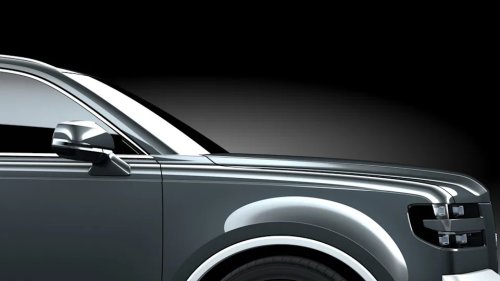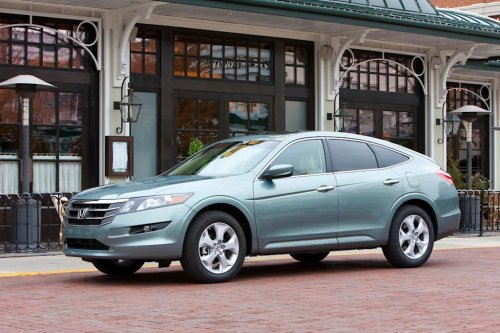
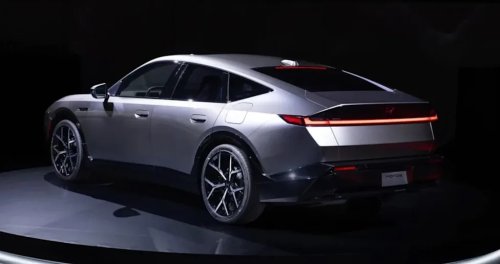
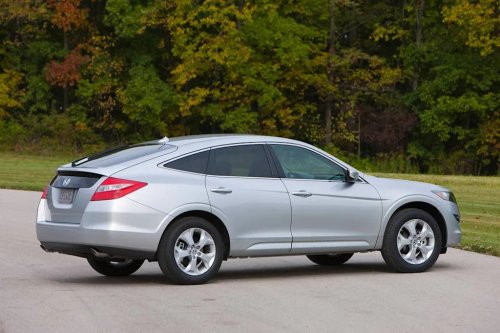
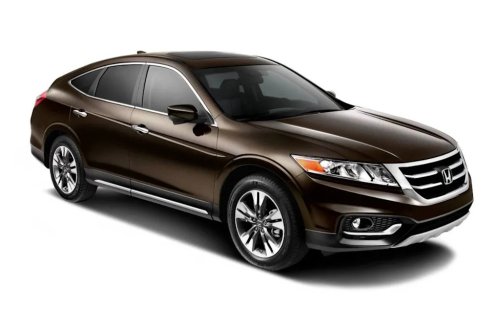
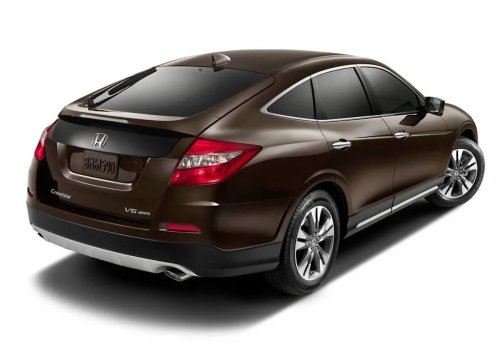
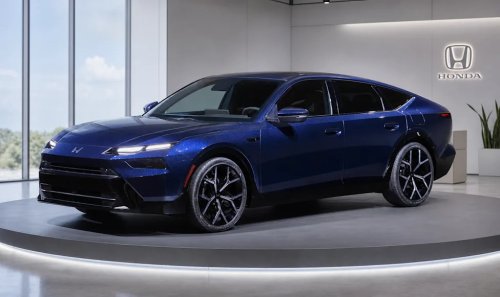
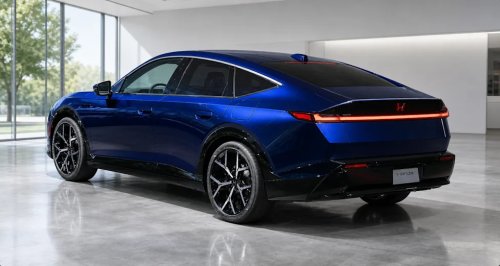

















Autoblog and Yahoo may earn commission from links in this article.Honda's success with lifted sedans isn't exactly stellar. Remember the much-malgined Honda Accord Crosstour (2010-2015)? That dismal and short-lived model still lingers in the pantheon of automotive failures. Now, the brand is considering an "Accord SUV", a lifted, hatchback-style crossover derived from the next-generation Accord. The prototype was unveiled at Honda's 2026 Global Business Briefing in Tokyo in May as part of a 15-model hybrid rollout by fiscal year 2030.2012 Honda Crosstour EX-LThe concept has a dramatic fastback/liftback silhouette, split matrix LED headlamps, connected LED taillamps, which amounts to a much bolder departure from current Honda sedan styling than the original Crosstour ever had. Part of the problem is that this potential move is trying to nab market share from the king of lifted four-doors, the Subaru Outback. Honda shoppers either choose the Accord sedan or just move upmarket to a CR-V, Passport, or the largest Pilot. The in-between-er lifted sedan isn't a Honda strength. So, if Honda brings this new vehicle to market, what are its chances?What's Actually Being PlannedThe purported new vehicle would be a lifted version of the redesigned 12th-generation Accord with "more utility, a higher driving position, and a sedan-like price," built on the same platform as the next Accord and potentially assembled alongside it in Marysville, Ohio.AdvertisementAdvertisementProduction is rumored to be sometime in mid-2029, and the model would share Honda's next-generation hybrid powertrain with the standard Accord. Honda has publicly denied any confirmed plans, stating the reports are "not based on any announcements," but the planning document's existence suggests the concept has advanced further internally than a passing idea.Why the Timing Looks Different Than 20102012 Honda Crosstour EX-L.The opportunity is a delicate one that has to be timed just right. Here's why: the redesigned Subaru Outback abandoned its low-slung wagon proportions for a more conventional, taller SUV shape, and buyers who wanted the old wagon-like driving feel have reportedly reacted by walking away: Outback sales fell 32.2 percent in Q1 2026 and 42.9 percent in March 2026 alone compared with the prior year, even as Subaru's other models held up better.Subaru cites a delayed Wilderness trim and a Japan-based production shift rather than a demand problem with the new design, but the scale of the drop-off — roughly a third of Q1 volume — is difficult to explain purely through supply timing. This number is pretty hard to ignore. That leaves an opening of potentially 30,000 to 50,000 annual buyers who liked the "lifted wagon" formula and may not want the new Outback's more rugged, boxier styling.Thinking about selling your car? Get an instant cash offer online now. Click here to get started.Why the Crosstour Actually FailedThe Crosstour's failure wasn't really about the SUV-wagon concept itself — it was about execution, timing, and pricing. Its swoopy, coupe-like roofline compromised the rear headroom that crossover buyers specifically want, and reviewers and buyers alike criticized its styling as "butt-heavy" from the day it was announced. It felt more like an Accord afterthought rather than a fresh and user-friendly idea.It also launched during the 2007–2009 recession's aftermath, arriving early to the coupe-crossover trend before consumers had warmed to the format, and it demanded a steep price premium — a 2010 starting price of $29,670, equivalent to more than $45,000 today, against a Honda CR-V that started nearly $6,000 cheaper with comparable equipment. It couldn't match the CR-Vs utility, and it couldn't sell based on style points.AdvertisementAdvertisementBecause it targeted the Outback's turf specifically, and virtually every non-premium brand that has tried an Outback clone has failed, the Crosstour was fighting an uphill battle even before its styling and pricing missteps compounded the problem.Reasons the New Version Could SucceedAmos Kwon using Perplexity AISeveral structural differences separate this proposal from the original Crosstour. The Honda Hybrid Sedan Prototype that previews the next Accord already has a well-proportioned fastback roofline, arguably solving the headroom and styling complaints that sank the Crosstour, since the base design was reportedly praised as more attractive from the outset. Basing the SUV tightly on the Accord platform — sharing its hybrid powertrain and Ohio assembly line — keeps development costs and the sales break-even point low, meaning Honda doesn't need Crosstour-scale volume to justify the model.Positioning it at "a sedan-like price" directly addresses the Crosstour's fatal premium-pricing problem, rather than asking buyers to pay a $2,000–$5,000 surcharge over a comparable crossover. Most importantly, the intended competitor has just alienated a meaningful slice of loyal buyers by changing its own formula, creating a specific, identifiable customer group — Outback wagon loyalists — for Honda to target, something that didn't exist when the Crosstour launched into a still-forming segment.Reasons It Could Still StruggleAmos Kwon using Perplexity AIThe core risk is that the Crosstour's failure was driven less by bad timing than by a durable market truth: almost no non-Subaru brand has ever successfully sold a "lifted wagon," because SUV buyers historically want genuine off-road capability and higher ground clearance over Subaru's specific brand cachet, all-weather reputation, and outdoorsy identity, none of which Honda can magically recreate overnight. Honda's sedan reptuation doesn't automatically translate to something more rugged and more utilitarian.AdvertisementAdvertisementHonda's Passport and CR-V already cover the "practical crossover" price points that a modestly priced Accord SUV would also occupy, raising the risk of cannibalizing existing Honda models rather than winning new Subaur Outback defectors, a dynamic that also hurt the Crosstour against the cheaper CR-V. Subaru's Outback decline might also be brief, and the new Honda vehicle's debut might be a case of too little, too late. If Outback demand recovers through 2026 and 2027 as the supply issues resolve, the specific customer gap Honda is targeting could shrink or disappear well before the Accord SUV even reaches production in 2029.Final ThoughtsThe concept has better styling inherited from the Accord hybrid prototype, tighter platform-sharing economics, and pricing aimed at the sedan tier rather than a premium tier — but its success still hinges on whether Subaru's Outback slump brief or more protracted, and whether Honda can convince buyers that a badge-engineered Accord offers the same outdoorsy credibility Subaru has nailed. Given the multi-year runway before any 2029 launch, Honda has time to correct the Crosstour's specific execution errors, but it has not solved the more bigger hurdle that has sunk nearly every previous "lifted wagon" attempt against the Subaru formula.This story was originally published by Autoblog on Aug 24, 2026, where it first appeared in the Features section. Add Autoblog as a Preferred Source by clicking here.