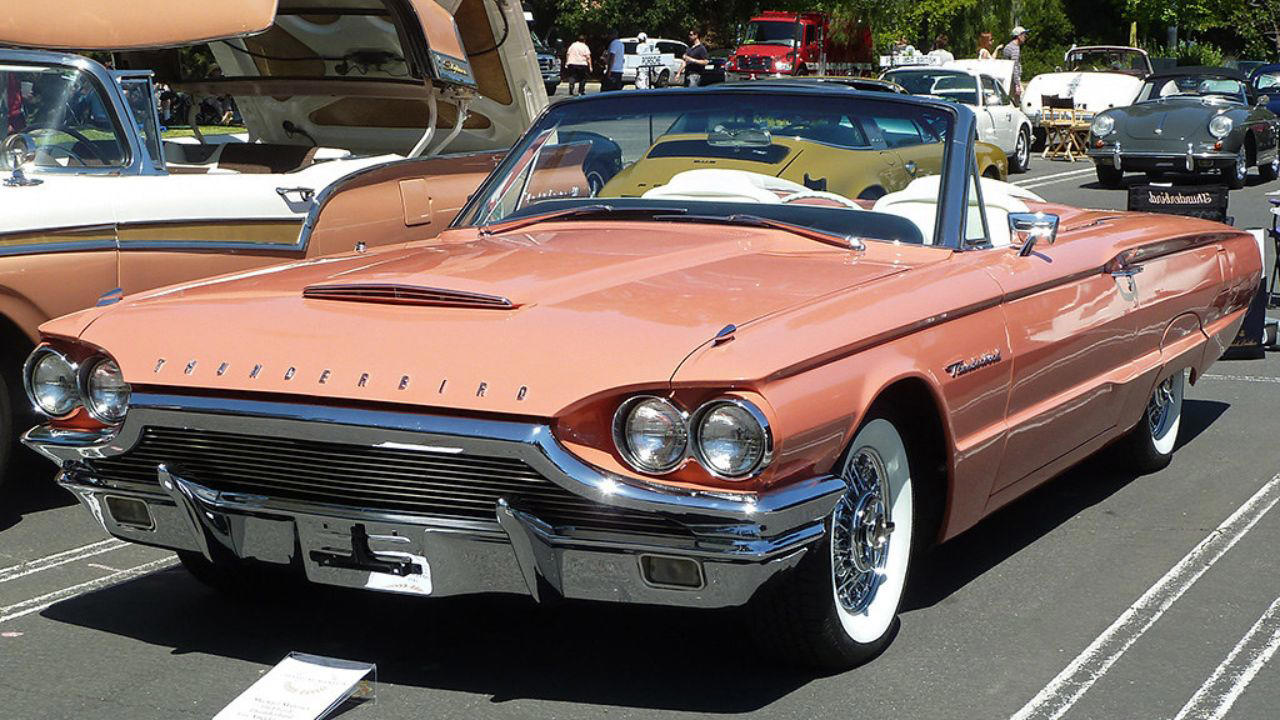


















Why the 1964 Ford Thunderbird changed directionThe 1964 Ford Thunderbird did not simply replace an outgoing model year. It redirected one of Ford’s most famous nameplates away from jet age exuberance and toward a more formal idea of personal luxury, reshaping what an American grand touring coupe could be. That change in course showed up in its sheet metal, its interior gadgets, its engineering choices, and even in how critics and buyers responded, turning the fourth generation into a case study in how Detroit adjusted to a maturing market. From rocket ship to drawing room The third generation Thunderbird had worn dramatic, almost space age bodywork, with pointed fins and sweeping curves that fit the early 1960s fascination with rockets and speed. By 1964, Ford executives judged that image to be aging faster than the customers they hoped to attract. The Company responded with what period observers described as squared off formal styling, a look that replaced the previous generation’s rocket ship aesthetics when Ford introduced its fourth generation personal luxury coupe for 1964. The new Thunderbird adopted deeply sculptured sides, a more upright profile, and prominent rectangular tail lamps that were integrated into the rear bumper, details that signaled a shift from sports car fantasy to tailored elegance. Contemporary commentary later described the car as an American original, with all new sheet metal and a bevy of clever convenience gimmicks that reinforced its move into the luxury arena, a characterization that fits the way Ford packaged the model as a distinctive alternative to both traditional sedans and pure sports cars. A low, wide statement of intent The 1964 Ford Thunderbird marked the debut of the fourth generation with a body that sat low and wide, its crisp lines and long hood making a deliberate visual break from the rounded shapes of the early 1960s. The front carried a bold egg crate grille that gave the car a more formal face, while the sides were sculpted into defined character lines that caught the light and emphasized length. At the rear, the deeply set tail lamps and the heavy bumper created a sense of solidity rather than lightness. The roofline flowed in a graceful arc that emphasized elegance over sportiness, a choice that aligned the car more closely with contemporary luxury coupes than with nimble European grand tourers. Inside, the theme continued. The cockpit wrapped around the driver with enveloping bucket seats and a dramatic console, but the emphasis was on comfort and spectacle rather than minimalism. Chrome trimmed controls, aircraft style toggles, and a sweeping dash created an environment that felt more like a high end lounge than a stripped back performance car. Engineering for comfort, not corners The mechanical package under the Thunderbird’s skin confirmed that Ford had chosen to prioritize relaxed power over razor sharp handling. Every 1964 model carried a 390 cubic inch overhead valve V8 that produced 300 horsepower at 4,600 rpm, a figure that gave the heavy coupe ample thrust for highway passing and quiet cruising. Power reached the rear wheels through a Cruise O Matic three speed automatic transmission, the only gearbox offered. That decision, to forgo any manual option, underlined Ford’s view that Thunderbird buyers wanted effortless progress rather than gear shifting involvement. The 113.2 inch wheelbase supported unibody construction with independent front suspension that used unequal length control arms and coil springs, plus a live rear axle on semi elliptic leaf springs. Four wheel drum brakes were standard for 1964, a conservative choice that favored smoothness and cost over cutting edge stopping performance. In period road tests, that hardware produced a driving experience that was smooth and quiet on straight highways but less satisfying when pushed. One influential review described the T Bird’s roadworthiness as an unpleasant adventure, even as it praised the bucket seats and the refined ride on gentler turns, a verdict that captured the car’s split personality. Gadgets and the personal luxury formula If the chassis leaned toward comfort, the cabin leaned toward theater. A popular accessory was the swing away steering wheel, which could move about 10 inches to the right when the transmission was in park, easing entry and exit and giving passengers a small show every time the driver climbed in or out. The interior layout surrounded the driver with an array of controls and instruments that were as much about visual drama as about function. Toggle switches, podded gauges, and sculpted panels created an impression of complexity and sophistication that appealed to buyers who wanted technology as a sign of status. This focus on personal luxury rather than pure performance fit a broader Detroit trend that the Thunderbird had helped start in the 1950s and was now refining in the 1960s. Ford positioned the car as a step above ordinary family sedans, a machine for executives and professionals who wanted comfort, style, and individuality in a two door package. Later updates would add more showpiece features, including sequential rear turn signals that arrived for 1965 after being intended for the program from the start, further cementing the Thunderbird’s reputation as a rolling showcase of design ideas. Sales vindication and lasting legacy The market response validated Ford’s strategic pivot. In the official production tables for the fourth generation, the figure for the Year 1964 is listed as 92,465, a number that represented nearly 50 percent growth over 1963 production and confirmed that buyers embraced the new direction. Those 92,465 cars were built at Ford’s Wixom, Michigan facility alongside the Lincoln Continental, a pairing that reinforced the Thunderbird’s move into near luxury territory. Sharing a plant with Lincoln also allowed Ford to align quality expectations and assembly techniques with its flagship sedan. Contemporary advertising and later retrospectives have continued to frame the 1964 model as a turning point. Enthusiast coverage has highlighted how the all new sheet metal, the convenience gimmicks, and the repositioning as an American original helped the Thunderbird stand apart from both muscle cars and traditional luxury sedans. Social media posts from Jan have revived that narrative for modern audiences, describing how the Ford Thunderbird of 1964 introduced a more refined and squared off design that exuded luxury and presence, and how its low, wide stance and graceful roofline emphasized elegance over raw sportiness. These contemporary reflections echo the original intent of the car and show how its visual language still communicates a clear message. Technical histories have also emphasized the continuity and change across the 1964, 1965, and 1966 model years. They note that while styling evolved only subtly after the initial redesign, the core formula of a 390 cubic inch V8 as the Thunderbird’s sole powerplant, a focus on comfort, and an interior rich with features remained intact, confirming that Ford believed it had found the right balance. The 1964 Thunderbird’s shift in direction therefore can be read as more than a simple restyle. It marked a conscious decision by Ford to define the personal luxury coupe as a distinct category, one that valued presence, comfort, and gadgetry over lap times. That formula would influence not only later Thunderbirds but also rivals from other American manufacturers, which adopted similar blends of formal styling, powerful but relaxed drivetrains, and feature laden interiors. For enthusiasts today, the car sits at an interesting crossroads. Its squared off formal styling and low, wide stance speak to a confident mid century aesthetic, while its engineering reveals both the strengths and compromises of Detroit’s approach to luxury in the 1960s. The 1964 Thunderbird changed direction by choosing to be a refined personal statement rather than a sports car, and in doing so, it helped chart a path that American coupes would follow for years. Behind the scenes, that legacy is preserved in a mix of archival road tests, factory brochures, and enthusiast documentation. Some of those materials were later collected by organizations that focus on automotive history, while others circulate through enthusiast platforms that catalog period advertising and technical data. Together, they show how a single model year, with its squared off lines, swing away wheel, and 92,465 sales, could redefine what a badge like Thunderbird was meant to represent. More from Fast Lane Only Unboxing the WWII Jeep in a Crate 15 rare Chevys collectors are quietly buying 10 underrated V8s still worth hunting down Police notice this before you even roll window down