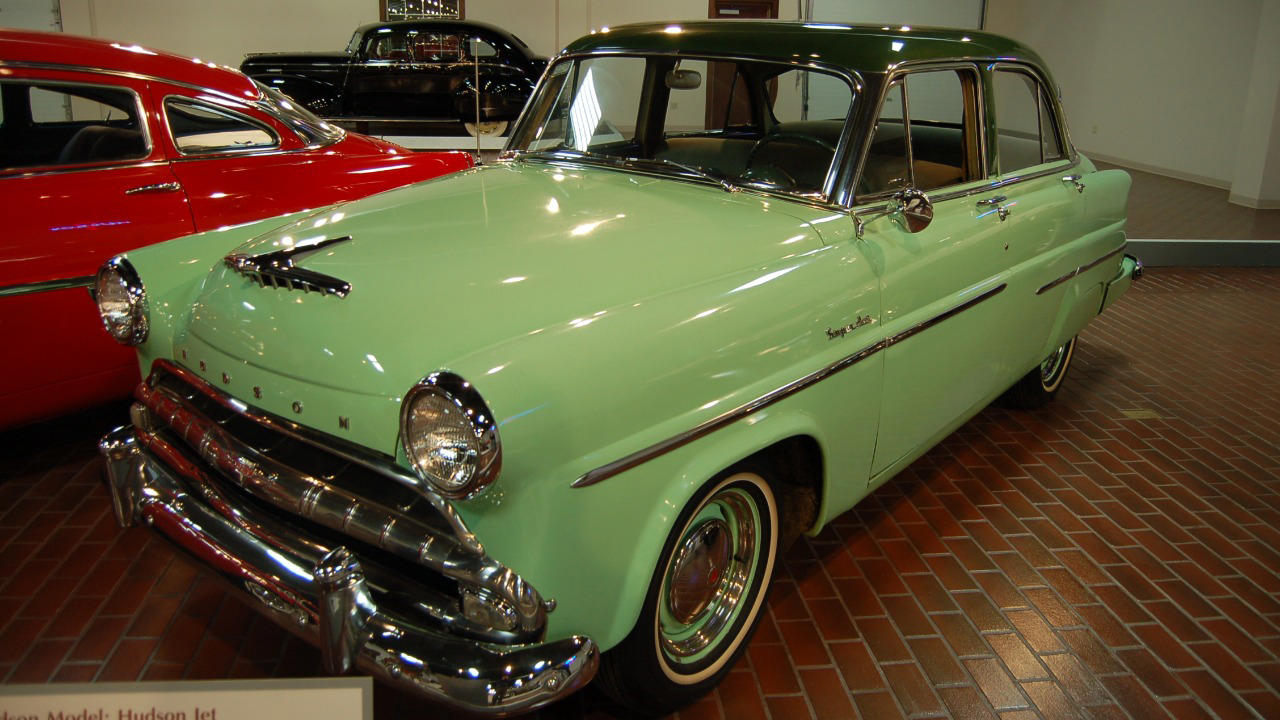



















When the 1954 Hudson Jet tried to go compact too earlyThe Hudson Jet arrived promising a compact answer to Detroit excess, yet it instead became a cautionary tale about timing, styling, and corporate survival. By 1954, the little Hudson had gained a new Jet-Liner variant and a modest refresh, but the market was not ready, the design language was confused, and the company itself was running out of road. Viewed from the distance of seven decades, the 1954 Hudson Jet looks less like a quirky footnote and more like an early, flawed attempt to anticipate the compact-car future. Its story shows how an independent automaker tried to pivot away from big sedans, only to discover that being early is not the same as being right. From step-down star to compact gamble Only a few years before the Jet, Hudson sat near the front of American automotive innovation. The company had pioneered the low-slung step-down construction, and models such as the powerful Hudson Hornet gave the brand a performance halo that enthusiasts still recall with affection, as period retrospectives on Hudson Hornet make clear. Success in big, powerful sedans did not shield Hudson from structural pressures, however. The Hudson Motor Car Company was one of several independent firms trying to compete with the Big Three, specifically General Motors, Ford, and Chrysler, as described in accounts of Hudson Motor Car. Tooling up an all-new full-size car would have required money the company simply did not have. Instead of a fresh, large Hudson, management chose a different bet. According to period summaries, Hudson “gambled” to introduce a new compact car and poured scarce capital into what would become the Jet, a decision later blamed as “the car that torpedoed Hudson” in the Hudson Jet entry. The logic was straightforward: if the company could not outspend Detroit on big iron, perhaps it could get ahead of them on small cars. Designing the Jet: conservative lines on advanced bones The Jet was introduced as a compact automobile produced by the Hudson Motor Car Company of Detroit, Michigan, with two and four-door sedans that carried the company into a new size class, as outlined in the Jet overview. Underneath, it carried some of Hudson’s best engineering instincts. The strong unitized Monobilt bodies, praised in later club histories, gave the small car a reputation for solidity that owners and taxi fleets would come to appreciate, as highlighted in descriptions of the Hudson Super Jet. Contemporary recollections describe the Jet as overbuilt for its class, with durability that encouraged hard use. Later video retrospectives on the 1954 model recount how taxi drivers considered the compact nearly indestructible and capable of enormous mileages, an image reinforced in coverage of the 1954 Hudson Jet. Yet if the structure impressed, the styling did not. Commentators have long argued that the Jet’s conservative, upright lines failed to capture the imagination in an era of chrome and flair. One assessment characterizes the car as a “torpedo in a plain beige wrapper,” suggesting that the mechanical promise sat beneath a body that looked anonymous, a view explored in detail in a Car Show Classic discussion of the Hudson Jet. Market timing and the compact that arrived before its moment Hudson’s leadership believed that a smaller, more economical car could carve out a niche, but the American market of the early 1950s still preferred full-size sedans. Club historians later concluded that there was “not yet a large enough demand for compact cars” and that sales of the Jet did not meet expectations, an assessment captured in the Unfortunately section of the Hudson Jet history. The compact segment did exist, but it was already occupied by rivals. The Nash Rambler and Willys models had established themselves, and Hudson’s entry arrived in a field where others had a first mover advantage, a comparison drawn explicitly in the same Hudson history that also notes detailed changes between the 54 and 53 model years. Without a dramatic styling hook or a low price that undercut competitors, the Jet struggled to stand out. Sales figures tell the story bluntly. Analyses of Hudson’s performance report that, as the Jet’s added production volume failed to appear, Hudson sales held around 66,000 units for 1953, with the Jet contributing only a fraction of the hoped-for growth, according to a detailed review of As the Jet. The company had spent heavily to enter a segment that was not yet mainstream, and the payoff did not arrive. The 1954 Jet and Jet-Liner: refinement on a tight budget By 1954, Hudson could not afford a radical redesign of the compact, so the Jet received only minor trim updates to its two and four-door sedans. A new luxury model, the Jet-Liner, appeared as an upscale variant within the same basic package, all of which is summarized in the Jet and Liner coverage. Interior adjustments tried to answer early criticisms. Club documentation notes that front seats were moved back 2 inches in 54 relative to 53, a small but telling response to concerns about space, recorded in the 54 53 entry. The Jet-Liner added more trim and comfort, and surviving examples, such as the car featured in the enthusiast video titled “My Grandpa’s Super Rare 1954 Hudson Jet Liner,” show how Hudson tried to give the compact a touch of premium character, as seen in the walkaround of the 1954 Hudson Jet. Hudson also tried to harmonize its broader range. Fact sheets from the period describe how, in 1954, the full-size Hudsons adopted a jet-like look, with straighter fender lines and more conventional profiles, an attempt to unify the design language that is detailed in a summary of Hudson Updates the Size Line. Instead of the compact borrowing glamour from the big cars, the influence ran in the opposite direction. Financial fallout and the road to American Motors The financial burden of the Jet program was severe. One detailed reconstruction notes that the car was developed for $16 million and generated only $29 million in sales, a gap that left little room for profit, as set out in the analysis of Flameout. For an independent already struggling to fund new full-size tooling, such an investment in a marginal segment proved punishing. By 1954, Hudson still relied on its aging step-down full-size line, since the company could not afford to redesign those larger models, a constraint that later commentators describe as a “BEST SURVIVAL STRAT” that had effectively run its course, according to a retrospective on Hudson and its Stepdown strategy. The Jet was supposed to provide fresh volume, yet instead it compounded the strain. The corporate resolution arrived in the form of consolidation. In what was described as the largest corporate merger in United States automotive history to that point, Nash and Hudson combined to create American Motors Corporation. His assistant, George Romney, became CEO, and under Romney, Nash focused on its Rambler line of small cars, a strategy outlined in the history of Nash Hudson merge. Ironically, the compact car path that Hudson had tried to pioneer would find commercial success under different management and a different badge. Legacy: from Italia dream car to enthusiast curiosity Even as the production Jet struggled, its chassis underpinned one of the era’s most striking concept-derived cars. The Hudson Italia was built on the compact Hudson Jet platform and combined American mechanicals with hand-formed Italian aluminum bodywork, a transatlantic collaboration described in detail in a feature on the Built Hudson Jet Italia. Later video presentations have called it an “American Jet wrapped in Italian metal,” a theme explored in depth in the walkaround of the 1954 Hudson Italia. More from Fast Lane Only Unboxing the WWII Jeep in a Crate 15 rare Chevys collectors are quietly buying 10 underrated V8s still worth hunting down Police notice this before you even roll window down