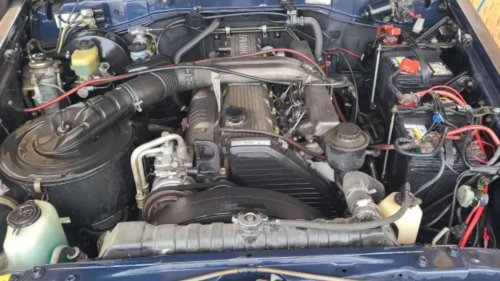






















You might well say that Toyota is one of the most forward-thinking car companies in the world, and it certainly hasn't risen to its heady heights without focusing carefully on innovation. But it's also shrewd and doesn't tend to change its approach too quickly if certain tried and true solutions are working.So, at a time when many new vehicles today champion downsized turbo engines, software-driven emission strategies, or increasingly complicated powertrains, Toyota is (selectively) looking the other way. And in certain parts of the world, it's marketing brand-new vehicles that have a dinosaur-like naturally aspirated diesel inline-six under the hood with roots that stretch all the way back to the early 1990s.ToyotaThe powerplant is the 1HZ engine, a 4.2-liter workhorse that came out well before common rail diesel injection, modern electronic engine management, and other trick solutions. It's also a piece of engineering that asks an important question of whether durability needs to be defined through software at all.After all, the 1HZ story isn't simply a case of a manufacturer using some leftover stock or channeling such engines into any niche build. Instead, the 1HZ is a part of Toyota's current production ecosystem in markets like South Africa and the Gambia, where it fits the engine to factory-new Land Cruiser 70 series variants.These vehicles find their way into utility, fleet and humanitarian slots, and they also raise an uncomfortable question for the auto business. If an engine like this was truly obsolete decades ago, why is it still on the menu today? Toyota Still Sells A 1990-Era Diesel In Brand New Vehicles Bring a TrailerWhile Toyota does not install its 1HZ engine into any mainstream passenger car, it's not merely producing it for fun or through any sense of nostalgia, and it's certainly not keeping it alive through aftermarket support. Toyota South Africa lists the Land Cruiser 79 DoubleCab 4.2D on its website, complete with the 1HZ engine, as part of an official 2026 specification sheet. It goes on to list the coded engine with its power and torque outputs and notes that it pairs with a five-speed manual transmission for that particular market.In parallel, Toyota Gibraltar Stock Holdings (TGS), which is the parent company's dedicated supply arm for humanitarian agencies, fleet operators, and NGOs, also offers multiple Land Cruiser 70 series variants with the HZJ model code. These vehicles have the 1HZ diesel engine, and this shows that the engine policy is not only a regional anomaly. Instead, it seems to be a deliberate product decision that sits within Toyota's global industrial ecosystem.However, Toyota doesn’t sell the Land Cruiser 70 Series everywhere with the 1HZ in place. For example, when it reintroduced the vehicle to the Japanese market in late 2023, it came with the newer 2.8-liter 1GD-FTV turbodiesel.If you go down to New Zealand or Australia, you'll find that Toyota has transitioned away from the 1HZ as well, due to both evolving customer expectations and emissions regulations, showing that the engine’s survival is certainly not universal.Instead, that survival does seem to be strategic, as Toyota confidently builds it and sells it in places where durability, serviceability, and regulatory allowances permit, and where the engine fully aligns with its original design intent.Fundamentally, the 1HZ is still going because it explicitly delivers what some customers require, and it's not simply a case of survival through accident or neglect. The 1HZ Thrived Before Electronics, Emissions Tricks Or Complexity Toyota South Africa Not so long ago, diesel engines could do their thing without worrying too much about emissions compliance and strict efficiency targets. The 1HZ is certainly a reminder of those times with its middle-of-the-road, but productive power outputs and internal configurations which were perfectly fine back then, even though they may be modest by modern standards. For example, you’ll only get about 129 hp at 3,800 rpm out of your 1HZ, and 210 lb-ft of torque at 2,200 rpm.Still, the numbers are only part of this story as the most defining characteristics of the engine are probably the missing ones. For example, you don't have any turbocharger to introduce heat loads or boost pressures into the chat. There’s no complex exhaust aftermarket treatment system of the kind that you’d definitely need in finicky markets. The vehicle also features a distributor-type fuel delivery system, which is fundamental from a mechanical point of view today compared to the latest electronically controlled common-rail diesels.Remember that the 1HZ is in its element when it's operating in environments where fuel quality cannot always be consistent, and, in that respect, its simplicity is not coincidental. It also works well in regions where it's tough to predict maintenance visits and where diagnostic tools can be limited or non-existent.The engine's long stroke configuration also favors low-speed torque and simple operation, while you may get less vibration and mechanical stress with such an inline-six layout compared to smaller or highly stressed engines.All this means that, from an engineering perspective, the 1HZ is conservative and durable, even if it is largely incompatible with modern regulatory frameworks. It just happens to work perfectly well for the environment Toyota places it in, where its characteristics become advantages rather than liabilities. Toyota Never Truly Replaced The 1HZ In The Places That Matter Most Toyota Gibraltar Stockholdings The 1HZ certainly looks archaic when you line it up against Toyota's 1GD-FTV turbodiesel. In the younger one, you have something with significantly improved fuel efficiency, lower emissions, and far better paper-based performance, displacing the older diesel design in most situations. But again, not all use cases will benefit from modern complexity, and that's why the 1HZ still exists. You can't accuse Toyota of ignoring the march of progress, and it clearly hasn't failed to modernize where necessary, but certain markets and uses make room for something different.Reliability is not always measured by peak efficiency or lab emissions performance. When you place your vehicle into a fleet, humanitarian, or industrial role, reliability may be measured by repairability, uptime and tolerance instead. And this is why Gibraltar-based TGS openly positions the 1HZ-equipped Land Cruiser 70 series in these environments.It knows that they are dependable and easy to maintain, and that efficiency credentials come a long way down the list of priorities. In markets that have strict emission standards, there's no question that the 1GD is mandatory. But if an engine like the 1HZ can still fulfill its original mission more effectively than a modern replacement, why not let it co-exist in markets where operating conditions and regulations permit? One Of The Oldest Engines Still Sold New And Part Of A Very Small Club Toyota South Africa Toyota's 1HZ engine is part of a very small and shrinking group of engines where you can trace its origin back more than three decades while still fitted to a factory new vehicle by its original manufacturer. The Cummins B-Series inline-six family may be one example today, but while the core engine layout is decades old, you're still looking at heavy modifications in its current 6.7-liter guise. Meanwhile, the 1HZ first appeared in Land Cruiser lineups in 1990 and today it's instantly recognizable by reference to its output architecture and operating philosophy.Other long-running engine families have tended to go through continuous redesign, while keeping the same name, but in the case of the 1HZ, you're looking at essentially the same thing through the decades. Heavy-duty pickup and commercial applications that may favor long-lived engines certainly exist throughout the global market, but again, few of them have been so mechanically honest for so long, and especially in passenger-derived vehicles. Why The 1HZ Still Matters Toyota Gibraltar Stockholdings With the 1HZ, Toyota reminds us that engineering decisions can sometimes be context-dependent. Certainly, complexity is typically unavoidable in the modern era, but here, Toyota has chosen to preserve a tool that is arguably better than many modern alternatives due to the environment in which it works and the reasons that matter to most of its users. The story also suggests that Toyota probably perfected and proved this concept decades ago and has certainly resisted the urge to overcorrect itself since then.While the 1HZ may not be fast, efficient, or clean by modern-day standards, it's surely understandable, resilient, and dependable. And as the world today seems to move relentlessly from one type of technology to the next, the engine’s tenacity alone makes it quite extraordinary.