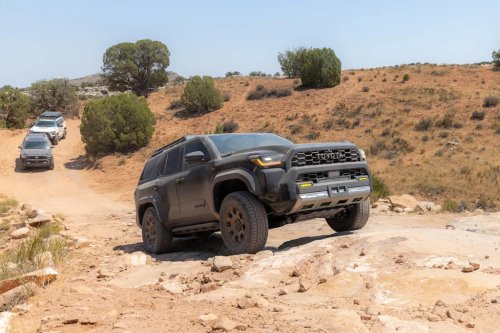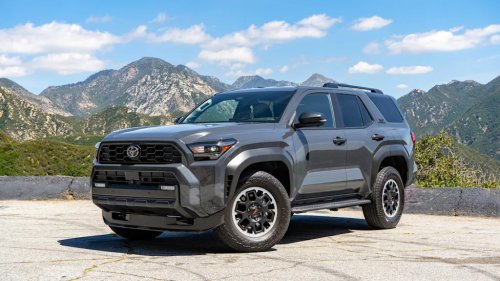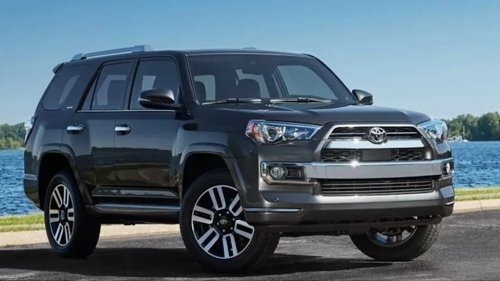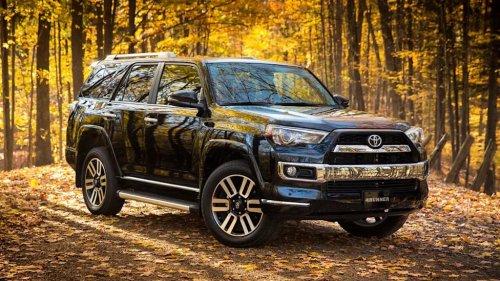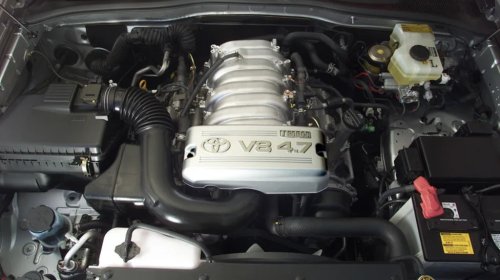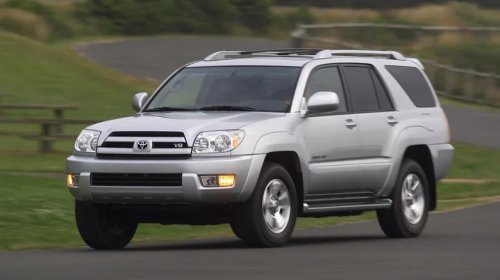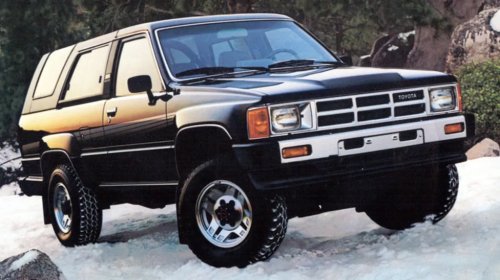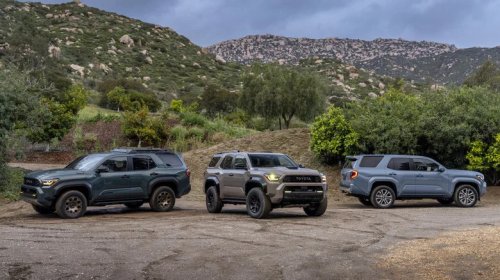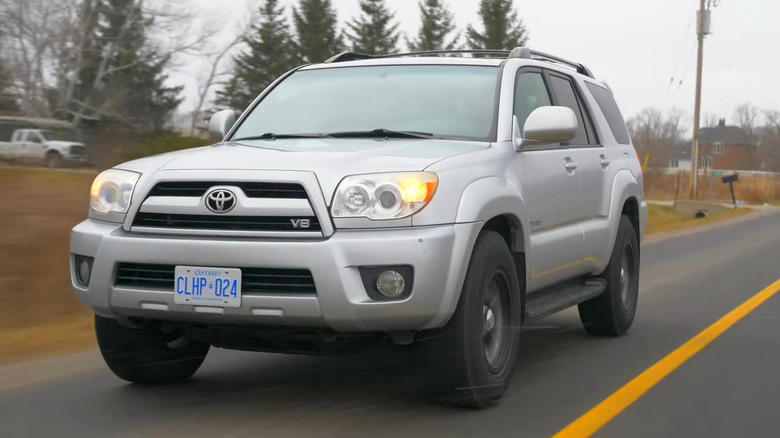
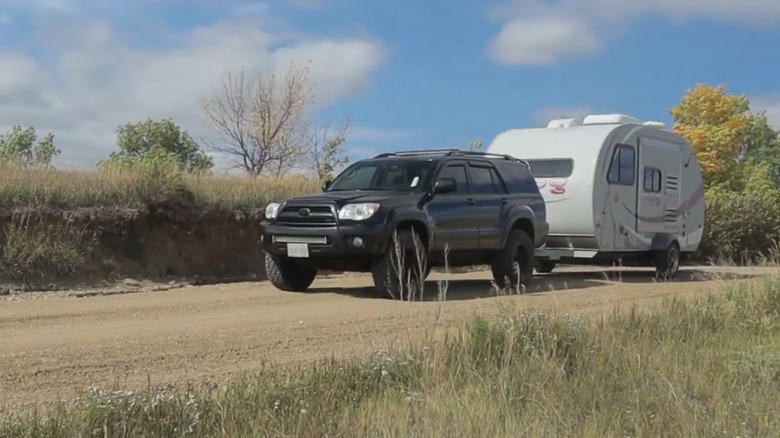
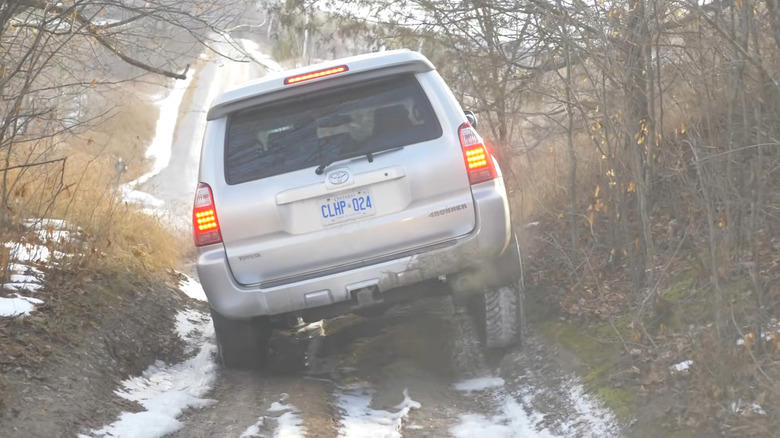



















A fourth-generation V8 Toyota 4Runner driving on the road - Throttle House/YouTubeThe Toyota 4Runner may be old, but it holds a special place in gearheads' hearts. That's especially the case for fourth-generation models built between 2003 and 2009, which left the factory with two extra cylinders under their hoods. Today, off-road enthusiasts are ready to spend upward of $25,000 for a clean fourth-generation V8-powered 4Runner. One big reason for its popularity is that it is the nameplate's only generation to feature a V8 engine — and not just any V8, but Toyota's legendary 4.7-liter 2UZ-FE. If the code sounds familiar, it's because this iron-block powerhouse earned a reputation for being indestructible.Also featuring under the hood of the Land Cruiser, Sequoia, and Tundra, this engine family is famous for being able to reach seven-figure mileages with original internals and nothing more than routine maintenance. Early V8 4Runners pushed a healthy 235 hp while 2005 and newer model years, equipped with Toyota's VVTi variable valve timing, bumped that figure to 270 horsepower and 320 lb-ft of torque. It's not just about the numbers, either. Start up a V8 4Runner, and you get a deep mechanical growl. With a nice aftermarket exhaust system, this symphony becomes similar to an old-school American V8 muscle truck.Read more: 8 Underrated V8 Engines That Deserve More AttentionThe V8 4Runners featured 4WD and more towing muscleA fourth-generation V* Toyota 4Runner towing a camper - Canadian Gearhead/YouTubeThe second major reason enthusiasts are scrambling for these 4Runners lies in their capability. The fourth-generation V6 4Runner is a fine SUV, but it was limited by its hardware. Sure, aTorsen center differential was standard with all engine variants, but while the V6 versions featured multi-mode four-wheel-drive (4WD) with the ability to send power to just two wheels (2WD) to save on fuel, V8 4Runner buyers had to choose between 2WD or a full-time 4WD system. Still, if you went for the V8, you got the more capable workhorse.AdvertisementAdvertisementA standard fourth-generation 4Runner is usually rated to pull up to 5,000 pounds, and can typically tow a couple of jet skis or a small utility trailer. The V8 4Runner, with a frame-mounted weight-distributing hitch receiver, can tow up to 7,300 pounds with 2WD or 7,000 pounds with 4WD. That's more than what the 2025 4Runner can tow. For many owners, this is a game-changer, allowing them to tow anything from a camper to a boat or a flatbed with their family SUV.Scarcity and used market economicsA fourth-generation Toyota V8 4Runner driving on an off-road trail - Throttle House/YouTubeHere's the catch, though. Toyota killed off the V8 engine option when the fifth-generation 4Runner arrived for the 2010 model year, offering only four-and six-cylinder options since. The pool of clean, surviving examples is shrinking by the day. As a result, the 2003-2009 4Runners represent a unique, historical golden era, making them quite expensive.Finding a good, clean example today can seem like hunting for a unicorn. Most V8 4Runners on the used car market show 200,000 or even 300,000 miles on the odometer. While the engines could still feel fresh despite the astronomical mileage on them, the rest of the truck still takes a beating. Enthusiasts looking at one of these need to watch out for frame rust, which can severely compromise the vehicle's structural integrity, especially if it's from the salt-belt states. The other thing fourth-generation 4Runner buyers need to watch out for is timing belt issues. The 2UZ-FE uses a timing belt rather than a timing chain, meaning you need to verify if it was changed every 90,000 miles. Another common and pricey issue is the air injection pump failure, which can put the ECU into limp mode. The fourth-generation 4Runner also suffers from cracked exhaust manifolds, which leads to nothing more than a loud ticking sound. AdvertisementAdvertisementDespite these potential issues, the demand for the V8 4Runner seems to be skyrocketing. This bulletproof SUV is a shining example of Toyota's overengineering phase, built right before giant screens and overcomplicated driving aids took over vehicle cabins. But, in case you are sick of overpriced Toyota 4Runners, there are definitely other capable SUV options on the used market, too.Want more like this? Join the Jalopnik newsletter to get the latest auto news sent straight to your inbox, and add us as a preferred search source on Google.Read the original article on Jalopnik.