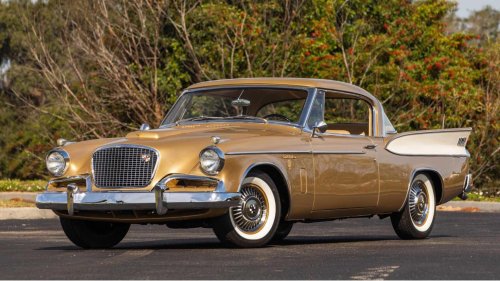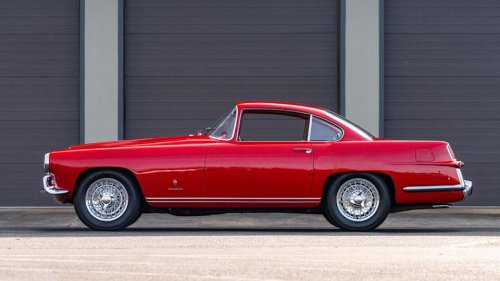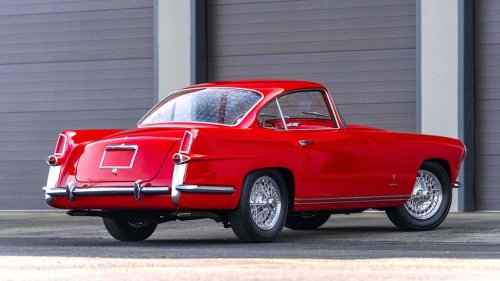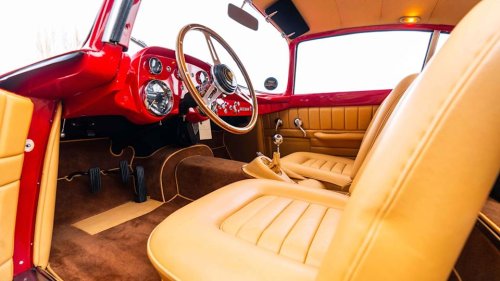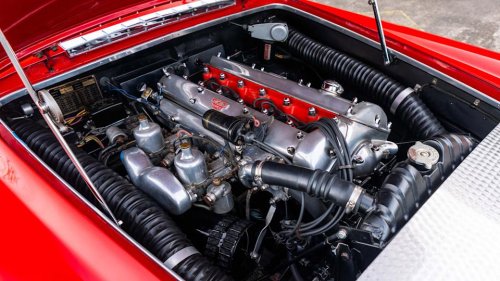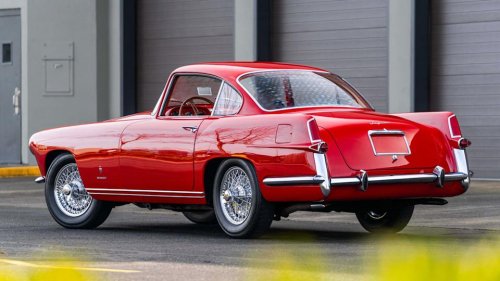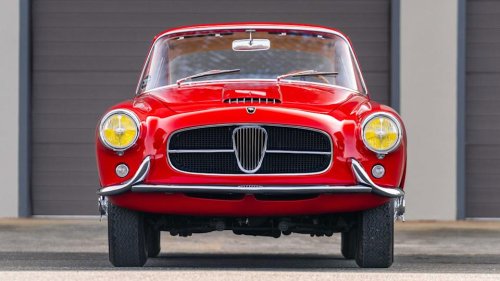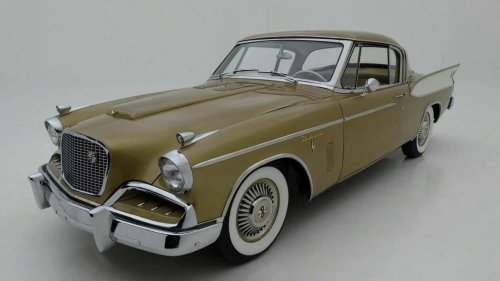
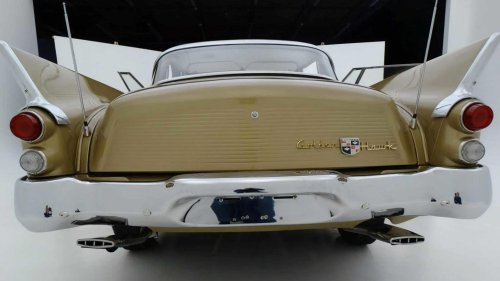
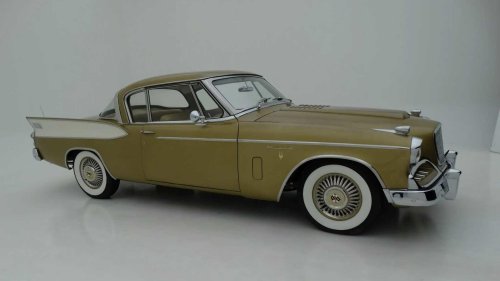
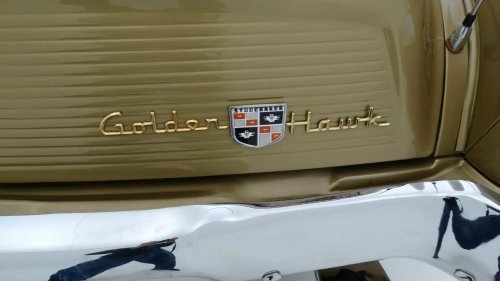
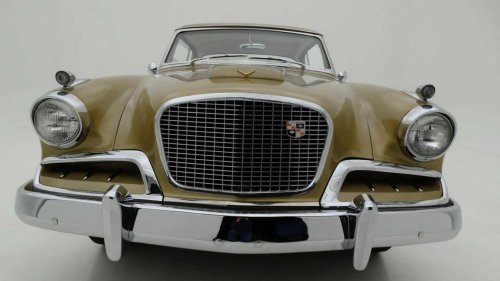
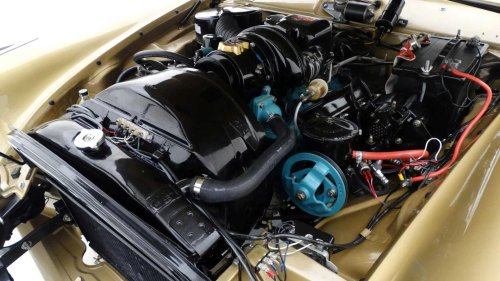
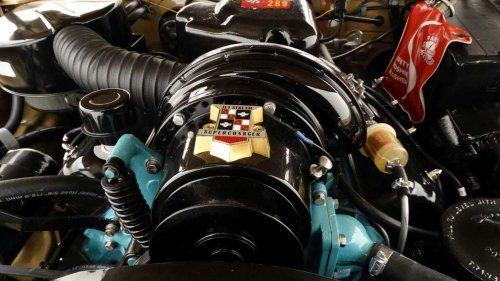
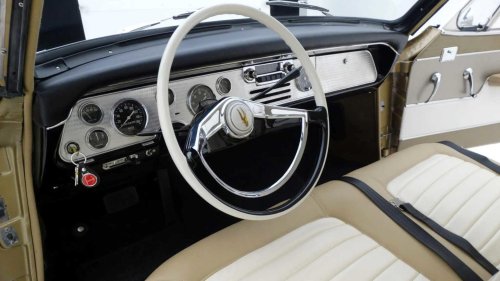
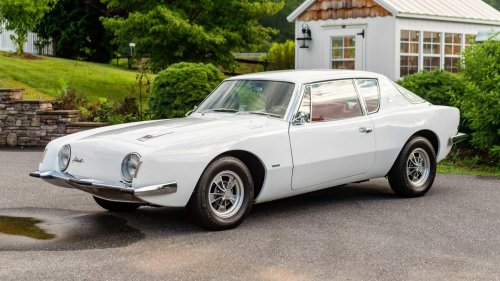
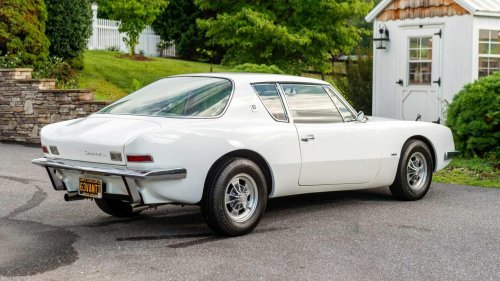
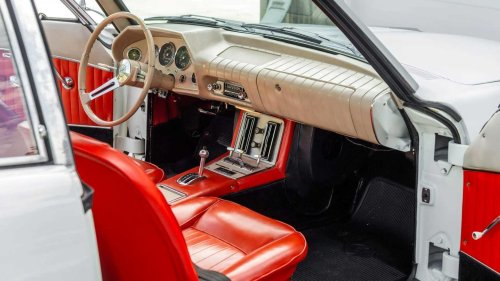



















Jump LinksStudebaker Golden Hawk Key PointsThe Studebaker Golden Hawk's DesignJust after the close of World War II, the automotive industry began to undergo several major changes. One of the then-new developments was a move away from the old-school, high-fendered, tall styling of yesteryear into a sleeker, smaller, and lower-slung era. Around the same time, the sports car as a concept was born, with models like the Jaguar XK120 entering the fold in 1948 and the C1 Chevrolet Corvette, which came about in 1953.Speaking of the Corvette, its release marked a period of sped-up advancements in automotive design, especially within the United States. Carmakers that still clung to the old-school styling, such as Nash and Hudson, were quickly being pushed into the proverbial irrelevance corner, as the larger American automakers were embracing the new, sleek '50s styling gripping the nation. One such American marque, called Studebaker, decided to take things a step further.Not only were they interested in building a car to compete with the Chevy Corvette, they were also keen to be seen as forward-thinkers in terms of design. So, with a fighter jet as their muse, Studebaker came up with one of their next – not to mention one of their final – sports cars: the Golden Hawk. Fighter Jet Looks With A Supercharged Engine Bring A Trailer Studebaker Golden Hawk Key Points Introduced in 1956 Based on the standard Studebaker Hawk Featured a supercharged engine Boasted some fiberglass body panels Discontinued following the 1958 model year While Studebaker is a somewhat forgotten brand these days, it was once one of the most popular automakers in the United States. The brand's claims to fame were few, but important, in the overarching history of the automobile. The South Bend, Indiana-based manufacturer traces its roots all the way back to 1857, before the American Civil War. After making a successful transition from building horse-drawn carriages and wagons at the dawn of the 20th century, Studebaker became one of the more popular car brands in the States for quite a few decades.During the height of the Second World War and just after, Studebaker was heavily invested in advertising for and encouraging women in the workforce, as much of its industrial might during World War II was built on the backs of thousands of working women. Studebaker was also known for its attention to detail and overall build quality. Reportedly, Studebaker's keen eye for detail and a knack for building well-made cars rivaled even Cadillac, at a time when the famed American luxury brand was known as "The Standard of the World".Bring A Trailer When the Chevrolet Corvette first hit the streets in late 1953, few folks bothered to turn their heads. This was mainly due to its lackluster engine, a piddly six-cylinder with only 150 horsepower. However, come 1955, the 'Vette gained a small-block V8, and sports car fever quickly spread throughout the US. Several automobile manufacturers were interested in jumping on the sports car bandwagon, including Studebaker. So, in 1956, they released the Hawk.Bring A Trailer The new Studebaker sports car came with a choice of four grades, beginning with the base "Flight Hawk". There was also the Power Hawk and the Sky Hawk, with the Golden Hawk taking the top-of-the-line spot. On top of a number of luxurious amenities, special color combinations, and tweaked styling, the Golden Hawk also received a significant power boost with the addition of a supercharged engine. With this blown mill, the Golden Hawk was well-equipped to compete with Chevy's finest. The Studebaker Golden Hawk's Design Bring A TrailerBeginning in the early 1950s, an interest in the Jet Age began to mount among the American population. The Space Race, fought between the United States and then-Soviet Russia, was beginning to heat up. Jet-powered commercial aircraft were quickly becoming commonplace at this time, as well. This new age was reflected in automobile design, with nearly every American automaker incorporating some sort of airplane-inspired styling into their models. Studebaker was no exception.Bring A Trailer Their Hawk-line of sports cars derives much of its styling from the North American F-86 Sabre, a fighter jet produced by North American Aviation. It saw much of its use during the Korean War, fought by the US between 1950 and 1953, and spent most of its time battling MiG-15s, Russia's then-prized fighter aircraft. The Hawk's low, slung profile and swept tail fins were the most glaring examples of the fighter jet-based styling, along with its low-slung front end featuring a prominently tall and narrow grille, along with a thin bumper line. Detailed Specs, Features, And Current Pricing Bring A Trailer Living underneath the Golden Hawk's hood was a 289-cubic-inch V8 of Studebaker's own design, replacing a Packard-built 352-CID V8 that was seen in the Hawk sports car lineup in 1956. Along with the new motor came an important piece of power-making kit: a supercharger. The blower was built by a company called McCulloch, and managed to increase the small V8's power considerably. Despite its much smaller size, the Studebaker V8 was just as powerful as the replaced Packard mill.Bring A Trailer A pair of transmission options were on offer for the Golden Hawk. The standard gearbox was a three-speed, overdrive-capable manual transmission built by BorgWarner, with a two-speed automatic coined the "Packard Twin Ultramatic". Being a car from the 1950s, the Golden Hawk took advantage of a rear-wheel-drive drivetrain configuration, much like every other American car built at the time. Its suspension consisted of front coil springs and rear leafs, and stopping was taken care of courtesy of a set of drum brakes.We'll lay out the Studebaker Golden Hawk's detailed engine and performance specs in the table below:*Specs courtesy of Supercars.netBring A Trailer Being the top-of-the-line model, Studebaker outfitted the Golden Hawk's interior with as many creature comforts and luxuries as it could. For starters, the Golden Hawk treated owners to things like a center console – a feature not often seen in those days – and a padded dashboard. Other luxuries included a vacuum supercharger output gauge, a 160-mph speedometer, and a full set of Stweart-Warner dials set into its instrument cluster. Vinyl seating surfaces were standard, with leather seats being an option. The Golden Hawk Wasn't The Last Studebaker Sports Car Bring A TrailerThough it was close. The true, final Studebaker sports car was introduced in 1962. It only saw two years of production, having received the axe following the 1963 model year. Without needing to give it much thought, it's easy to see how much of a leap Studebaker made in terms of its styling between the exit of the Golden Hawk and the introduction of the Avanti. Gone were the classic, American looks and jet-age styling, replaced with a much more reserved, European countenance.Bring A Trailer However, things were much more American underneath the hood. The Studebaker 289 CID motor made a comeback, and the MucColloch supercharger was still offered as an option. Reportedly, the Avanti even managed to secure the fastest car in the world title briefly, following a top-speed run at Bonneville Salt Flats where a supercharged "R2" model achieved 170 mph. Its record was taken from it in 1967, when a Lamborghini Miura reportedly managed a top speed of 174 mph.Bring A Trailer While we can look back on the Studebaker Avanti as a handsome sports car, albeit with a slightly-too-boxy front end, American automobile buyers in the early 1960s simply were not impressed by its European-inspired design. While the Corvette managed to sell over 23,000 times in 1963, the Avanti didn't even manage 10 percent of that. The Avanti's creator and Studebaker president, Sherwood Egbert, planned to sell 20,000 Avantis in 1962, but could only manage to shift 1,200.Following the Avanti's axing in 1963, Studebaker only managed to hold on as a company until 1968, when it was rendered defunct. While the Avanti wasn't much of a success, the Golden Hawk did manage to secure itself a place among the best that the 1950s American automotive industry had to offer.