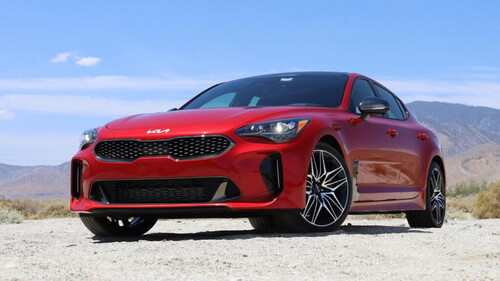
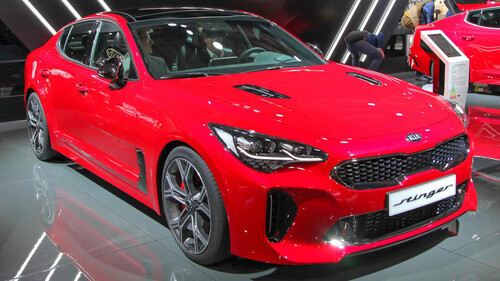
Autoblog and Yahoo may earn commission from links in this article.Don’t you forget about me.Car enthusiasts tend to have really good memories when it comes to some of the most memorable and powerful performance cars to grace the earth, but they also have some pretty glaring blind spots for others. While flagship go-fast vehicles get the big spectacle and marketing budgets and attention, some true engineering marvels are often left forgotten in showrooms and at auctions. This pattern across the industry has left behind a graveyard of capable vehicles that most people could not identify today. Nonetheless, these cars never got their flowers, and that's a shame, because every single one of them had something real to offer.So consider this a long-overdue tribute to five cars below that weren't perfect. Some cars on this list were affected simply by timing, others by badge snobbery, and a few by both. But, they were all more interesting than history gives them credit for. If you ever spot one at a car show, a used lot, or rusting in someone's driveway, take a second look. These are the kind of cars that not only slipped away, but takes some advanced “ball knowledge” to truly know, as the kids say.FordView the 3 images of this gallery on the original articleFord Mustang Mach 1 (1969–1970, 2003–2004, 2021)On paper, the Mach 1 should have been a legend. Ford's performance-focused Mustang fastback debuted in 1969 with a standard 351 Windsor V8 pushing 250 horsepower, with optional upgrades that included the thundering 428 Cobra Jet; a motor that could get the car to 60 mph in the low six-second range and through the quarter mile in the high 13s. It looked the part too: a blacked-out hood with a shaker scoop, iconic side stripes, and a fastback roofline that made the standard Mustang look like regular traffic. It was the real deal and it proved to be a hit. In 1969 alone, Ford sold over 72,000 Mach 1s. .AdvertisementAdvertisementHowever, the problem was that by this time, the Mach 1 was overshadowed by the Boss 302 and Boss 429. The Bosses were built to meet homologation variants and had actual motorsport pedigree; they were race cars you could register for the road. On the other hand, the Mach 1 was pitched as a sport-luxury cruiser in the middle, rather than a pure fighter. When Ford revived the nameplate in 2003 for the New Edge Mustang era, the story repeated itself. That version made a solid 305 horsepower from its 4.6-liter V8, handled better than the standard GT and came loaded with Cobra-sourced suspension bits. However, for just $5,000 more, the SVT Cobra made 390 horsepower from its supercharged V8.After a 17-year hiatus, the Mach 1 name was revived in 2021 to fill in the slot left behind by the discontinued Shelby GT350. The latest iteration of the Mach 1 was a track-focused S550 engineered to bridge the gap between the standard GT and the screaming GT500. ITo achieve this, Ford raided the Shelby parts bin for various bits, including the intake manifold, oil filter adapter, engine oil cooler, and front and rear subframe from the Shelby GT350, as well as the rear axle cooling system, rear toe link, and rear diffuser from the more powerful Shelby GT500. Although the addition of Shelby parts made it seem like a promising package over the GT, the truth is that the ‘21 Mach 1 made just 20 more horsepower than the GT, while costing over $12,000 more. What’s more, buyers who were set on buying the ultimate Mustang turned to the $74,095, 760-horsepower Shelby GT500.STAN HONDA/AFP via Getty ImagesPontiac G8 GXP (2009)If there is a car on this list that has suffered from a case of bad timing, there is the Pontiac G8 GXP. Introduced for the 2009 model year, it was a rear-wheel-drive, Australian-built sports sedan packing a 6.2-liter LS3 V8 borrowed from the Corvette, good for 415 horsepower and 415 lb-ft of torque and a zero to 60 time of around 4.5 seconds. It could be optioned with a six-speed stick, but it already came standard with a limited-slip differential, Brembo brakes, and tail-happy handling derived from its Holden Commodore bones. By any objective measure, it was the most exciting car Pontiac had built in a generation possibly ever.However, the year was 2008, and General Motors wasn’t exactly doing so good. To make things short and free from advanced financial jargon, Uncle Sam had to step in with a multi-billion dollar life raft as the company barreled toward a messy Chapter 11 bankruptcy filing in June 2009. As part of this government-mandated "restructuring,” GM was forced to trim the fat and let go of assets it couldn’t keep propping up. Unfortunately for enthusiasts, Pontiac, Saab, Hummer and Saturn was deemed "fat,” and were unceremoniously sent to the great scrapyard in the sky.AdvertisementAdvertisementAs a result, the G8 GXP was sold for exactly one model year before the whole brand was shuttered in 2009. Pontiac made around 1,800 GXPs, making it extraordinarily rare today, but also meaning it never had any time to build a reputation or a following while it was still on sale. Buyers who might have considered it were spooked by the collapse of GM and the uncertainty around parts, support, and resale value. The car that should have been Pontiac's comeback act, but became its eulogy instead. Ironically, GM tried this same formula just a few years later with the Chevy SS, which was essentially the same platform (Holden Commodore) sold under a different badge.Volkswagen Corrado (1988–1995)The Volkswagen Corrado was ahead of its time in ways that the market simply wasn't ready to appreciate. Built on the Golf platform but stretched into a sleek, low-slung sport coupe, it launched in 1988 with Volkswagen's supercharged 1.8-liter G60 engine, which made around 160 horsepower. However, VW introduced a real party piece in 1992 when it stuffed the narrow-angle VR6 under the hood; a 2.8-liter six that made 178 horsepower and turned it into something special. Apart from an unmistakable sound, the unique motor allowed the Corrado VR6 go from zero to 60 in around 6.7 seconds, all the way up to a top speed of 143 mph. Notably, the Corrado VR6 it did it all with a kind of sophistication and refinement that most hot hatches of the era couldn't touch; featuring advanced tech like an automatically deploying rear spoiler in 1992.However, VW fans had to pay up for this kind of magic. The Corrado VR6 carried a base price of $21,840 in the early ‘92; a considerable sum for a Volkswagen when Vee-Dub buyers could pick up a Golf GTI with the bigger 16-valve for under $14,000. To make matters worse, other sports car buyers had a lot of choices for under $22,000, including the Toyota MR2 Turbo (SW20), the Mazda Miata, Ford Mustang GT.To put things into perspective, that year’s BMW 3-series was $23,275. Despite also being German, VW's brand cachet in the US wasn't strong enough to justify the premium in buyers' minds. As a result, sales were modest throughout its production run. Only about 97,000 were built globally across seven years, and the US got a fairly small slice of those. It was quietly discontinued in 1995, replaced in VW's lineup by the VR6-equipped Golf GTIs that didn’t exactly match the Corrado's visual drama or mechanical uniqueness. Today it has a devoted cult following among Volkswagen fans, but during its actual production life, it was a car that buyers ignored.AdvertisementAdvertisementView the 4 images of this gallery on the original articleMazda 323 GTX (1988–1989)Throughout its storied history, Mazda has made some vehicles that would be on any list compiling some of the most legendary Japanese sports cars. In their own right, Mazda have been pioneers of enthusiast-grade vehicles. These include cars like the RX-7, RX-8 and the Cosmo, which have revolutionized wankel-rotary engines for high performance applications. In addition, the humble MX-5 Miata is Mazda’s own tribute to British roadsters from marques like Triumph, MG and Lotus; continuing the 20th-century tradition across four generations.However, the Mazda 323 GTX doesn't have the same level of attention, and it’s trifling. Introduced in 1988, the 323 GTX was a compact all-wheel-drive turbocharged hatchback that Mazda built to homologate for FIA Group A international rally competition in the late 1980s. It packed a 132-horsepower, 1.6-liter turbocharged four-cylinder that powered a package that weighed under 2,300 pounds and sent power to all four wheels through a sophisticated AWD system that could actively vary torque distribution between front and rear axles.The result was a car that could reach 60 mph in less than 9 seconds and, more importantly, could eat up corners with ease. In a May 1988 review, contributors for Car and Driver, had nothing but praise for the GTX, with contributor Arthur St. Antoine calling it “the most entertaining and capable snow-tamer ever to sneak under the $15,000 barrier,” while Nicholas Bissoon-Dath called it a “pint-size Audi Quattro clone.” Mazda sold the GTX in the US for only two model years, 1988 and 1989, and sales numbers barely moved the needle; selling only about 1,200 between both model years.AdvertisementAdvertisementPart of the problem was that it looked identical to the standard 323 hatchback, it had no aggressive body kit, no flared arches and no visual drama to signal that it was something special. As a result, the 323 GTX’s base price of $12,999 was a hard bargain for some. Worst of all, at the time, Mazda was known as a value brand; its ambitious motorsport program was virtually unknown outside of Japan. But, before Subaru made the Impreza WRX and Mitsubishi made the Lancer Evolution, Mazda pioneered the small, lightweight, AWD turbo formula that would define a competitive segment of Japanese performance cars and send Mitsubishi and Subaru to global success.KiaView the 5 images of this gallery on the original articleKia Stinger GT (2018–2023)The Kia Stinger GT might be the most recent entry on this list, but it was forgotten at a remarkable pace given how capable it actually was. Developed under BMW's Albert Biermann, the man responsible for the M3 and M5, the Stinger GT arrived in 2018 as a rear or all-wheel-drive grand touring fastback that copied the German DNA. Under the hood was a twin-turbocharged 3.3-liter V6 making 365 horsepower and 376 lb-ft of torque. This made it good for zero to 60 in 4.7 seconds and a top speed of 167 mph. In addition, the GT also got adaptive dampers, a limited-slip differential, Brembo brakes, and a Nurburgring-tuned chassis. For around $52,000, it was cheaper than comparable offerings from BMW, Mercedes, and Audi while matching them in most performance metrics.But despite all the features that made the Kia Stinger GT a cool performance car, there was one thing that really held it back from being taken seriously badge snobbery is a real thing and it hurts. Beyond the enthusiast market, a significant portion of the buying public simply couldn't get past the Kia logo on a car that cost fifty grand, regardless of what the car was actually capable of. The Stinger GT earned glowing reviews from critics, but sales never caught up with the praise; buyers in the segment kept defaulting to German rivals with more familiar prestige. Kia discontinued the Stinger after the 2023 model year, citing slow sales in a market that had pivoted hard toward SUVs.The Ones That Got AwayWhat connects all five of these cars isn't a lack of quality, it's a lack of luck. They were either outshone by flashier siblings, killed by corporate decisions, priced into uncomfortable territory, or faced with brand perceptions that buyers refused to move past. In every case, the car itself was doing everything right, and the market failed to pay attention.AdvertisementAdvertisementThe good news is that history has a way of correcting itself, at least partially. Today, many of these overlooked machines have finally found their audience thanks to social media, internet forums and internet communities that have sung the praises of these unsung machines. In turn, these cars have earned the status of modern classics among dedicated enthusiast followings that celebrate their unique engineering and character.This story was originally published by Autoblog on May 11, 2026, where it first appeared in the Features section. Add Autoblog as a Preferred Source by clicking here.