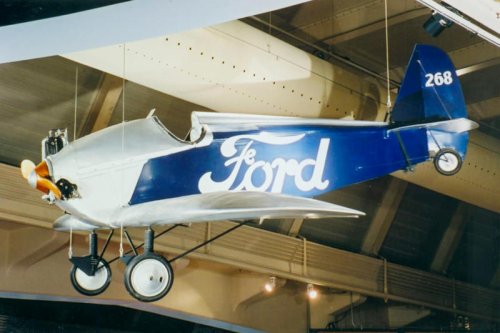
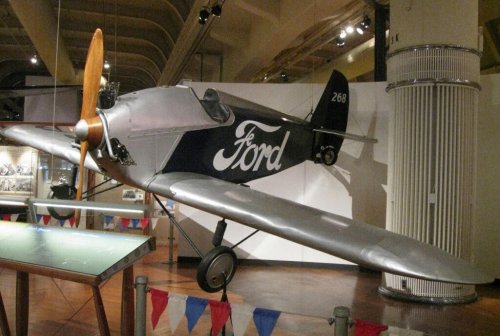
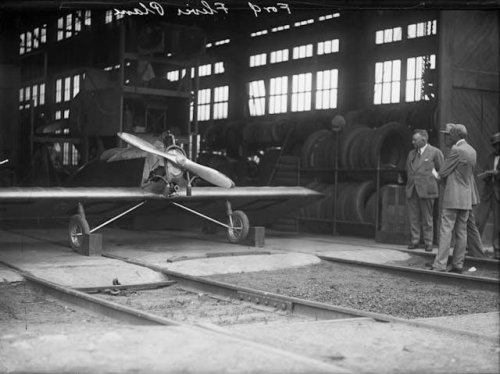
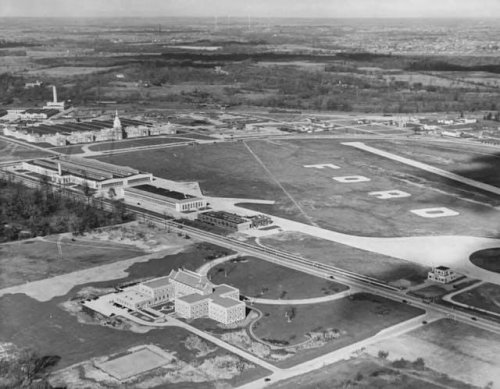
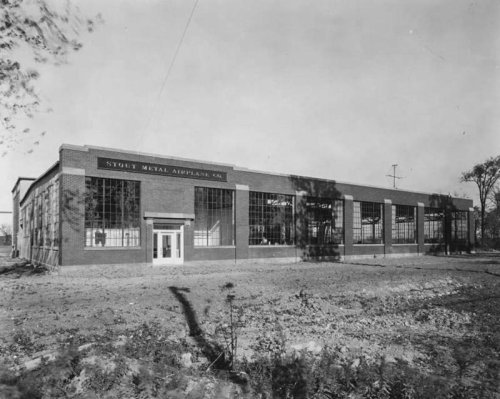
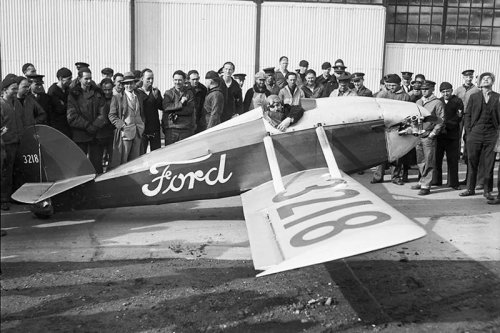
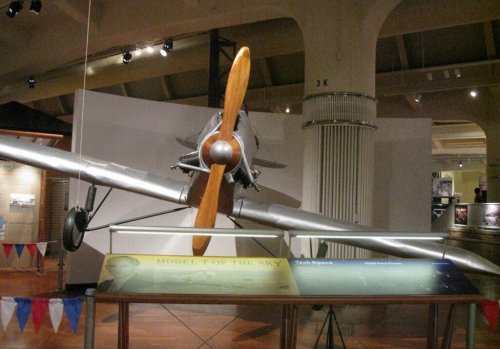
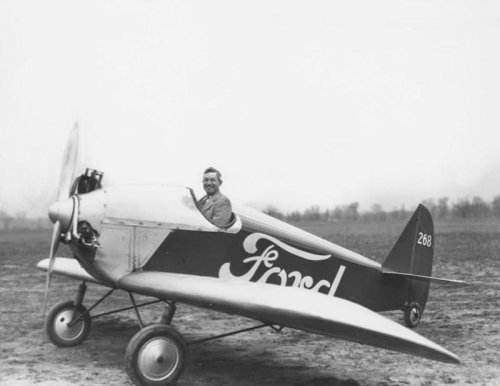
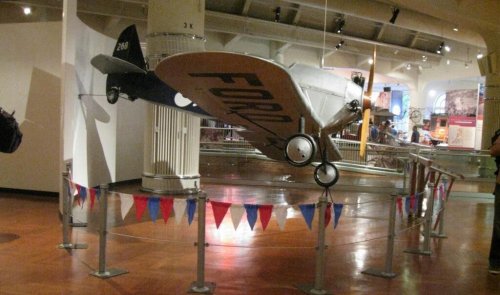
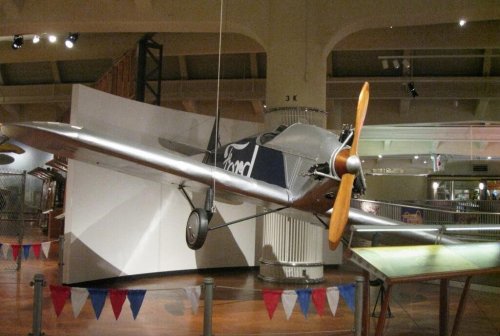
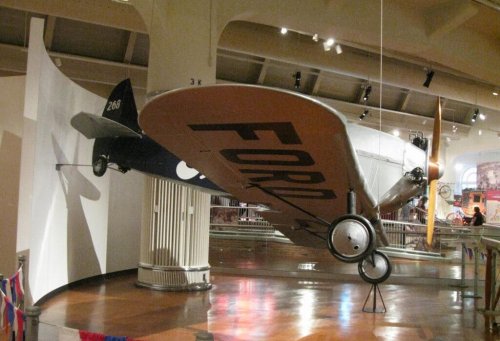
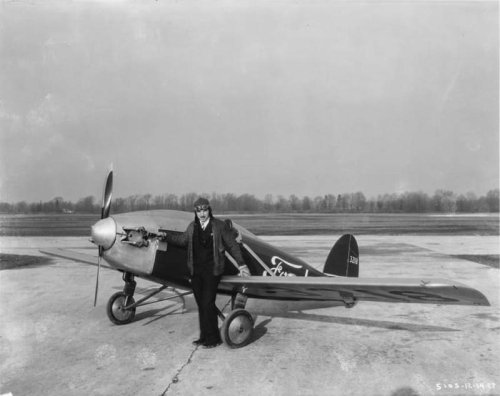
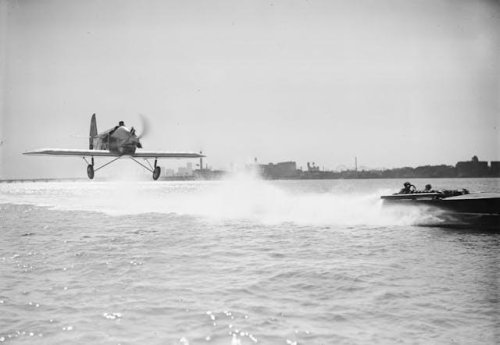
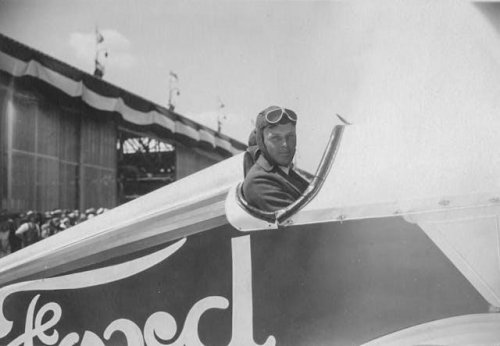
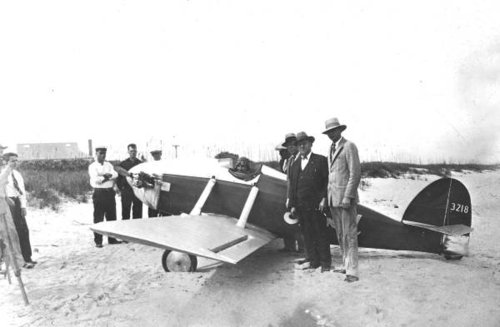
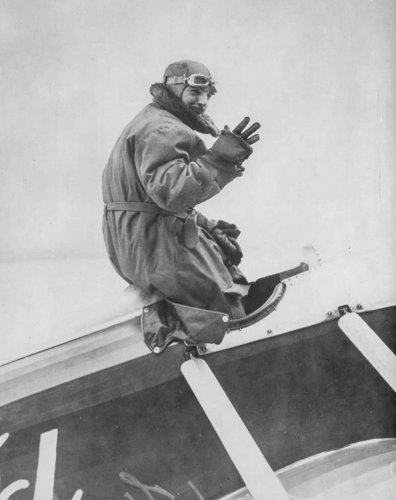
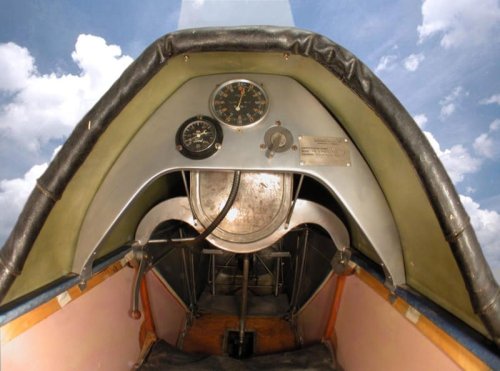
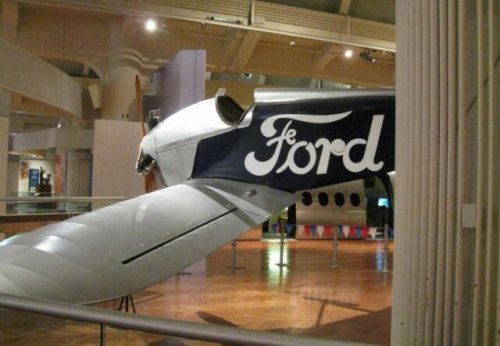


















The Tragic Tale of the Flying Flivver, Ford’s “Model T of the Air” You probably know that Henry Ford put America on wheels with the Model T. What you might not know is that the automotive pioneer had a significant role in the development of commercial aviation. Under chief designer William Bushnell Stout (who also designed the Stout Scarab) and manager William Benson Mayo, Ford’s aircraft division, Stout Metal Airplane Company, had introduced the Ford Trimotor, one of the first successful commercial passenger and cargo airliners, in 1925. Ford also lobbied regional and local governments to build airports, just as he had earlier lobbied for intercity roads. While the Trimotor was a commercial aircraft, Ford wanted to do with aviation what he had done with automotive transportation: make it accessible and affordable to the average person. He proposed what he referred to as a “Model T of the air,” a small, inexpensive, single-seat airplane. It appears that from the outset, Ford called the little plane the “Flivver,” or “Sky Flivver,” playing off one of the Model T’s nicknames. Logically, since he owned an aircraft manufacturing company, Ford turned to Stout and Mayo, men with substantial aeronautical experience. Henry Ford (with arms folded) and Flivver #1. The Henry Ford They declined, perhaps due to safety reasons. Undeterred, Henry moved the project to a building shared with the Ford Museum in the Ford Laboratories complex in Dearborn. In charge of designing the plane was a young aeronautical engineer named Otto Koppen who had trained at MIT. After earning his degree, he enlisted in the U.S. Army Air Corps (the predecessor to the U.S. Air Force), where he served under Jimmy Doolittle, who later became famous for the audacious raid on Tokyo with carrier-based bombers during World War II. After four years, Koppen left the service when he discovered, after a flight, that his parachute was faulty. If he had tried to bail out, he would have fallen to his death. Once discharged, Koppen was hired at the Stout company. Ford Airport. You can see The Henry Ford Museum’s replica of Independence Hall’s Tower in the upper left. The airfield is now the site of one of Ford’s test tracks. The Henry Ford There Koppen was assigned the task of designing a tail wheel for a revised version of the Trimotor. The originally Trimotor was a “tail-dragger,” with a skid in back, not a wheel. Apparently, Henry Ford was displeased that the Trimotor’s rear skid was tearing up the sod at his private Dearborn airfield, Ford Airport. Ford was so pleased with Koppen’s solution that he put the young engineer in charge of designing the little plane, after Stout and Mayo turned him down. (After working on the Flivver, Koppen returned to his alma mater, MIT, where he went on to have a long and distinguished career as a professor of aeronautical engineering and even developed the first successful short takeoff and landing airplane (STOL), the Helio Courier. It’s likely that lessons he learned from the Flivver project informed his later work on STOL aircraft.) Koppen said the Ford’s design brief was simple: It had to be a single-seat plane that only needed a short runway and was small enough to fit in Ford’s office. The target price was $500 in 1926 dollars, about $9200 today. Koppen’s Flivver was just 15 feet long, with a wingspan of 22 feet and an unladen weight of just 350 pounds. It was a bit larger than a Model T but tiny for an airplane; it was about half the size of a WWI-era Curtiss JN “Jenny” biplane, a model that was popular with barnstormers in the 1920s. The Flivver’s fuselage was made of welded steel tubing with wooden spars for the wings. Surfaces were made of stretched and doped fabric. The control surfaces and flaps were designed for maximum lift for short take-offs, with full-width ailerons. As mentioned, Ford didn’t like tail-dragging skids, so the Flivver had a rear wheel, which was steerable and had the aircraft’s only brake. Those last two features were essential because part of the concept was to “drive” your Flivver from your home to a nearby runway (remember, all you needed for a runway then was a long patch of grass). The wheel struts were even mounted to the wings with tall rubber doughnuts, in the original design, as a rudimentary suspension system. As a matter of fact, when the first prototype was introduced in 1926, people called it “Ford’s Flying Car.” Even into his late 70s, Henry Ford said in 1940, ”Mark my words: a combination airplane and motorcar is coming. You may smile, but it will come.” Two different engines were tried in the Flivver, both air-cooled, initially a 35-hp Anzani radial triple, and then an in-house, Ford-designed horizontally opposed two-cylinder that displaced 143 cubic inches and was rated at 40 hp. The only FoMoCo-designed engine that ever flew, it used Wright Whirlwind internal components, and reportedly the crankcase and cylinders were made of magnesium to save weight. Both engines’ exhausts were routed through the mufflers from a Model T. Koppen’s first iteration of the Flivver was revealed to the public on Mr. Ford’s 63rd birthday, at the start of what was called the “1926 Ford National Reliability Air Tour.” Crowds flocked to see the tiny airplane. Humorist Will Rogers, a pilot himself, posed in the cockpit of the Flivver, though he never actually flew it. Popular Science called it an airplane for the “average Joe,” declaring that it was small enough to fit in a garage. How many average Joes had garages in 1926, let alone garages big enough for an airplane with a wingspan of 22 feet is an open question … A columnist for the New York Evening Sun waxed poetic, looking into the future: I dreamed I was an angelAnd with the angels soaredBut I was simply touringThe heavens in a Ford It’s not clear just how many Flivvers were made. Some sources say only three, some say four, and one source says there were two initial prototypes and then three with a revised design. Either way, there were at least two iterations, possibly three. Revisions included a wider wingspan, actual suspension for the landing gear, a lower, sleeker profile, and both fuselage and wings were made of welded steel tubing, covered by fabric. A larger, 55-gallon fuel tank was installed for planned long-distance record attempts. Because of the larger, heavier wings, the revised Flivver had supportive struts from the fuselage to the wings’ upper surfaces. As it turned out, no average Joe ever flew a Flivver (say that five times fast!). Only two people are recorded as having flown a prototype: Charles Lindbergh and Harry J. Brooks, the chief test pilot for the Trimotor and possibly Ford’s personal pilot. Henry Ford met Brooks through one of his other interests, traditional American music. Joseph Brooks, Harry’s father, played fiddle in a dance band (Henry’s personal “fiddles” were Cremona violins by Stradivarius, Amati, and Guarneri) and mentioned to Ford at a dance that his son had a strong interest in aviation. According to an Associated Press story published after Brooks’ demise, “Ford was interested and told the father to send his son to see him.” When the younger Brooks met Ford, he immediately hired him. Brooks wasn’t hired simply because of personal connections. William Stout called the young pilot “a natural flier,” who “would do things with an airplane that the old pilots couldn’t do.” Stout told an interviewer, “He was just a kid that had practically never flown before. Part of it was nerve or rather lack of nerve. He just had no fear.” Ford’s chief airplane engineer in the late 1920s, Harold Hicks, called Brooks, “a very levelheaded fellow but also daring.” In part to publicize the Flivver’s utility, Ford gave Brooks permission to commute by air to Dearborn from the northern Detroit suburbs where he lived with his parents. Once, Brooks got fined for landing in the middle of Woodward Avenue on the way home. A Ford executive recalled Brooks arriving at golf outings by plane, landing on the fairway, taxiing up to the first hole, and teeing off. The man certainly had style! One of the prototypes was used by Brooks to travel between Ford facilities, and was also raced by him against Gar Wood’s “Miss America V” speed record boat, during the Harmsworth Trophy Races on the Detroit River. Lindbergh, who was close to Henry Ford, thought enough of Brooks’ skills as a pilot to have him fly his mother, Evangeline, to Mexico City in a Trimotor. Brooks was delighted with the little Flivver. “Flying a plane like this is no more difficult than flying a large plane, except in this plane the pilot has to think a little faster,” he said. Besides test flights, Brooks barnstormed across the country, even flying into Washington D.C., as documented by newsreels. As mentioned, Charles Lindbergh also flew the first prototype. After becoming a national hero following his history-making transatlantic flight, in August 1927 Henry Ford invited him to visit Ford Airport and fly the Flivver. Lindbergh may have been nicknamed “Lucky Lindy,” but he didn’t feel very lucky in the Flivver’s cockpit, later calling it “one of the worst aircraft” he ever flew. The Flivver project came to a sudden end on February 25, 1928. The longer wingspan design was intended to compete for long-distance records for light aircraft in the 200-to-400-kilogram class. Two attempts to fly from Dearborn to Miami, Florida, non-stop were scheduled for early 1928. Flying the third prototype in January, Brooks made it as far as Asheville, North Carolina. The next month, in the second prototype, he got to Titusville, Florida, 200 miles short of the destination but still a record of 972 miles, using just 55 gallons of fuel for an average of 17 mpg. While setting down, the propeller got damaged, but overnight in Titusville, he replaced it with the prop from the plane that had to make a forced landing in Asheville. Here, the tale turns tragic. According to many sources, to prevent moisture in the oceanside air from condensing in the fuel filler and contaminating the gasoline, Brooks used toothpicks or wooden matches to seal the gas cap’s vent holes. Late in the next day, February 25, he took off and circled out over the Atlantic near Melbourne, Florida. He never arrived in Miami. The next day, seaplanes spotted the Flivver, partially submerged a half mile off the coast, close to where bystanders reported seeing a small plane plunge into the water near dusk the evening before. The wreckage of the Flivver eventually washed up on shore, but Brooks was never found. A few weeks later, some Boy Scouts found his billfold and bank book on the beach. According to one story, the wooden plugs were still in the vent holes when the wreckage was examined. It was thought that Brooks forgot to remove them before takeoff, and because the fuel tank was unable to vent, a vacuum formed, depriving the carbs of fuel and killing both the engine and Harry Brooks. However, that’s not the only explanation for the crash. According to the Smithsonian, when the wrecked Flivver was returned to Dearborn, it was discovered that the cable to control the rudder had snapped, leaving Brooks with no directional control. Whatever was the actual cause of the flying Ford’s fatal crash, Henry Ford told reporters that work on the Flivver would continue. Privately, his associates said that he was distraught with grief for Brooks, with whom he was close and whom he considered a protégé. What we do know is that Ford Motor Company never again made an aircraft of its own design. The B-24 bombers that Ford and “Rosie the Riveter” famously built at a rate of one every hour at the Willow Run plant in Michigan were designed by Consolidated Aircraft, and the CG-4 military gliders Ford Motor Company assembled in Michigan’s Upper Peninsula were originally drafted by the Waco Aircraft Company. As with the electrified Model T and the front wheel drive, flathead-V-8-powered 1935 Miller-Ford Indy 500 racecars, Henry Ford considered the setback to be personally embarrassing, and walked away from the project. Harold Hicks recalled, “After Brooks’ death, late one night Henry Ford came through the laboratory on his way home. I stopped him and said, ‘Mr. Ford, do you want anything more done on the development of this two-cylinder engine?’ He said, ‘Well, what’s it good for?’ I said, ‘Well, it’s good for a Flivver plane.’ He said, ‘What are they good for?’” It’s not clear what happened to the wreckage of Brooks’ Flivver. Flivver #1, though, is on permanent display at The Henry Ford Museum’s Heroes of the Sky exhibit. There are replicas at the Experimental Aircraft Association’s AirVenture Museum and the Florida Air Museum. Some sources online say the Ford Museum’s Flivver is also a replica, but that’s just AI slop. It’s the real Ford Flivver, the Model T of the air that never came to be. The post The Tragic Tale of the Flying Flivver, Ford’s “Model T of the Air” appeared first on Hagerty Media.