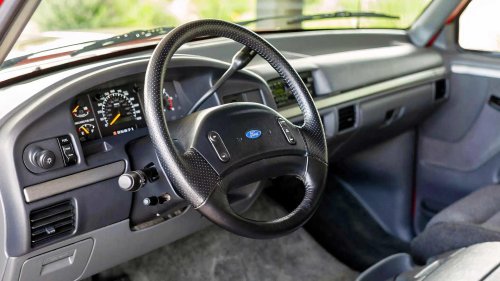
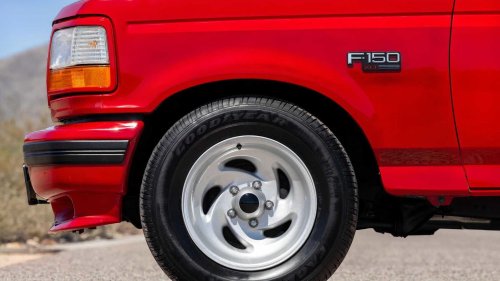
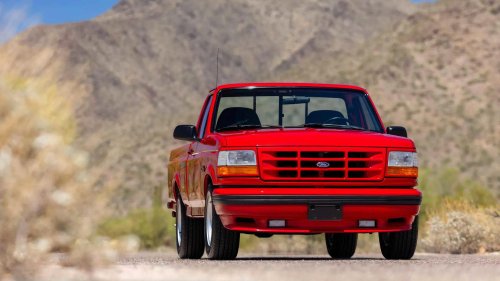
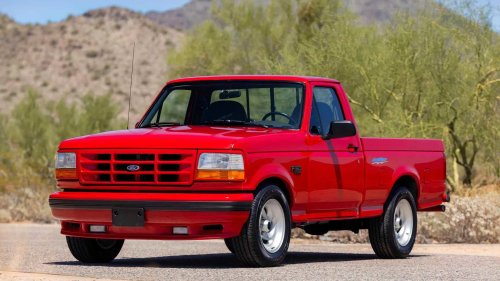
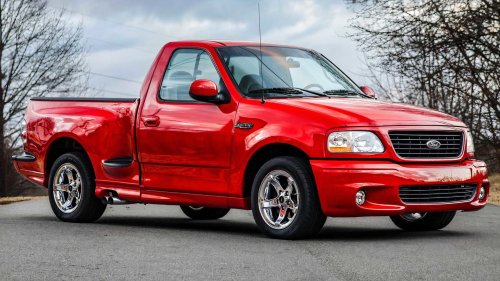
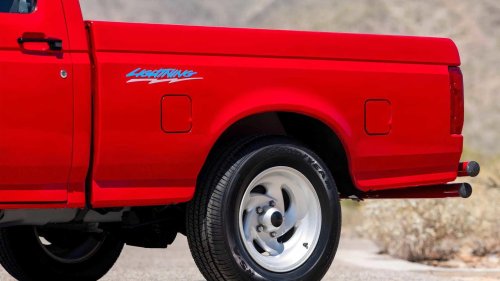
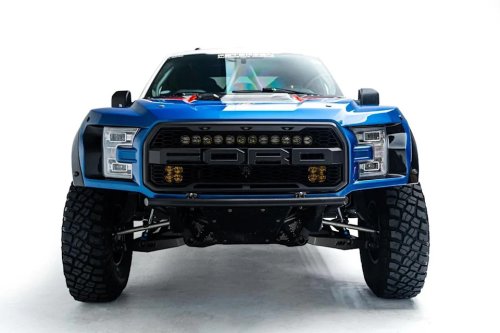
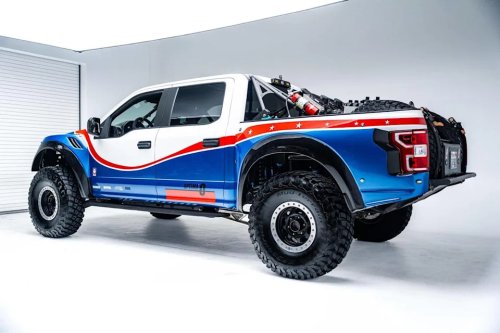
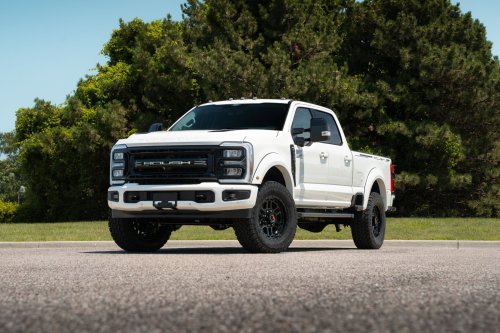
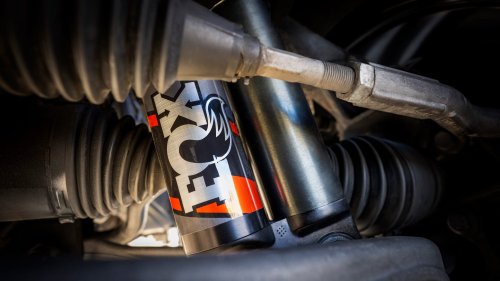
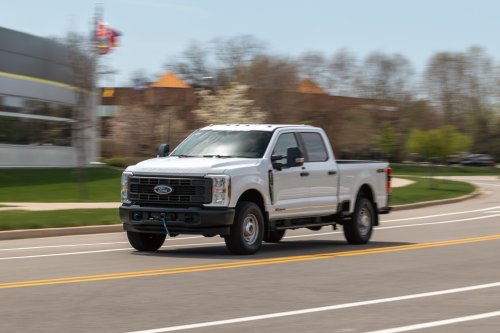
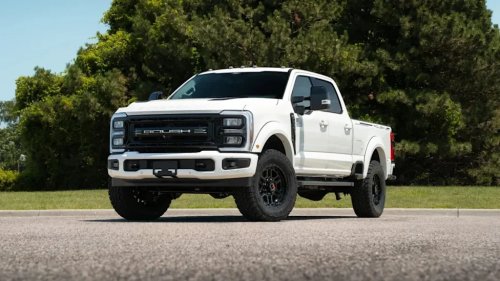
The beastly Ford F-150 Raptor has long been viewed as the benchmark for high-performance trucks with power exceeding sensible levels. In particular, the range-topping Raptor R is nothing short of mind-blowing, equipped with a supercharged 5.2-liter V8 capable of producing 720 horsepower and 640 lb-ft of torque. It has Fox racing shocks, massive 37-inch tires, and the ability to hit 60 mph from a standstill in around 3.6 seconds, dialing the already capable Raptor all the way up to eleven. And with the F-Series being America’s best-selling pickup for nearly half a century now, the Raptor and its beefier R variant get plenty of time in the spotlight. Lightning Filled The Sky Before Raptors Walked The Earth Bring a TrailerThe Blue Oval was flirting with the idea of a performance-oriented pickup long before the Raptor's arrival, though, albeit from a very different angle. Iconic models like the GMC Syclone, Shelby Dakota, and Dodge Lil' Red Express proved the formula could work before Ford decided to give it a go, with Dodge being the first to do so in 1978. These aforementioned legends were basically muscle cars disguised as pickup trucks, and it shouldn’t come as a surprise that gearheads were extremely fond of them. Ford wanted to get in on the action, too, so the F-150 lineup got its wildest constituent yet in the nineties. Ford Takes The Muscle Truck Segment By Storm Bring a TrailerPayload and towing capacity were mere afterthoughts, because the automaker sought performance above all else here. This resulted in one of the raddest and most memorable pickups ever built, with a personality that could hardly be more different than a Raptor’s. It was a matter of street dominance rather than off-road ability or workload capacity, which is a big part of what made it such a legendary name in the pickup segment. Right after GMC blew everyone away with the Syclone, Ford stepped in to keep the party going with an F-150 variant like no other. Unsurprisingly, the model was a smash hit loved by enthusiasts and destined to go down in history. Put A Muscle Car Soul In A Pickup, And You’ve Got The F-150 SVT Lightning Bring a TrailerEnter the mighty Ford F-150 SVT Lightning, a stylish truck from a cosmetic standpoint but more of a muscle car at heart. Developed by the company's Special Vehicle Team (shortened to SVT), the first generation was released in 1993 at what seems like the perfect time in hindsight. Traditional muscle cars were still recovering after the Malaise Era, and pickup trucks were starting to be viewed as more of a lifestyle choice rather than something you’d use just for utility. Buyers were thirsty for performance and the Lightning was happy to deliver it in spades, so it’s no wonder that people loved it to bits. Broadly speaking, it was built in the exact same vein as the earlier GMC Syclone and Chevrolet’s Silverado 454 SS. What Made Ford’s Muscle Truck So Appealing? Bring a TrailerAnd with the Chevy 454 SS getting discontinued in 1993, nothing stood in Ford’s way toward dominating the muscle truck segment. The SVT Lightning came with a short bed and a regular cab, complemented by aggressive styling to hint at its capabilities. It was offered solely with rear-wheel-drive, and the engine bay carried a 5.8-liter Windsor V8 linked to a four-speed automatic transmission. SVT really went to town with the powertrain upgrades to maximize the motor's potential, installing a high-performance camshaft, GT40 cylinder heads, and a bigger throttle body, among other goodies.Improved airflow was made possible by a reworked exhaust system as well, and power got sent to the rear wheels via an aluminum driveshaft and a limited-slip differential. The V8 mill could muster up to 240 ponies and 340 lb-ft of torque, enough for the Lightning to provide a fun driving experience. It was capable of accelerating from zero to 60 mph in 7.2 seconds, while its quarter-mile time landed somewhere in the mid-fifteens. Top speed was electronically limited at 110 mph, pretty stout for a boxy pickup with the drag coefficient of a brick. And all that SVT goodness extended to the chassis department. Technical Specifications Lowered suspension with high-grade Monroe Formula GP shocks, beefier sway bars, and upgraded brakes were part of the package, together with a special set of alloy wheels measuring 17 inches in diameter and eight inches in width. Handling felt surprisingly responsive for a pickup, thanks in no small part to the involvement of three-time Formula 1 world champion Jackie Stewart in suspension tuning. The first-generation Lightning stayed in production until 1995, with a total of 11,563 units leaving the assembly line over a three-year timespan. It disappeared for a while thereafter but would return fully redesigned in 1999, flexing a supercharged 5.4-liter Triton V8 under the hood. The Lightning Becomes Cooler And Sportier Than Ever Mecum The engine had 360 hp and 440 lb-ft of torque to play with, resulting in a top speed of 140 mph and zero-to-60 times between 5.2 and 5.8 seconds according to period tests. Power output grew for the model-year 2001, reaching 380 ponies and 450 lb-ft of ground-shattering twist. Stylistically, the second-generation Lightning was much more rounded and streamlined than its predecessor, while also sitting closer to the ground and rolling on 18-inch wheels. Production lasted up until 2004, and Ford made a little over 28,000 copies during the model’s second generation. Legacy And Current Market Values Bring a TrailerClearly, the F-150 SVT Lightning was the ultimate expression of a fire-breathing muscle truck, nowadays regarded as a very desirable collector’s item. Both generations are highly sought after among enthusiasts, with values on the second-hand market surging considerably between 2021 and 2023. A first-generation Lightning in great condition will cost you around $40,000 according to Hagerty, while a clean example from the second generation is slightly pricier at approximately $45,000. But when it comes to impeccable 1993–1995 specimens in tip-top shape, expect to pay up to $60,000 in order to snatch one when it becomes available. Even though that's far from cheap, you're still getting a fair bit of bang for the buck given the model's iconic status.In our day and age, high-performance pickups are hard-core off-roaders as opposed to street-focused speed demons, so the SVT Lightning stands as a reminder of a different chapter in automotive history. That, in and of itself, is a big part of its appeal, which will likely drive prices up even further in the coming years as the Lightning continues to age like fine wine. And although it seems almost tame compared to the 720-hp Raptor R, it still packs enough of a punch to make you forget that you’re actually driving a pickup from time to time. Quite frankly, the muscle truck genre should totally make a comeback at some point in the near future, but we have to be realistic and admit that it’s unlikely to happen given the way the industry is heading.