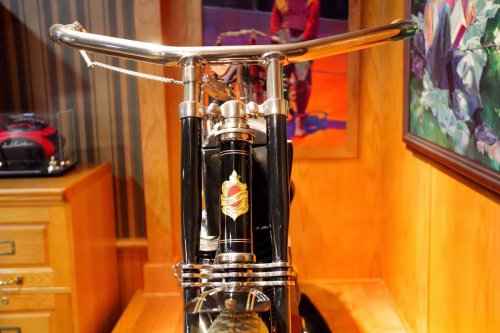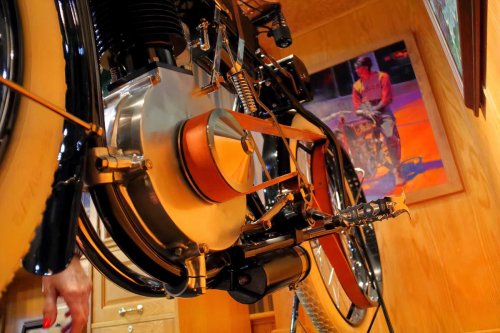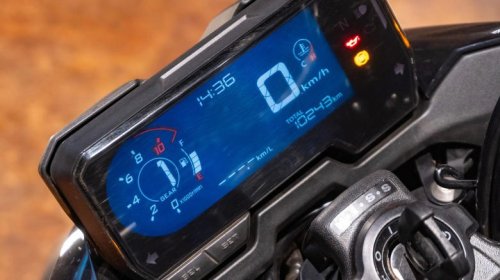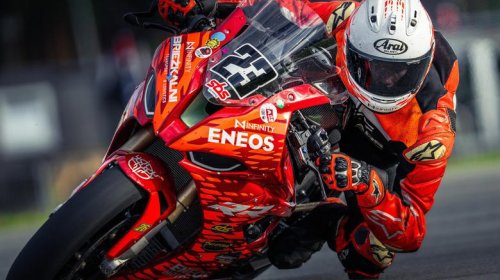
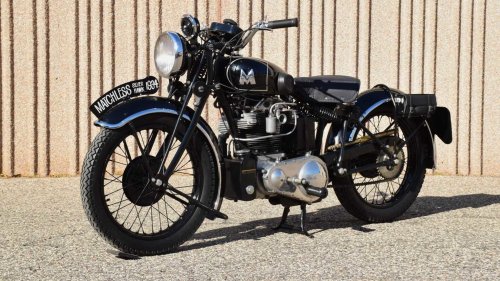
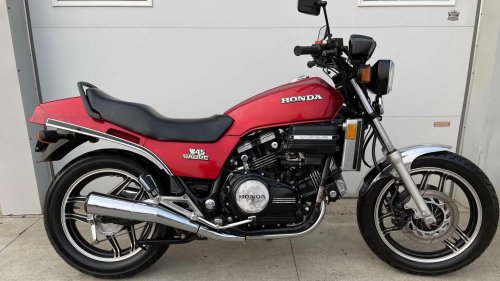
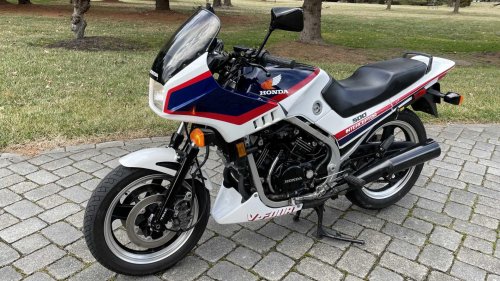
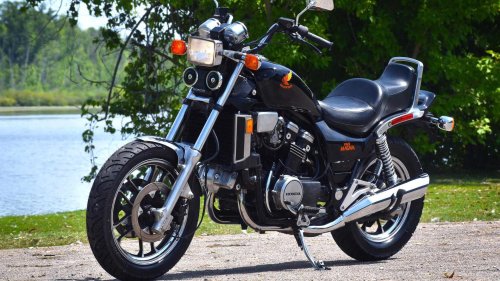
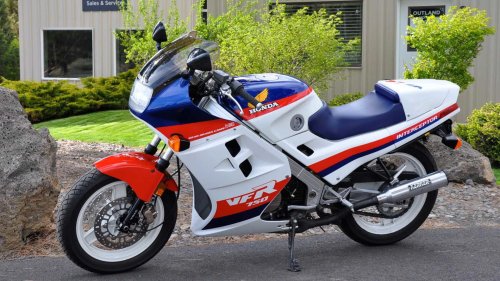
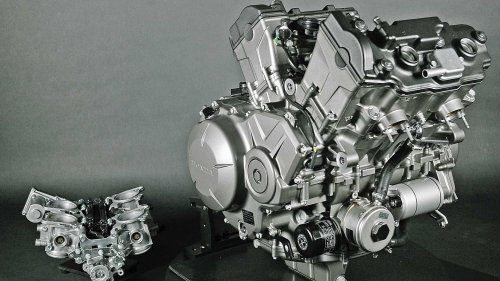




















Motorcycling, and the automotive world at large, survives through innovation. It needs people and brands who forge new paths and test things without fear of failure, questioning the status quo. And while there were plenty of bikes that pioneered different parts of the motorcycle, the engine was conspicuously absent from this as manufacturers largely seemed happy with inline layouts. That was until 1982, when there was one engine that undeniably pushed V4-powered motorcycles forward but, for a moment, nearly killed them entirely. For Bikes, Inline Fours Just Made Sense BonhamsInline-four engines have a lot of benefits for a motorcycle. They use smaller, lighter pistons than large-displacement engines or twins, allowing them to rev higher and produce more power at those elevated RPMs. Four cylinders also mean more frequent firing pulses and generally better engine balance, resulting in smoother power delivery and reduced vibration.Having all the cylinders in a straight line means that an inline-four engine is easier to maintain, and they were simpler to produce than their V-angled equivalents, too. They do come with some drawbacks when compared to the V4 though, like less compact packaging and less centralized mass, which can make it harder to optimize handling compared to a V4. There can also be more flexibility due to a longer crankshaft, but, for the most part, inline-fours were the most common fare. But despite these advantages, one Japanese manufacturer was about to bet everything on proving inline-fours weren't the only solution. V4 Engines Existed, But Were Highly Specialist MecumThough they were uncommon, some brands had experimented with the V4 layout. The Matchless Silver Hawk, produced between 1931 and 1935, was one of the earliest pioneers of the engine, but fell by the wayside due to high production costs and limited consumer interest. Boxer engine bikes like the Puch 800, and “square four” engines like the Ariel Square Four entered the market trying to tackle the ever-present inline-four, but ultimately failed as there just wasn’t a huge need for a mass-produced V4-engined bike.The layout had found promise in racing though, particularly with Honda. The Japanese marque had been experimenting with V4 engines and, in 1979, released its NR500 bike to take on Grand Prix Motorcycle Racing. Its innovative oval piston design was intended to deliver performance characteristics similar to an eight-cylinder engine while remaining within the four-cylinder rules. Both bikes failed to finish the British GP and failed to even qualify for the French GP a month later. Still, it was undeterred and, in 1982, released its VF series to bring the first mass-produced motorcycle with a V4 engine to the mass market. Honda's V4 Gamble Launched With Three Radically Different Motorcycles MecumWith the GP racing issues in the past, in 1982 Honda released three motorcycles that shared the same V4 engine in hopes of bridging the gap between race and road motorcycles. The 750 cc engine, codenamed the V45, would power the Honda Sabre, Honda Magna, and, a few months later, the Honda Interceptor.Though the Sabre and the Magna both used the same engine, they used it to target two different markets. The Sabre was a sports-touring bike with high footpegs, less rake than the Magna, and, exciting for the time, an electronic LCD instrument panel. It was an aggressive setup for the bike, with its single-shock suspension (also state of the art for the time) putting it at the forefront of where sports bikes were in 1982. The Magna, meanwhile, was intended to be a Harley-Davidson alternative. To this end, the pegs were further forward, the seat was stepped to give a better view for passengers, while the bike's use of chrome gave it a much more American look than the Sabre had.The Interceptor, coming slightly later, was a dedicated sportsbike that used that same V45 engine. It was still a street bike though, so it was far stiffer than its two siblings. It had a more aggressive seating position, clip-on handlebars, and more rearset footpegs than the already sporty Sabre, making it an option for people who wanted to push rather than enjoy long rides.Bring a TrailerTariffs would come into play two years into the V45’s run, as the US government placed heavy import taxes on motorcycles with 700 cc or larger engine displacement. The Sabre would drop to a 700 cc engine in 1984, while the Magna would fall to 498 cc in 1984. Honda would also release an 1,100 cc V65 Sabre in 1984.Regardless of the bike that the V45 was in, though, it was well-liked. The 82 HP it produced was praised, as was the smoothness of that power’s delivery. The V4 format also created an intoxicating sound not possible from an inline-four. Cycle World called the Sabre “an impressive motorcycle” and the Magna “a wonderful engine, an acceptable motorcycle, and a hint of more marvels to come.” But for all the engine’s praise, it wasn’t without its foibles. And one of them almost derailed the layout completely. But While The V4 Worked, A Scandal Nearly Killed It Altogether Bring a TrailerWhile the first impressions and reviews of the bikes were positive, reliability issues were starting to rear their head. Excessive camshaft wear led to the bikes earning a “chocolate cam” nickname, while ticking top-end noise, a rough idle, and performance loss were also common. Inadequate lubrication would be blamed, as issues with oil delivery were eventually found.Teething problems with new technology are hardly new, and should be expected by those brave enough to be first adopters. But while the issue persisted, Honda was initially reluctant to acknowledge the issue, and often attributed failures to a lack of proper maintenance. It was a rare instance of Honda's reliability not being up to snuff, and while not every bike was impacted, it was enough of a problem that they had to return to the drawing board. Honda’s next iteration would not only fix the issue, but save its V4 project entirely. The VFR750 Offers V4 Redemption Bring a TrailerWith the issues of the VF750 still fresh in consumers’ minds, Honda released the VFR750 in 1986. The 748 cc bike would retain the V4 engine layout but was deliberately over-engineered from a mechanical standpoint, to the point of rumored loss-leader territory. The cams for the new bike were gear-driven compared to the traditional timing chains, while the redline was pushed from 10,000 RPM to 11,000 RPM, lifting the power from 82 HP to 105 HP in the process.It was a resounding success. The bike that needed to salvage Honda’s reputation did exactly that, resolving the prior reliability issues and saving Honda’s V4 program. The VFR750 would be so good, in fact, that Honda adapted it for race use in the iconic RC30 (VFR750R). That bike went on to win the inaugural riders’ and manufacturers’ Superbike World Championship in 1988, repeating the double in 1989. Honda’s V4s Are Legendary Today HondaTrue progress doesn’t come smoothly. The Sabre/Magna/Interceptor’s V45 engine proved that. But it also proved that you win nothing by simply sitting around and waiting for other people to do the hard work for you. Honda undoubtedly took a risk by embarking on a mass-produced V4 engine at a time when everyone else was largely leaving them alone, and it paid for it. But rather than let it define the company, it used those failures to come back and win the WSBK championship with a V4 just six years later. Honda understood that progress needs time. And thankfully it had it.