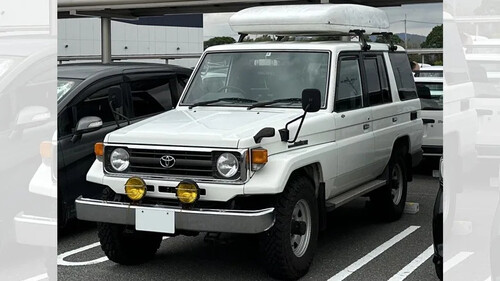
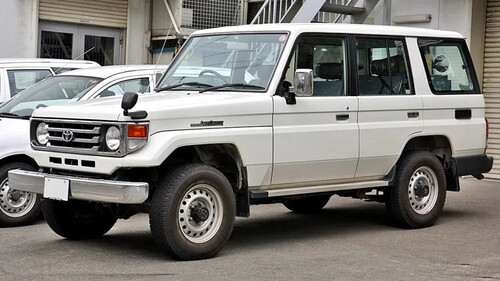
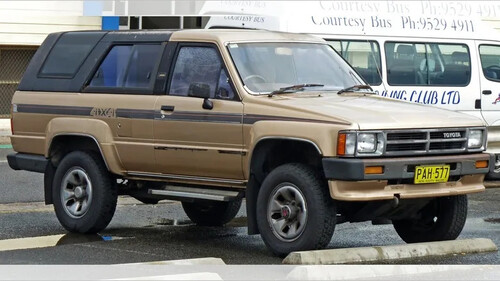
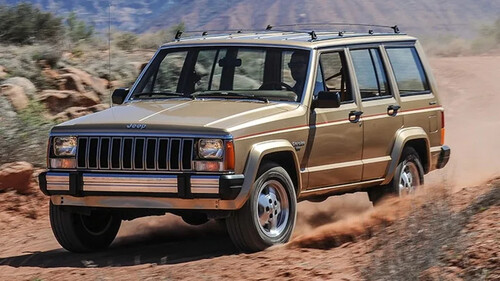
Many people feel that 150,000 miles is a high-water mark for vehicles and a point where a typical car starts to feel old. While that may be the case for many of those vehicle's components, it's not the correct assumption for the Aisin A340E transmission set. This piece of engineering can quite calmly carry various Toyotas far beyond that 150k mark, and it can do so because Toyota engineered it to be deeply conservative in the best possible way.The company designed the A340E as a four-speed automatic with sturdy internals, a lock-up torque converter, straightforward hydraulics, and sensible electronic control. And it's done its duty across a huge spread of rear-drive and truck-based Toyota products, from pickups and SUVs, all the way to six-cylinder performance cars. This means that the A340E has played a significant part in the legend that surrounds old Toyotas, and it's rooted in a closely held transmission philosophy that prizes durability first. The A340E Is The King Of Durability ToyotaThe Aisin A340E is undoubtedly one of the toughest automatic transmissions from its era, and even though it's featured in many passenger car applications, Aisin designed it for far tougher challenges. This wasn't a flimsy economy car automatic, but a robust rear drive unit that had a substantial gear train. It was predictable and could tolerate loads well and was just as happy in a tough-as-nails truck as in an everyday commuter car.Toyota fitted the A340E to its Supra halo car to match the naturally aspirated 2JZ-GE engine and fitted classic sensible ratios such as 2.804:1 in first, 1.531 to 1 in second, 1.00 to 1 in third, 0.705 to 1 in overdrive, and 2.393 to 1 in reverse. Those ratios are not aggressive by modern-day interpretations but more conservative, and they help show why a transmission like this can last.Those carefully spaced ratios mean that the system is not constantly chasing extra gears or working within ultra-tight windows, but just doing what an old-school automatic should do. The A340E can multiply torque cleanly, settle nicely into direct drive, and use overdrive or converter lockup where needed for highway efficiency. And all this helps explain why the Toyota/Aisin A340E has been around for such a long time. It first came into the picture in 1985 and has since then sat behind a variety of four and six-cylinder engines, commonly sailing right past the 150k mark before even needing any meaningful attention. The A340E Was An Excellent Truck Transmission Bring A Trailer Toyota originally developed the A340E to work with high-performance engines like the 3VZ-E. The company knew that this transmission system would need to cope with the harshest of environments and deal with the toughest owners and this is why many of the A340E's best-known applications are not within soft luxury cruisers. Instead, you'll find these transmissions in trucks, SUVs, and body-on-frame vehicles that frequently have to tow heavy loads, trundle over uneven terrain, or face the sort of daily punishment that would kill off marginal automatics.Toyota also paid special attention to the architecture with end use in mind. It built the system around three planetary gear sets, clutch and brake elements, hydraulic accumulators, and a simple lock-up converter. It just layered any electronic control elements over the top rather than replacing the hydraulic fundamentals and all of this represented a strong recipe for longevity. Nothing depended on a hyper-complex mechatronic brain, and the workload was instead spread across a proven gear train. The electronics would manage the shift timing and the lock-up strategy, but everything else was mechanically substantial.It’s also important to look at this transmission from a historical perspective and realize that the company designed it in far simpler times. Back then, manufacturers were not as obsessed with squeezing every last fractional gain in fuel economy, adding ever more gears, and chasing super-fine tolerances.This is why the A340E is not some six-, eight-, or 10-speed box trying to keep the engine in an impossibly thin efficiency band. Instead, it's a simple four-speed with a direct third gear and straightforward overdrive, which means fewer shifts or clutch events and far less heat where it matters. That's why many of these transmissions sail through those mileage records without ever making their owners nervous. Jeep Saw The Magic As Well Jeep The famous Jeep AW4 transmission was strikingly close in philosophy to Toyota's A340 hardware. This was also a four-speed electronically controlled automatic with a lock-up converter, three planetary gear sets, hydraulic accumulators, a valve body with electronic solenoids, and a separate transmission control unit. And this approach also led to significant success within the Jeep ecosystem. Why These Transmissions Survive When Other Automatics Do Not Toyota While the A340E is a stalwart that just keeps on going, that doesn't mean that it never fails at all. But when it does wear, it will typically do so in a familiar and repairable way rather than self-destructing catastrophically with no warning. Some of the age-related issues linked to the A340E family suggest low line pressure, poor shift quality, low lube oil flow, burnt clutches, converter clutch apply-and-release concerns, bushing wear, and overheated fluid. And that's a list of wear and pressure-related issues that you might expect from a transmission system that's already lived a long life.Crucially, none of those problems provide evidence of a fundamentally weak design. Weak transmissions usually die off because their core concept was already compromised, but that's not the case here with this durable automatic. Instead, this system will usually last a very long time before it needs some tender loving care in places like the valve body, pressure regulation, lock-up control, or lubrication circuits.While some of these problems will inevitably arise at some stage once age and mileage finally catch up, the good news is that there are multiple repair paths for these units in the aftermarket. Companies like Sonnax have solid aftermarket support for this transmission because it knows that the A340 is so dependable. The company also knows that this gearbox will keep showing up in viable trucks, SUVs, and cars that their owners want to keep going for the long haul. The A340E's Support Network Is Still Strong Bring a Trailer Part of the A340E's success story today relates to its broader ecosystem. And that's very important when you think that other mechanically durable transmission systems have disappeared because nobody remembered how to diagnose or fix their problems. By contrast, the A340 has avoided that fate because it was in such widespread use and has been around for so long. There's plenty of Toyota documentation today for related truck and performance car applications and there's also a lot of Jeep-side service literature for that AW4 cousin. You don't have to look far to find aftermarket specialists that publish identification guides, vacuum test procedures, or valve body fixes as well as offer repair kits. And that level of continuity matters just as much as the hardware itself.The ecosystem also helps to explain why the transmission's reputation has grown rather than faded away. It's a big part of the story when you look at old 4Runners, Tacomas, T100s, and Supras that are still moving purposefully under their own power. They all feature transmissions that may be a little tired but are certainly not broken. And even if the A340E should finally need work, owners know that such a fix can still be economically rational. There'll be plenty of support around at such a time and those owners also know that the vehicle itself may well have another decade of useful life left in it.In summary, the A340E never became a legend because it was mechanically dazzling, it did so because it kept showing up for work long after flashier hardware had given up the ghost. Essentially, it's a relatively simple four-speed automatic that can take the abuse, select another gear, and keep coming back for another 50,000 miles. And for Toyota and those old Jeeps that carried the A340E's cousin, that made all the difference.