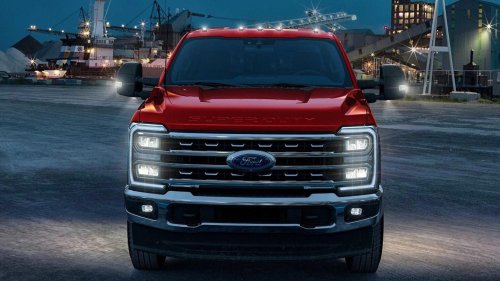
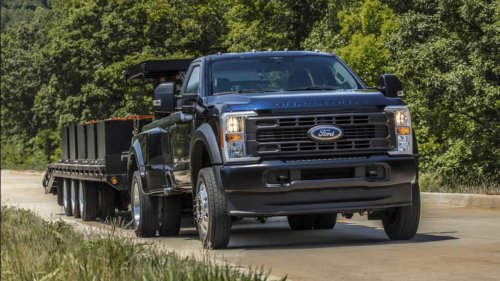
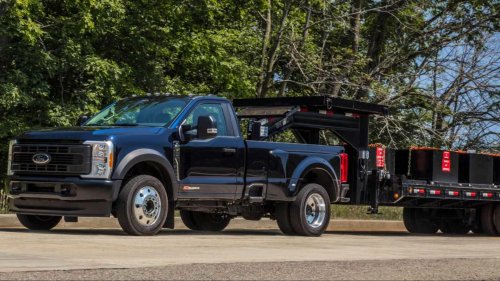
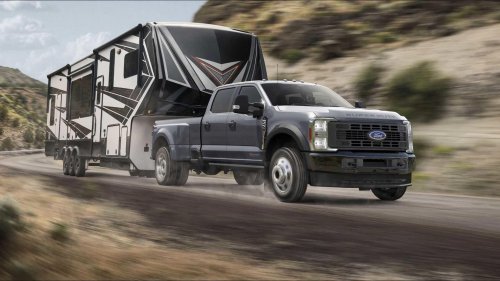
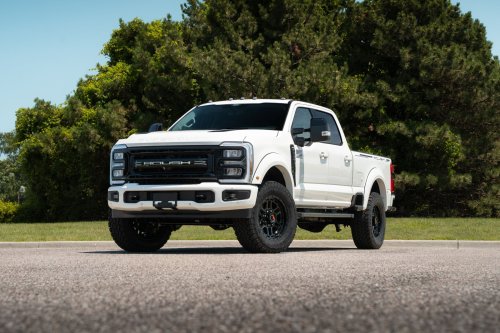
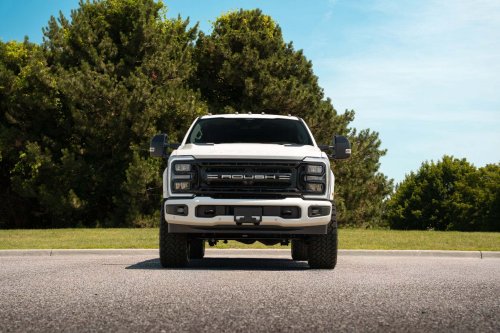
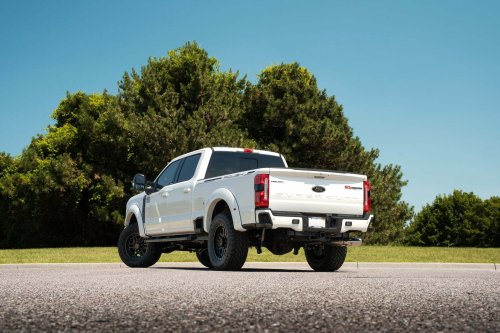
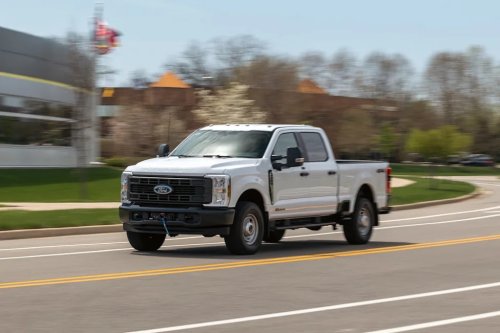
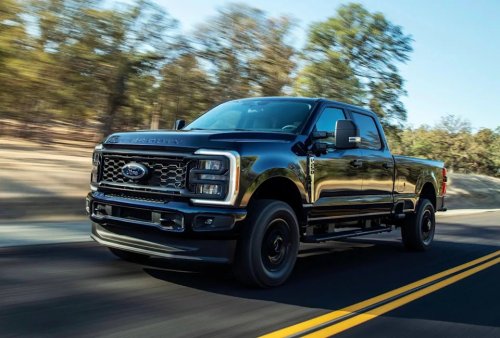
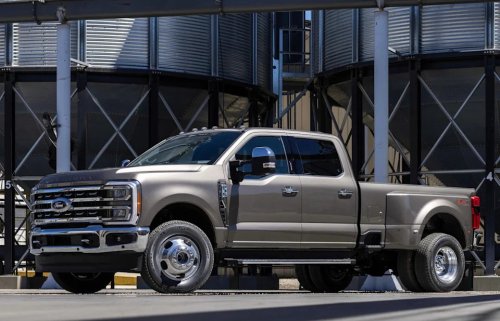
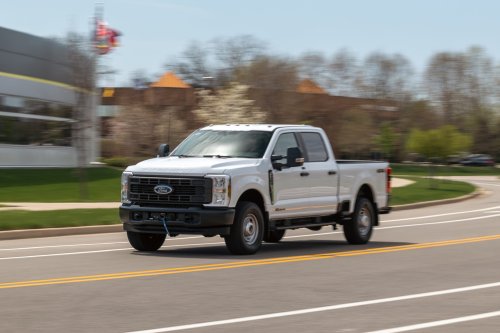
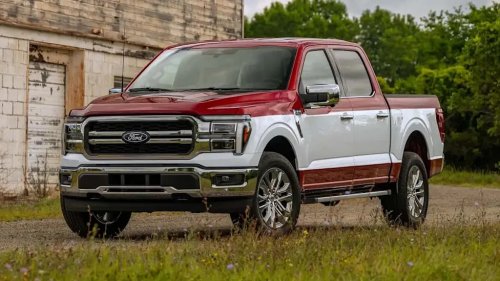
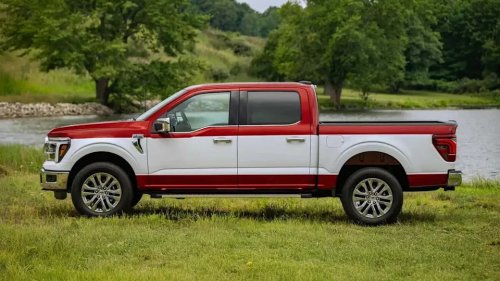
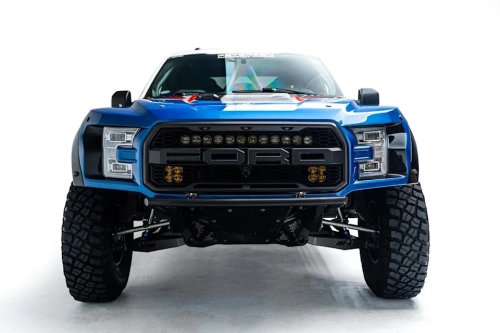
When compared to some parts of the old world, everything in America seems to be bigger, bolder, and brasher. Freeways are wider, subdivisions sprawl, and even the most straightforward trucks can take on gargantuan proportions.Take the Ford F-450 Super Duty as an example, and if you walk into any American truck stop, you'll see that this monster is right at home. It's got that hulking front end and seems to be about as wide as a compact car is long and proudly owns its reputation as one of the biggest production pickups you can buy from a US dealer.Now, imagine trying to fit that truck down some narrow roads in the center of Paris or Rome and you can see why not many people choose to do so. European regulations may not necessarily prohibit people from doing so, but this type of vehicle lives in a legal and practical grey zone that may make it all but undrivable on European roads. The Ford F-450 Seems Just Too Big For Europe FordThe tail of the tape measure suggests that the current Ford F-450 Super Duty pickup is just too big for any Euro boots. It's around 105.9 inches wide overall, with a body width of around 96 inches, before you take into account those towing mirrors, and without considering any aftermarket add-ons or mirror extensions.Over in Europe, the EU places a general maximum width for road-going vehicles of 2.55 m, which equates to 100.4 in and applies to the vast majority of vehicles, including full-size trucks and buses. While the F-450 might squeak under the raw body width cap, it's getting very close to the limits with those dually rear fenders and big mirrors and starting to sneak into a bit of a grey area.When you consider that it's basically a privately owned pickup, it's starting to occupy the same footprint as a heavy commercial truck and life is already a lot harder for drivers of such vehicles through those typically narrow streets.European regulators are already fretting about vehicle size. One 2024 analysis from Transport and Environment discovered that the average new car width in the EU is already about 180.3 cm or 71 in. These regulators understand that growing vehicle sizes represent an immediate problem and are now using parking policy and access rules to discourage bulky SUVs from downtown areas.Technically, a US-spec F-450 could still drive around European roads from a legal perspective and squeak onto the high street, but such a task would certainly be a lot more challenging, given the creaking nature of the infrastructure. The Sheer Size Of One Of America's Biggest Production Pickups Ford The Ford F-450 sits on top of the company's Super Duty lineup and above the F-250 and F-350. Ford intended this vehicle to deal with the heaviest challenges of today, towing equipment and pulling fifth-wheel trailers that would have been particularly challenging a generation ago.The current F-450 Super Duty has Ford's 6.7-liter Power Stroke turbo diesel V8 under the hood and this gives it a gross vehicle weight rating of up to around 14,000 lbs. It's squarely in the class three medium-duty category in pickup form and getting close to class four territory in some chassis cab configurations.The F-450 is also in a different league when compared to big European double cabs in terms of dimensions. It has a curb weight that's north of 7,500 lbs, depending on the equipment and trim, and it can typically carry around 6,000 lbs of payload or tow many times that if you configure it properly.In Europe, a big pickup tends to be something like a one-ton Toyota Hilux or Ford Ranger, and a vehicle like this generally measures around 17.5 ft long and 6 ft wide. It'll have a curb weight closer to 4,000 to 4,500 lbs and it's roughly three feet shorter than the F-450, to say nothing of the width difference before you even consider wheel arch extensions or towing mirrors.In America, size makes sense as the entire road infrastructure is built with plenty of space in mind. Sprawling parking lots and existing culture all favor vehicles that can perform from a towing point of view without breaking a sweat. And the F-450 feels like the perfect tool for any job, whether it's driving down a wide Texas farm road or steaming along a four-lane interstate.However, it would start to become a handful really quickly if you steered it along a two-lane French alpine pass or wanted to inch your way along a centuries-old British city street. In those kinds of environments, the F-450 quickly starts to look absurd. What Europe's Rules Actually Say About A Truck Like This Ford The legal fine print in Europe makes your job quite tough if you want to ship an F-450 across the Atlantic and try bolting on some plates. Most countries rigidly enforce their 2.55 m (100.4 inch) maximum permitted width for road vehicles, although there's a slightly higher cap reserved for vehicles that have refrigerated bodies, including thicker insulated walls. Some countries may also add restrictions on weight according to the vehicle category, for extra complications.As the F-450 has a body width of around 2.44 m, it technically fits below the 2.55 m bar on paper, but you might be starting to edge into inspection territory when you factor in those big rear fenders, side steps, or a set of US-spec extended mirrors that are particularly handy for towing wide trailers.But even though vehicle width may not be an idea killer, homologation could be another hurdle altogether. After all, if you want to drive a vehicle in the EU these days, it needs to conform with a type-approval process that focuses on emissions, lighting, crash performance, and other safety systems.And while the F-450 Super Duty certainly complies with America's Federal Motor Vehicle Safety Standards and EPA rules, it doesn't automatically meet EU regulations when it comes to lighting, emissions, and other factors like side marker lights, indicator colors, and rear fog lamps.So, you can't just walk into a European Registration Office with your US-spec F-450 papers, but instead, you'll have to import it as an individual vehicle before getting it inspected and approved under national rules. You may need to modify some parts of the lighting, exhaust, and even instrumentation systems, and all of that takes time, involves hassle, and incurs cost. Conversion Shops Can Shrink A Super Duty For Europe Ford As challenging as an F-450 importation may be, there are still people who want to do that, and a small industry has sprung up to help them. Specialist shippers and converters can tell you exactly what you need to do if you want to make a US market vehicle eligible and pass EU or national inspections. They may begin by focusing on the lighting, where you may need specific headlamp patterns meant for driving on the "other" side of the road. At the rear, some regulations stipulate that indicators must flash amber instead of red. And conversion shops often swap in EU-approved headlight units before rewiring tail lights to separate brake and turn functions.Emissions and exhaust challenges can be trickier, as even though late model US trucks tend to be quite clean by American standards, they may not automatically comply with Euro emissions listings. Import specialists may have to upgrade some components to hit the thresholds before an F-450 can access congestion zones and get its registration.It may also be a good idea to fit different mirrors that sit closer to the body and choose wheel and tire setups that don't push the dually track any wider than it already is. It's always a good idea to accurately document the truck’s measurements as well, should you come across a curious inspector in the wild and to prove that the body shell itself comes within the 2.55 m width limit. Given all this hassle, it's no wonder people hesitate before exporting an F-450 Super Duty to Europe, as after all, you need to add the price of all these modifications to the already significant costs of shipping, duty, and taxes. Life With An F-450 On Europe's Medieval Streets Ford Congestion is often a fact of life in European towns simply due to the way that these places were designed and the difficulty of carrying out any wholesale modifications through the years. European safety and transport groups are especially aware of how modern crossovers and SUVs are growing bigger as time goes by, putting even more pressure on existing infrastructure.But congestion and regulation aside, it will be a challenge to drive a truck like the F-450 through dense city centers with their narrow lanes, and where on-street parking is often permitted on both sides of the road. You're dealing with a vehicle that may be a full half meter wider than the average European car and something that's even as long as some small buses. Also, it'll be especially challenging to try and park one of these vehicles in a European multi-story garage if that facility was built in simpler times and to older standards.Many of the rural back roads in much of continental Europe and the UK are extremely narrow. They sometimes come without a center line and have high hedges or stone walls right at the edge of the pavement. You'd probably have your heart in your mouth if you were driving down one of these roads, as you'd likely have to stop altogether when certain vehicles approach. You'd then have to play a cat and mouse game about who backs up first, and where they actually go, in order to allow both vehicles to carry on their merry way.So, across Europe the F-450 is more of a niche vehicle that's largely impractical. It may not be literally illegal and, with enough money and patience, you can surely import one, modify it, and get your registration. Still, your vehicle would be turning heads wherever you went, and you'd have to deal with a simple lack of physical space during your everyday activities. And this means that one of the biggest production pick-up trucks in America would feel far less like a form of transport in Europe and more like a rolling spectacle.