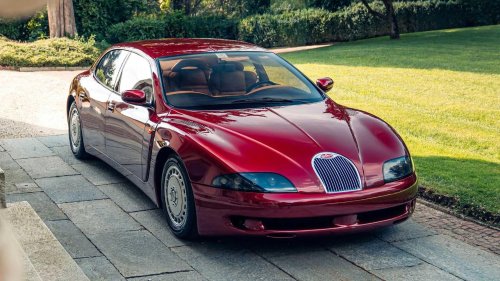
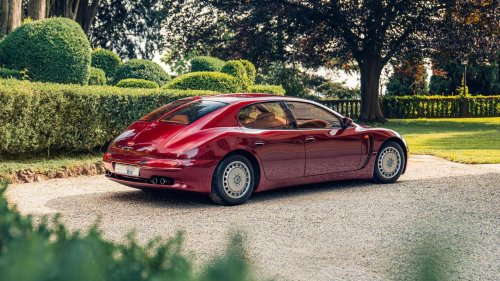
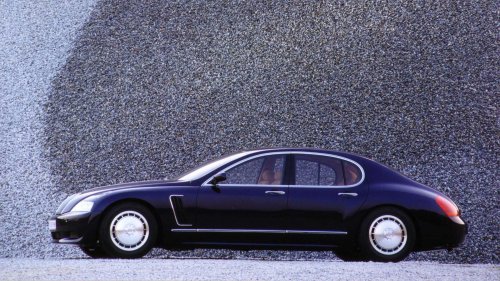
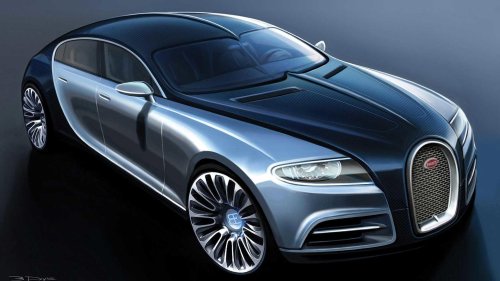
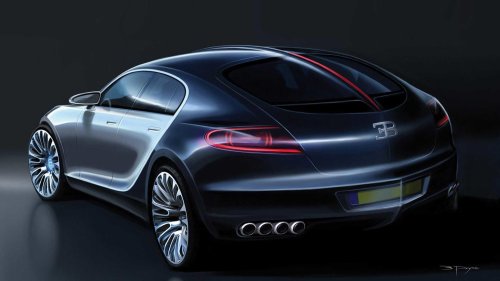
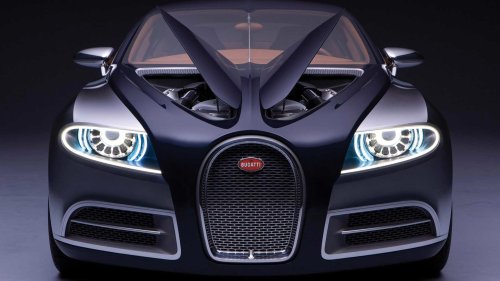
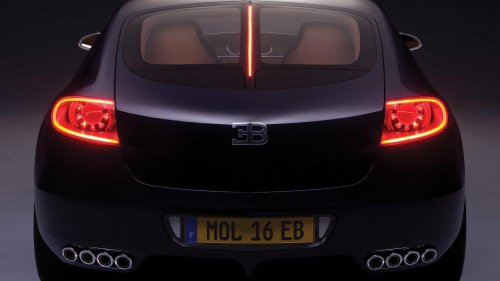
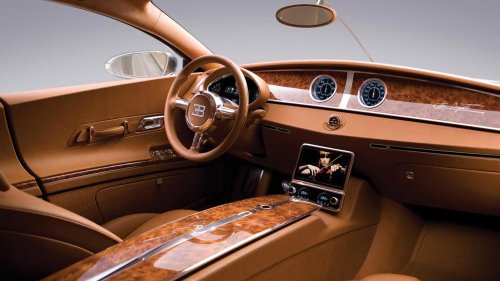
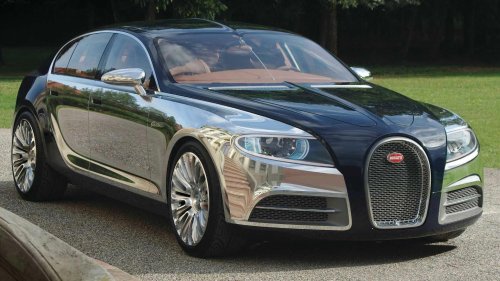
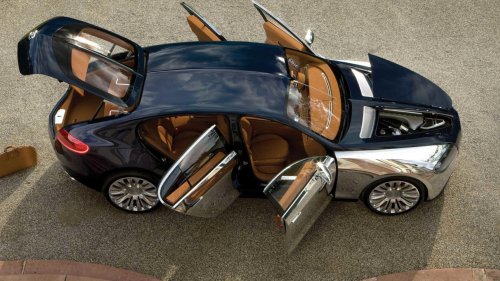
One hundred years after Italian Ettore Bugatti created his car company, the 16C Galibier fastback concept made its first public appearance at the 2009 Frankfurt Auto Show. Bugatti management initially stated the Galibier was expected to go into production by 2013.But the company soon changed its message, saying it was definitely just a concept study, to be used over a number of years to gauge public feedback and decide the future direction of the brand.Either way, with an 8.0-liter, twin-supercharged W16 producing an estimated 950 hp, the 16C Galibier was set to become the world’s fastest and most exclusive, four-door car. By 2012, fate would intervene. A distinguished gentleman called Ferdinand Piëch, chairman of the Volkswagen Group, reportedly had a thing or two to say about the ostentatious Bugatti. In The Beginning…BugattiThe 16C Galibier was actually not Bugatti’s first modern attempt at a four-door family sedan. That honor belongs to the EB112, revealed to the public at the Geneva Motor Show in 1993. Penned by the renowned Giorgetto Giugiato’s styling firm Italdesign, the EB112 was powered by a 6.0-liter V12 engine with 450 hp.The engine was mounted behind the front wheels, in a front-mid-engine layout, ensuring a more favorable weight distribution between the front and rear axles. The big sedan featured permanent all-wheel-drive, and Bugatti claimed that it could sprint from 0-60 mph in just 4.3 seconds, and reach a top speed of 185 mph. In 1993, those numbers were in the ballpark of iconic sports car brands like Ferrari and Lamborghini.Bugatti The EB112 received a mixed bag of reviews. Most punters said the lines were not pleasing to the eye at all. Yet some mainstream motoring publications called it the most beautiful car in the world.Bugatti went bankrupt in 1995 and the EB112 never made it to showroom floors. Interestingly, when Gildo Pastor, hailing from the Monaco-based Pastor commercial real estate dynasty and owner of the Venturi car brand, bought some of the Bugatti assets, it included EB112 spare parts and three unfinished EB112 sedans. Pastor completed the three cars in the workshops of his Monaco Racing Team.One car is owned by Italdesign while the other two were sold to international car collectors. Pretty or not, these EB112s should be quite a valuable commodity today. More Cylinders, More Power! BugattiBy 1998, Germany’s mighty Volkswagen Group had acquired Bugatti. With a healthy cash injection, VW commissioned Giugiaro from Italdesign to create a set of two-door and four-door concept cars.The EB118 made its debut late in 1998, and was a luxurious and striking coupe powered by a mighty Volkswagen W18 cylinder engine. The engine had 18 cylinders, with three banks of six cylinders in a ‘W’ layout. The naturally aspirated engine produced 555 hp and was coupled to a Lamborghini Diablo VT all-wheel-drive system.The four-door EB218 followed a year later, powered by the same drivetrain, producing 555 hp and sending the power to all four wheels via a five-speed automatic gearbox. It was 212 inches long, and weighed 4,800 pounds.Most punters believed the EB218 was easier on the eye than the 1993 EB112, which some said was trying to be a sedan and a fastback, and only getting stuck in no man’s land. The EB218, most said, was a four-door sedan, nothing more, and nothing less. But the EB218 would also never get to see a production line. A New Dawn… A New Bugatti Sedan Bugatti In 2008, an up-and-coming designer called Achim Anscheidt was the head of Bugatti’s design department. Anscheidt and his team had been working on a new iteration of Bugatti’s long-standing dream to build the ultimate four-door saloon. The team used the Bugatti Type 57 Atlantic and the new Veyron halo supercar as inspiration.There is a bit of a story behind the Type 57C Atlantic. Volkswagen chairman, Ferdinand Piëch, was on holiday with his family when his son Gregor saw a model of a Bugatti Type 57C Atlantic in a shop. Young Gregor was besotted with the car, and insisted his father buy the model car. Piëch obliged, buying not one, but two model cars: one was for Gregor, the second for VW’s board of directors.Bugatti Back at work, Piëch presented the model car to his board, clearly taken with the classic Bugatti, one of the rarest and most valuable cars ever made. He also instructed the Volkswagen board to pursue the acquisition of the Bugatti brand, which was up for sale at the time.The acquisition was completed, and in 2005 Bugatti, under Piëch’s technical leadership, introduced the W16-powered Bugatti Veyron 16.4, the fastest production car the world had ever seen, with a top speed of 253 mph.The Bugatti Type 57C model car was still in the game, too. Piëch tasked his Bugatti design team to pen a new four-door car, using the Type 57 as an influence and inspiration. When Anscheidt presented his designs and drawings to Piëch and the board, the project was green lit. The concept car was a go, with an eye to introducing the new model by around 2012. The Galibier Makes Its Debut BugattiFast-forward to 2009. Bugatti’s new four-door concept, the Galibier, was ready for its secret unveiling to a select group of industry guests in Molsheim, at the historic site where Ettore Bugatti’s original manufacturing plant was located, back in 1909.The Galibier was powered by a new 8.0-liter version of the W16 engine that did service in the fastest car in the world, the Veyron. But where the Veyron engine used four turbochargers, the Galibier used twin superchargers. Although Bugatti never officially revealed the power output numbers, the engine was said to be good for around 950 hp. Very handy. And it looked amazing with those eight exhaust outlets.BugattiThis enabled the big Bugatti to reach a top speed of 235 mph – it would be, without any doubt, the fastest four-door family car in the world.Bugatti stated that the intention with the car was to create ‘the most exclusive, elegant and powerful four-door automobile in the world’. Guests were in awe of the Bugatti, with the sheer girth, the supreme luxury, the eight exhaust pipes and the massive performance potential, ticking many aspirational boxes. A Sumptuous Business Bugatti The Galibier’s interior is, of course, an extraordinarily luxurious and plush space. But also minimalist. The dashboard features just two main instruments, mounted prominently in the center of the dash so that even the rear seat passengers, cocooned in luxury, can keep an eye on the instruments.Another important aspect of the interior is the timepiece, located in the dashboard. Swiss watchmaker Parmigiani created a removable clock called the Reverso Tourbillion, which the owner can remove and wear as a wrist piece, thanks to an innovative leather strap. Recognize the name, Tourbillion? #justsayingAnd just in case you tire of staring at those bespoke centrally located instruments or admiring your timepiece, there is an LCD screen where you can watch Who wants to be a billionaire? The Galibier’s Fate Is Sealed Bugatti Styling again proved to be a contentious issue. Following customer feedback sessions and research, Bugatti management instructed Anscheidt to create a more practical version. So the car grew in length and height, and the sleek lift gate – possibly the coolest part of the design – was replaced by a small trunk. Anscheidt is said to have described the new, more practical design as “looking like a dachshund from the side and a bowler hat on wheels from the rear.”But it was a personal inspection in 2012 by Ferdinand Piëch himself that sealed the updated Gabilier’s fate. Considering Piëch had set out to acquire the Bugatti brand following his fascination with the Type 57 model car, and this new concept represented the modern interpretation of that iconic car, he was particularly keen to sign it off.Bugatti With all the revisions requested by the board, following potential customer feedback and with a more practical focus, Piëch apparently found the ‘new’ Galibier’s styling completely at odds with the vision he had for Bugatti’s four-door car.In short, function killed form. According to urban legend, Piëch canceled the project, and the Bugatti development team shifted its focus to the 1,500-hp Chiron supercar, which made its debut in 2017, and went on to go faster than 300 mph.



















 +11 others