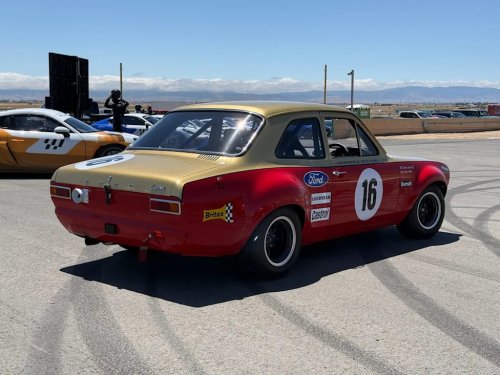



















Don't Underestimate Pricey Classic Car RevivalsIllustration by Tim Marrs / Photos by Matt Farah (Illustration by Tim Marrs / Photos by Matt Farah)When I was 23, I learned something about car buying that stuck with me: If you're going to buy a car that's a conversation starter, a car where people will come up and ask you questions, you never want the answer to the first question they ask to be, "No."It's pretty simple, really, and the fastest way to get to that "No" is to drive either a fake up-badged car, or a replica. If your car is the former, take those badges off right now. The only people who even know what they mean know they are fake, and no one else cares.In my case, it was the latter. My business partner, Larry Kosilla, and I purchased a promotional vehicle for our business, a small detailing shop in Westchester County, N.Y. We wanted to have something cool we could take to Cars and Coffees and on local group drives. We were young and on something of a budget, but wanted something super fun to drive that would get a lot of attention at car shows.Matt Farah (Matt Farah)We settled on a Superformance MkIII, better known as a high-quality replica of a wide-body Shelby Cobra 427. The story of this car is a whole other tale, but suffice to say we're all familiar with replicas of Cobras, Daytona Coupes, and GT40s from this and a dozen other makers of similar recreations. In 2006, it was $50,000. It would be roughly double that today, inflation and all, but we're still talking about somewhere between five and ten percent of what it would cost you to get a real 427 Cobra.AdvertisementAdvertisementAt 23, I had no idea what I was doing with such a thing. It wanted me dead, and had I kept it for even a minute longer, it may have succeeded at this mission. But I got rid of it within months, and put the money into modifying my then-stock C5 Corvette. Why? Because I was crushed by the word "no." Not that most kids in their early 20s would have a real Cobra, but wherever I went, this was the line: "Awesome car! Is it real?"You should have seen the joy drain out of people's faces every time I said, "No." I'd try to bring them back in by talking about how insane it was, or the wild color (Nissan 350Z Gold), or the license plate (MAKEUP00). No luck. I'd explain that not only was it built better than the originals, but many parts were also backwards compatible with the originals. I even popped the hood and showed the 353ci Ford Racing ex-Bill Elliot NASCAR practice engine that powered it. (Like I said, a whole other story). Once it was a replica—a fake—that was that. The audience was lost.Matt Farah (Matt Farah)Fast forward 20 years, and my, how perceptions have changed. I've just spent some time in two very cool cars: first, I did six hours of canyon driving in a 1967 Shelby GT500 by Revology Cars. Then, I ran about twenty laps out at Willow Springs in the Boreham Motorworks Alan Mann 68 Edition Ford Escort Mk1. Dynamically, both of these cars are superb in their own intended ways. But first off, understand that both of these cars are ground-up recreations without so much as a distant "Ship of Theseus" connection to an original car. Furthermore, both cost more than the cars on which they are based. One can easily find a genuine '67 Shelby GT500 for under $380,000, and one of the just six genuine Alan Mann race Escorts sold at Bonhams for $246,0006 (converted from £195,500) just two years ago. This recreation is a hair under double that—$475k. And the Bonhams one was raced by Graham Hill!Let's start with Revology Mustangs. When you fire it up, and the modernized gauges do their startup dance, the LED screen scrolls, "We don't build them like they used to."AdvertisementAdvertisementDisclaimer: In addition to my job at Road & Track, I own Westside Collector Car Storage, which stores Revology's marketing cars in Los Angeles. They have not paid me for my opinions, nor were they given any editorial control, for what I say about their cars here.Matt Farah (Matt Farah)For between $250,000 and $450,000, Revology Cars of Florida will build you a brand new classic Mustang. Any classic Mustang. Pick a bodystyle from 1965 to 1971, a color, and a 6-speed manual or 10-speed automatic transmission, and you're 90 percent of the way there. The whole thing isn't entirely authorized, but doesn't seem to overly irk Ford, either.From 20 feet away or driving past, it looks bang-on, save for a set of tastefully upsized wheels to fit proper disc brakes and good tires. Get closer, and it starts to look too good, as the stance is always perfect, the paint is of a quality 50 years newer, and every single body panel gap is identically tight. Should you find yourself around one, insist on a closed-window door slam—it's like a Benz. Yes, there's a brand new Coyote powertrain and more comfortable seats, and all that, but the door slam is where it all goes. Anyone can make a car go faster, stop better, be louder, handle better, or appear shinier. That's basic. You know how hard it is to consistently, repeatedly, un-shitbox something? Rarified air, my friends.AdvertisementAdvertisementHow do they do it? Simple: by not starting with an old one. These cars are built using modern manufacturing methods, with brand new unibodies and hand-aligned panels, screwed together really freakin tight. This '67 GT500, which has the optional and wholly unnecessary supercharger, is near top of the range. Make mine the 1970 Boss 302, which has the interior and seats I prefer, but I would, in all seriousness, comfortably daily drive this car in Los Angeles. That's something I would absolutely never say about any other vehicle from the 1960s, south of a late 300SL, a 6.9, or a fully sorted V-12 Ferrari.Matt Farah (Matt Farah)Now, they aren't quite Singer Vehicle Design—the radio implementation is a little too Crutchfield, the redundant console window switches are the cheapest looking part of the whole car, and directly in my eye line, and the low-back seats used in most of the model range aren't great after an hour or two. But to be fully immersed in the vibe of 1967 in a car with no squeaks, no rattles rattles, and the door slam of an E-Class, with either the same or lots more power than a new Mustang GT, and four hundred less pounds, with a superior greenhouse, is a top notch motoring experience that far eclipses not only the original, but also the offerings from many mainstream manufacturers for similar money.Perhaps most importantly (to this story), when I tell people it's a brand-new car and not a restored or original car, and do the door slam, they don't care, they aren't disappointed—They're impressed, even after hearing the price.Evoluto (Evoluto)Boreham Motorworks is the Ford-focused division of DRVN Automotive, the U.K. firm that will, for a proper fortune, turn your F355 GTB into a "355 by Evoluto," which I will cover in depth in an upcoming print issue. They have an actual licensing agreement with Ford Motorsport and plan to resurrect ten fabulously dead Fords in the upcoming years, starting with the Mk1 Escort, in both racing and road-going versions. The Alan Mann 68 Edition is developed from laser scans of the original, championship-winning car (and parts!), including a very cool GT40-derived front suspension used on the racing cars in period. Unlike the Revology Mustang, the "AM68" (for short) uses a period-correct Ford twin-cam 1.8L engine making 208 horsepower. Available in "full period correct" or "correct looking but with modern race safety gear" variants, Boreham claims it weighs just 1,600 lbs wet.AdvertisementAdvertisementLet me just say that on a track, "vintage BTCC car" is about as peak slow-car-fast as it gets. Sound insulation? Nah. Carbon buckets, right-hand drive, bolt-action four-speed manual, no power assist anything, and an engine that is utterly gutless below 4,000 RPM, then turns into an all-chainsaw gang fight from 4,001 until the 8,200 RPM redline. You feel positively everything through your hands, your feet, and your backside, as there is seemingly nothing there to dampen a single pebble - you are now the princess and the pea of motor racing! That's not to say it's got a bad ride - the opposite. This is your very own touring car, identical to the championship-winning car and built with the help and endorsement of some of the same people. And that means it can take a damn curb. The solid axle and watts link out back have surprisingly good traction—I have to try really hard to hold a slide—it just hooks and goes.But it's a real race car - the clutch is grabby off the line and the manual inputs are heavy despite the low curb weight. Pushing the AM68 is a workout after five or six laps around. It's one of those cars that's easy to get up to a medium pace, but would challenge you for a lifetime to master. Because Boreham says you can enter it in vintage events, even prestigious ones like Goodwood, you could conceivably compete against the best in this very car. And it is addictive. I did about four or five sessions in the thing, refusing to let it sit for too long.Matt Farah (Matt Farah)Boreham is making 24 of these, assuming they find 24 takers for a niche product like this at, again, just under half a million dollars. Given that this is a race car, you could conceivably produce an equal or better track car by starting with a genuine Escort and enlisting Richard Tuthill, Vermont Sports Car, et al, not to mention buying any number of real and fully sorted MK1 Escort race cars, but truthfully, putting money aside, I found no fault with this exquisite driving machine.Matt Farah (Matt Farah)The homogenization and electrification of the modern supercar will lead, at least for a time, to more and more recreations like this. In the past, a recreation existed because we couldn't afford the original thing - they were too special and too few, so we played budget fantasy camp. Now, recreations exist because a different customer demands it, as the real thing likely won't live up to 2026 standards for what a good-driving (or well-made) car is.AdvertisementAdvertisementThese are rose-colored rearview mirrors on wheels, taking you viscerally back to that place, but without any of the headaches of owning an original, and without the realization that the originals may have actually been medium-grade trash even when new - you were just too young to realize it.Mainstream carmakers won't make stuff like this—they can't for legal reasons. So if we want the good stuff, the super fizzy analog stuff, the stuff that makes us work and talks back to us, we are going to start looking elsewhere: Kimera, Totem, Tuthill, Evoluto, Singer, and more, reanimating the greatest hits of cars gone by, either licensed or on the sly.Fortunately, now when someone asks you about your car at a gas station, and you tell them it's a fake, they smile and say, "Jealous! The real ones drove like absolute trash."You Might Also LikeIf You Can Only Own One Car, Make It One of TheseThese Are the Most Popular Cars by State