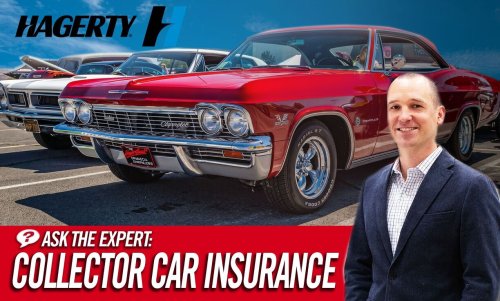
If you're interested in classic cars or classic car insurance, here's a unique opportunity to get your questions answeIf you're interested in classic cars or classic car insurance, here's a unique opportunity to get your questions answered.John Marecki is a classic car enthusiast and Chevelle owner who works for Hagerty Insurance and will be answering questions over at Chevelles.com all day.For a little more about John, see his bio below.Hey everyone! My name is John Marecki and I’m an in-house Chevelle expert at Hagerty Insurance. Ask me Anything!As a heads-up: I’ll be on here all day on Wednesday, September 3rd to answer questions. I wanted to give time for people to leave a comment so I’m posting good and early.I have personally owned 2 Chevelles so far. A 1969 Chevelle Malibu and a 1967 Chevelle SS 396. I’m very passionate about these cars and their history. The Chevelle/Malibu was Chevys entry to the mid-size sedan market. The Chevelle SS is a very complicated model especially from 1969-1972. The Chevelle started life as the Malibu in 1964 and the SS started as an trim option and was called the Malibu SS. The Chevelle/Malibu could be ordered in many different body styles from 2 or 4 door sport coupes, 2 or 4 door post sedans, Convertible and station wagon body styles were also available.In 1965-1968 the Chevelle SS was its own separate model and could be decoded and verified with its 138 VIN. From 1969 -1972 the Chevelle SS was an option package on the Malibu. The first big block Chevelle was introduced in 1965 with the Z16 option that gave you the legendary 396 Big Block Chevy engine. Only 201 Z16’s were produced in 1965! From there the true legend of the Chevelle SS began!I love researching the history and the decoding Chevelle’s. There are not many records kept from Chevrolet or GM about Chevelles but there are ways to decode and verify a true SS. A build sheet is the best way to verify a true SS. Many assembly plants like Baltimore, Atlanta and Oshawa (Canada) have been known to put the build sheet in the car many behind the door panels or under the seat springs. GM of Canada has resources to decode and verify SS production if the car was built and assembled in Oshawa. Some specific SS items included the F41 rear suspension (boxed lower control arms with a sway bar) and a 3/8 Fuel line with a return line. In 1969 there were 2 specific color options that were SS only 72 Monaco/Hugger Orange or 76 Daytona Yellow.The 1969 still holds a special place in my heart as 1969 style and options where very vast and in 1969 you could get the SS option on many body style including the Sports Coupe (Hardtop) Convertible and the baseline 300 (available in a sports coupe or 2 door post sedan) The 300 was the bare bones entry level of the Chevelle/Malibu platform. The 300 came standard with a rubber floor mat instead of carpet on the floor along with other options like radio and or heater delete. Also in 1969 you could order a COPO (Central Office Production Order) Chevelle with almost unlimited options including the historic 427 big block Chevy engine. This was a popular option for drag racers to order a bare bones Chevelle with the mighty 427 something you could not get off the showroom floor at your local Chevy dealer. Aftermarket Dealers like Don Yenko Chevrolet, Dick Harrell, Balwin Motion were just some of the places that could build you a ultimate 1969 COPO Chevelle in 1969.One of Chevrolets most iconic body styles has to be the 1970 Chevelle. The “Coke Bottle” Body style mixed with the Historic LS-5 and big daddy LS-6 454’s are some of the most prized Chevelle’s with collectors. The legendary “Cowl Induction” hood with is vacuum operated hood flap still amazed people to this day. Fun fact as rare as a LS-6 454 is that the 396 big block Chevelle has a lower production number making it actually more rare than the 454. Early 454 cars also did not get the Cowl Induction hood as this option actually came later in 1970.One las fun fact is that due to the GM strikes in 1971 the 1973 was actually supposed to be the 1972 model but due to the strike all GM A-Body vehicles (Chevelle, Cutlass, Skylark, LeMans) and other models were forced to make slight changes to the 1971 trim (Slight color changes in grilles, headlight and tail light trim) and use that for 1972.As you can see, I share your passion. With that said, I’m here to ask any questions you might have, ranging from obscure trivia to why you’d want specific insurance for your classic car. Or you can ask me about my dog, or the last car show I went to. It’s up to you.I can also provide answers on things like collectable models, buying a Chevelle or selling yours. Online car auctions seem to be all the rage these days.And while I’m not here to sell you insurance, if you do have questions about coverage, I’ll try my best to help.