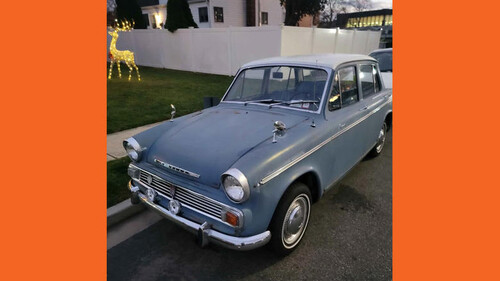
Most people overlook the 1966 Hillman Super Minx but it played its role quietlyThe 1966 Hillman Super Minx rarely appears on poster walls or auction headlines, yet it once carried British families through the 1960s with quiet competence. It sat between the basic family saloon and the aspirational executive car, doing the everyday work of motoring while louder rivals grabbed the limelight. That low-key role, more than any single headline figure, explains why most people overlook it and why it still deserves a closer look today. The forgotten sibling of a household name To understand the 1966 Hillman Super Minx, it helps to start with its better known relation, the Hillman Minx. The Minx nameplate ran from the early 1930s to 1970 and became a fixture on British roads, evolving through Phase and later Series versions as part of the Rootes Group family. As the decades went on, the Minx moved from prewar upright saloon to the sharper Audax body that defined the late 1950s and early 1960s, and it was this long presence that made the Minx a staple of British motoring culture. Owners and historians still describe how the Hillman Minx was a staple of British motoring from the 1930s to the 1970s, and how by the 1950s and 60s versions it had become a familiar sight outside suburban semis and on coastal holiday runs. A detailed community history notes that by the time the 1950s and 60s versions rolled out, the car had become one of the default choices for middle class families, sharing space with other British saloons in driveways and on high streets. In that context the Minx was not glamorous, but it was trusted. That popularity created a problem for Rootes. As postwar prosperity grew, some Minx buyers began to look upward. They wanted more space, more comfort and a touch of status, but they were not ready to jump to a full executive saloon. The gap between the family car and the executive saloon was real, and it was commercial. Rootes needed something to sit above the Minx, but still feel familiar to loyal customers. The answer was the Hillman Super Minx. Contemporary commentary framed it directly around that missing middle, asking, in effect, what filled the gap between the family car and the executive saloon. The Hillman Super Minx was introduced in the early 1960s as a larger, more comfortable derivative that shared the Minx’s basic mechanical philosophy but wrapped it in a slightly grander shell. It was not a luxury car and never tried to be one, but it was clearly a step up from the basic Minx. How the Super Minx tried to move the game on Rootes pitched the Super Minx as a car for families who had outgrown the standard Minx or simply wanted a bit more breathing room. The Super Minx carried over the conservative engineering that Rootes customers expected, but it added size, refinement and a more substantial presence on the road. Period descriptions of the Super Minx highlight this strategy, noting that it continued the traditional Rootes philosophy of offering the UK customer something technically conservative but with a touch of style and comfort that made ownership feel a little more special. In practice, that meant a bigger body, more interior space and a cabin that felt less spartan than the Minx. Club histories of the Minx line explain that the Audax range covered a host of bases, and that the Hillman Minx itself remained the best seller, yet the existence of the Super Minx allowed Rootes to stretch the same basic formula into a larger segment. The Super Minx sat above the Minx saloon, while related models like the Singer Vogue and Humber Sceptre pushed further upmarket, all sharing elements of the same underlying architecture. Under the bonnet, the Super Minx evolved over its production life. Enthusiast references explain that the original Super Minx had a cast iron cylinder head version of the familiar Rootes four cylinder engine, and that later cars adopted an alloy head for better performance and efficiency. The Super Minx itself is described as a distinct model within that broader family, with its own bodywork and trim, rather than just a lightly dressed Minx. That separation helped justify the higher price to buyers who might otherwise have stayed with the cheaper car. By the mid 1960s, the Super Minx had gained a reputation as a dependable, if unexciting, choice. A detailed feature on the 1966 model notes that the Super Minx, along with the Audax Minx and every Rootes car except the Imp, followed a consistent design language up to the last Hilman Avenger. This continuity meant that a Minx owner could step into a Super Minx and feel immediately at home, which was precisely what Rootes intended. 1966: the Super Minx in its final form The 1966 Hillman Super Minx arrived near the end of the model’s life, and by then the car had accumulated a series of incremental improvements. A focused overview of the 1966 Hillman Super Minx explains that the model from that year typically came with a 1.6-l engine, a unit that reflected the gradual capacity increases Rootes had applied to its saloon range. That same overview points out that the 1966 version carried some of the later styling updates, which gave it a slightly cleaner and more modern appearance compared with earlier Super Minx iterations. Other enthusiast material confirms that the Super Minx line eventually received larger engines as well, including a 1725 cc unit that appears in club descriptions of specific 1966 cars. A social media post titled 1966 Hillman Super Minx, for example, highlights a car powered by a 1725cc engine, while the same thread lists a 1964 Hillman Super Minx Convertible and a Stunning 1964 Hillman Super Min as related models. This mix of 1.6-l and 1725 cc references illustrates how the Super Minx straddled a transition period in Rootes engine development, with different specifications appearing in different markets and build batches. Performance figures from period style tests and modern re-creations show what that meant on the road. In a video review of a 1960s Hillman Super Minx Mk3, the presenter explains that the car could achieve a top speed of around 80 m and do 0 to 60 in just over 21 seconds. Those numbers place the Super Minx firmly in the middle of the 1960s family saloon pack, behind the quickest rivals but entirely adequate for British roads of the time. The same video notes that this Mk3 was the last of the Super Minxes to be fitted with certain earlier features, which underlines how the 1966 cars represented a final, tidied version of the concept. From the driver’s seat, the 1966 Super Minx feels very much like the car Rootes intended it to be. In a modern road test by Steph from My Driver Classic, filmed in a 1960s Hillman Super Minx Mk3, the host introduces herself with the line, “hello I am Steph from My Driver Classic, and today I am taking you out in a car which I think is going to win you over just as much,” before proceeding to demonstrate the car’s relaxed gait and surprisingly compliant ride. The video, which focuses on a well preserved example, shows how the Super Minx’s light steering and soft suspension make it easy to place on narrow lanes, even if it leans noticeably in bends. The 1966 model also benefited from the gradual refinement of interior fittings. Period brochures and enthusiast scans describe a more modern dashboard layout, better seats and improved trim compared with earlier cars. A fold out brochure shared in a classic car group lists 1966 Hillman Super Minx key features under headings like Todd Brennan Racing and Sport Cars, and includes a 1966 Hillman Super Minx Overview that starts with a Production Period section. That overview confirms that the Hillman Super Minx was produced from the early 1960s through to the mid decade, with the 1966 cars among the last saloons before replacement. Although the Super Minx never became a performance icon, it did what it set out to do. It took the basic virtues of the Minx, added size and comfort, and wrapped them in styling that still looks understatedly handsome today. The 1966 version, with its 1.6-l specification and tidied bodywork, represents that formula at its most mature. Placed between the Minx and the Hunter The 1966 Hillman Super Minx also sits at a turning point in the Rootes product story. By that year, the company was preparing a new generation of cars to compete with the rising Ford Cortina and other rivals. The Hillman Hunter replaced the Super Minx saloon in 1966, with the Estate version available until 1967, and period analysis describes the Hillman Hunter as an expression of new thinking from a company which had previously prospered on more conservative designs. The Hunter kept some mechanical links to the Super Minx, but its styling and marketing signaled a break from the old Minx based hierarchy. That shift helps explain why the Super Minx faded so quickly from public memory. The Minx name had decades of recognition, and the Hunter arrived with a clear mission to take on the Cortina, yet the Super Minx was caught in between. It existed to fill a gap for a few years, and once the Hunter arrived, Rootes and later Chrysler had little reason to keep talking about it. The Hillman marque itself was eventually discontinued in the mid 1970s, which further blurred the brand’s back catalogue for later generations. Within the Minx family, the Super Minx also occupied an awkward space. A detailed buyer’s guide to the Minx explains that although the Audax range covered a host of bases, the Hillman Minx was by far the best seller, and that in 1960 Rootes installed a more modern engine to keep it competitive. The Super Minx, launched slightly later, shared much of that mechanical DNA but did not have the same name recognition. For many British drivers, the Minx was the car they remembered, while the Super Minx became a half recalled variant. Contemporary video essays on the Hillman Minkx concept reinforce this point. One analysis describes how the Hillman Minkx was once everywhere on British roads, but today hardly anyone remembers it, while cars like the Morris Minor have become cultural touchstones. If the core Minx itself struggles for recognition compared with the Morris Minor, the Super Minx sits another step back in the shadows. The same applies to the Hilman Minkx featured in another enthusiast video, which treats the Minx line as a kind of unsung backbone of British motoring rather than a star in its own right. Language and regional coverage add another layer of obscurity. The Minx appears in Arabic, German, Finnish and French reference works, with entries on the model that were discovered via citation trails from an Untitled English language article. These multilingual references confirm the Minx’s international reach, yet they rarely single out the Super Minx for special attention. The Super Minx is acknowledged, but usually as a branch of the Minx story rather than a headline act. Everyday workhorse, not poster car Why, then, does the 1966 Hillman Super Minx matter at all today? The answer lies in the kind of motoring it represents. Club write ups of a 1963 HILLMAN MINX 1600, for instance, explain that the Minx offered good practicality with a spacious cabin, a roomy boot and durable materials, and that the Hillman became a familiar sight on British roads throughout the 1950s and 60s. The Super Minx took that same ethos and stretched it slightly, giving families more space for luggage, children and the growing paraphernalia of modern life. Classic car enthusiasts who encounter a surviving Super Minx often comment on how ordinary it feels, and how that ordinariness has become its charm. The Curbside Classic feature on a 1966 Hillman Super Minx describes a car that is technically conservative but visually distinctive, with subtle styling cues that mark it out from the Minx without drawing too much attention. The piece notes that the Super Minx and the Audax Minx and other Rootes cars shared a coherent design language that made the whole range instantly recognizable to contemporary buyers. Modern video content reinforces this impression. The 1960s Hillman Super Minx Mk3 review that records the 80 m top speed and 0 to 60 in just over 21 seconds also spends time on the car’s day to day usability. The presenter points out the generous glass area, the light controls and the way the car shrugs off poor road surfaces, all qualities that mattered to families far more than outright speed. The same channel’s shorter clip, hosted by Steph from My Driver Classic, underlines how a well sorted Super Minx can still win over drivers who are used to newer machinery, simply by being honest and easygoing. Owners in online groups echo that sentiment. One enthusiast post about a 1966 Hillman Super Minx notes that people like these motorcars because they have characterful details like a red dashboard and period trim, while still being usable in modern traffic. Another club entry on the Minx series describes how Over the years the engine was increased in capacity from 1390 cc in the Series I and II to 1725 cc in the later Series, which gave both Minx and Super Minx variants enough torque to cope with motorways and continental touring. The Super Minx, with its larger body, made the most of those incremental gains. For many families, cars like the Super Minx were part of life’s milestones. They took children to school, couples on honeymoons and grandparents to seaside boarding houses. They were not bought to be cherished as classics, but to be used. That utilitarian role is one reason so few survive. When the time came, they were traded in, scrapped or simply driven into the ground, replaced by Hunters, Avengers and eventually front wheel drive hatchbacks that made them feel old fashioned. Yet precisely because the Super Minx was not a poster car, surviving examples tell a different story from the usual classic show field. They speak of the middle of the market, where engineering budgets were tight and styling had to be carefully judged to avoid alienating conservative buyers. They show how companies like Rootes tried to stretch a single platform into multiple niches, using badges like Minx, Super Minx and Singer Vogue to cover as many price points as possible without entirely new designs. Why the 1966 Super Minx deserves a second look In the context of 1960s British motoring, the 1966 Hillman Super Minx was never a star. It did not introduce radical technology, and it did not dominate motorsport or define youth culture. Instead, it played its role quietly, bridging the gap between the workaday Minx and the more aspirational Hunter. That quiet role is precisely why it has slipped from popular memory, yet it is also why it matters to enthusiasts who care about how ordinary people actually lived and drove. From a historical perspective, the Super Minx illustrates how a mid century carmaker tried to manage a portfolio of overlapping models. Rootes used the Minx as a base, added the Super Minx as a step up and then launched the Hunter to modernize the range. Each move reflected changing expectations about space, comfort and style in family cars. The 1966 Super Minx, sitting at the end of its line and just before the Hunter’s debut, captures that transition in metal. From a driving perspective, surviving Super Minxes offer a reminder that not every classic needs to be fast or famous to be satisfying. The combination of a 1.6-l or 1725 cc engine, a top speed around 80 m and a 0 to 60 time in just over 60 seconds may sound modest on paper, but on the right road it is more than enough. The car’s light controls, generous glass and soft ride make it a relaxed companion, exactly what many families wanted in the 1960s and what some enthusiasts still appreciate today. Finally, from a cultural perspective, the 1966 Hillman Super Minx stands for a kind of understated British motoring that is easy to overlook in an age of curated nostalgia. It lacks the cult following of the Morris Minor or the Mini, and it carries a badge that disappeared decades ago. Yet behind that anonymity lies a story of quiet service, of school runs and seaside trips, of a car that did its job without fuss. For those who take the time to look past the headline names, that makes the Super Minx worth remembering. More from Fast Lane Only Unboxing the WWII Jeep in a Crate 15 rare Chevys collectors are quietly buying 10 underrated V8s still worth hunting down Police notice this before you even roll window down The post Most people overlook the 1966 Hillman Super Minx but it played its role quietly appeared first on FAST LANE ONLY.