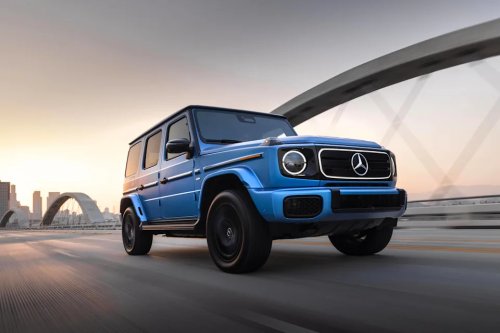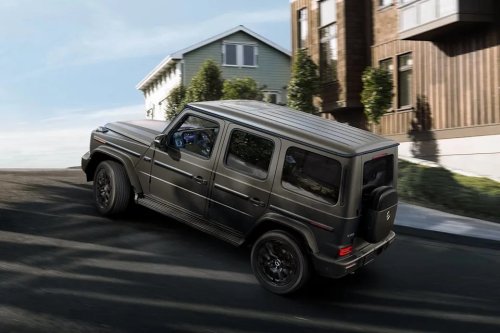














Mercedes Floating SUV Patent: Buoyancy Math, Boat Laws, and InsuranceBackfire NewsEve NowellFri, September 11, 2026 at 5:11 PM UTCAdd us on GoogleMercedes Floating SUV Patent: Buoyancy Math, Boat Laws, and InsuranceEvery serious off-roader has one number in its spec sheet that really means "turn around here." For the electric G-Class, that number is 850 millimeters. Mercedes-Benz's latest German patent application asks a stranger question: what if you stopped worrying about how deep the water is and started worrying about how well the truck floats?What the Application DescribesThe application, listed in the German patent register, reportedly describes removable buoyancy inserts, made of foam or inflatable material, that sit in the wheel arches. A control unit would adjust buoyancy at different points on the vehicle to handle an uneven load or a current. The deflated inserts would be stowed near the spare-wheel area and inflated with the tire compressor. Once afloat, the wheels would keep turning and steering, the suspension would raise or lower individual wheels, and the steered wheels would work something like rudders. Individual wheel control would vary torque and wheel speed, including spinning wheels in opposite directions to turn or counter a current.The filing reportedly doesn't name the G-Class, the application is still pending, and Mercedes already holds a separate German patent for a floating-vehicle concept granted in December 2025.AdvertisementAdvertisementMercedes hasn't announced a product, and patents protect ideas, not build plans. Still, the idea is worth taking apart, because it runs into physics, maritime law, and insurance fine print all at once.Three Tons of ArithmeticBuoyancy is simple and unforgiving: a floating object has to displace its own weight in water. The G 580 with EQ Technology has a curb weight of 6,746 lb. Fresh water weighs about 62.4 lb per cubic foot, so an empty G 580 needs to displace roughly 108 cubic feet of water, about 3,060 liters, just to break even. That's more than three times the truck's 34.8 cubic feet of cargo space, and it's before you add passengers, gear, or a cooler of Spaten.Related ArticlesBoris Said's Lake Elsinore Track Club: What the Plans Show and What's MissingLia Block Just Beat Every Car at Ojibwe, Not Just the Field in Her ClassAnalysis: Even generous inserts filling all four wheel arches would provide only a fraction of that volume. Most of the lift has to come from the body displacing water, which means the hard engineering is keeping water out: door seals, cabin vents, and high-voltage connectors. That makes the inserts' likelier role trim rather than lift. They'd keep the truck level when the weight isn't evenly distributed, which fits the per-corner control the filing reportedly describes.AdvertisementAdvertisementThe electric G has one advantage here. Mercedes says the 116-kWh battery built into the ladder frame gives the vehicle a low center of gravity, according to its Canadian press kit. On the water, a heavy mass mounted low works like a keel's ballast, and it's the main thing keeping a floating box from rolling onto its side.Why the Electric G Is the Obvious CandidateThe G 580 already goes deeper than its gas-powered siblings. Mercedes rates its maximum fording depth at 850 mm, 150 mm more than the G 550 and AMG G 63. The mechanical reason is straightforward: electric motors don't need air. A combustion engine needs a steady supply of intake air and can hydrolock if it swallows water, which is why serious ICE off-roaders wear snorkels.The drivetrain also matches the patent's approach. The G 580 has four motors, one near each wheel, sharing 579 hp and 859 lb-ft, and its G-TURN function can spin the truck up to two full rotations in place by driving wheels in opposite directions. It requires Low Range and Rock mode. Analysis: counter-rotating wheels to change heading in water is essentially G-TURN adapted for a lake. The hardware is already in showrooms. The open question is the software.The idea of using a car's wheels to paddle isn't new. A USPTO patent from the 1990s cites a 1961 patent by L. A. Curcio in which a car sat on an inflatable raft with its wheels dropping through openings in the floor. Turning the wheels moved the raft, and ribbed belts could be fitted over the tires for more thrust. Analysis: that belt detail shows the real limitation. Road tires are designed to push water out of the way, not to push against it, so any wheel-driven SUV will move through water at something closer to a slow walk than a jet-ski pace.Once It Floats, It's a BoatThis is where the legal side gets complicated. Asked whether an Argo amphibious ATV counted as a vessel, the Coast Guard's legal opinion applied the federal definition, which covers any contrivance "capable of being used, as a means of transportation on water." It concluded the machine is a vessel while on the water and falls under Coast Guard regulation. A floating G-Class would almost certainly get the same treatment.AdvertisementAdvertisementThat brings real obligations. Recreational vessels must show navigation lights from sunset to sunrise and in poor visibility, according to Florida's wildlife agency. The Coast Guard's navigation rules require a red sidelight on the port side and green on starboard. Picture a G 580 with running lights like a bass boat. [VERIFY] Mercedes' earlier granted patent reportedly includes separate marine lighting, which suggests someone in Stuttgart has already read these rules.Florida also groups vessels by length, with its own equipment list for boats between 16 and 26 feet. At 182 inches, a G 580 would actually fall into the smaller class below that.Commercial use is stricter still. Amphibious vehicles that carry passengers for hire count as small passenger vessels and require Coast Guard inspection under the Subchapter T rules, according to a Coast Guard circular. Any expedition outfitter picturing paying customers crossing a river in a floating G would be looking at a marine inspection process, not just a DMV visit.Insurance and Repair: The Questions to AskThis section is analysis, and it comes down to one thing: get the answers in writing. If the truck legally becomes a vessel when it floats, an auto policy may not cover what happens on the water at all, and a marine policy may not cover the vehicle on land. Auto comprehensive coverage typically handles flood damage, but a flood that happens to you is different from a lake you deliberately drive into. Expect insurers to spot that distinction immediately.Related ArticlesToyota's Hydrogen Truck Math: 1,500 Rigs, 30 Stations, One Break-Even NumberA Car Ended Up Balanced on an Atlanta Overpass Beam, and the Driver Walked Away From ItAdvertisementAdvertisementFor repairs, think about what's underneath once the truck climbs back out. Wheel bearings, brake hardware, suspension bushings, and electrical connectors will all have been submerged. Salt water would add corrosion to the list, meaning a thorough frame rinse becomes mandatory. Any water in the cabin means soaked carpet and seat foam, and mold after that. On a truck that starts at $163,200, a single bad crossing could turn into a total-loss conversation.Why Mercedes Is BotheringMercedes' factory off-roader has never sold better. The company reported best-ever G-Class sales in 2025, and Mercedes-Benz USA said its U.S. G-Class sales rose 26 percent, the model's best year ever. Buyers at this level pay for capability they'll rarely use, and G-TURN is the proof. Analysis: a floating mode would fit that pattern, and a patent also stakes a legal claim on the idea whether or not it ever reaches production. There's also a practical case for flood response and emergency services, where a vehicle that can float to safety has more obvious value than it does on a weekend trail.For now, the takeaway is simple. The 850 mm fording limit is still the only water rating Mercedes actually promises. Anything past that line is a vessel, an insurance claim, or both.