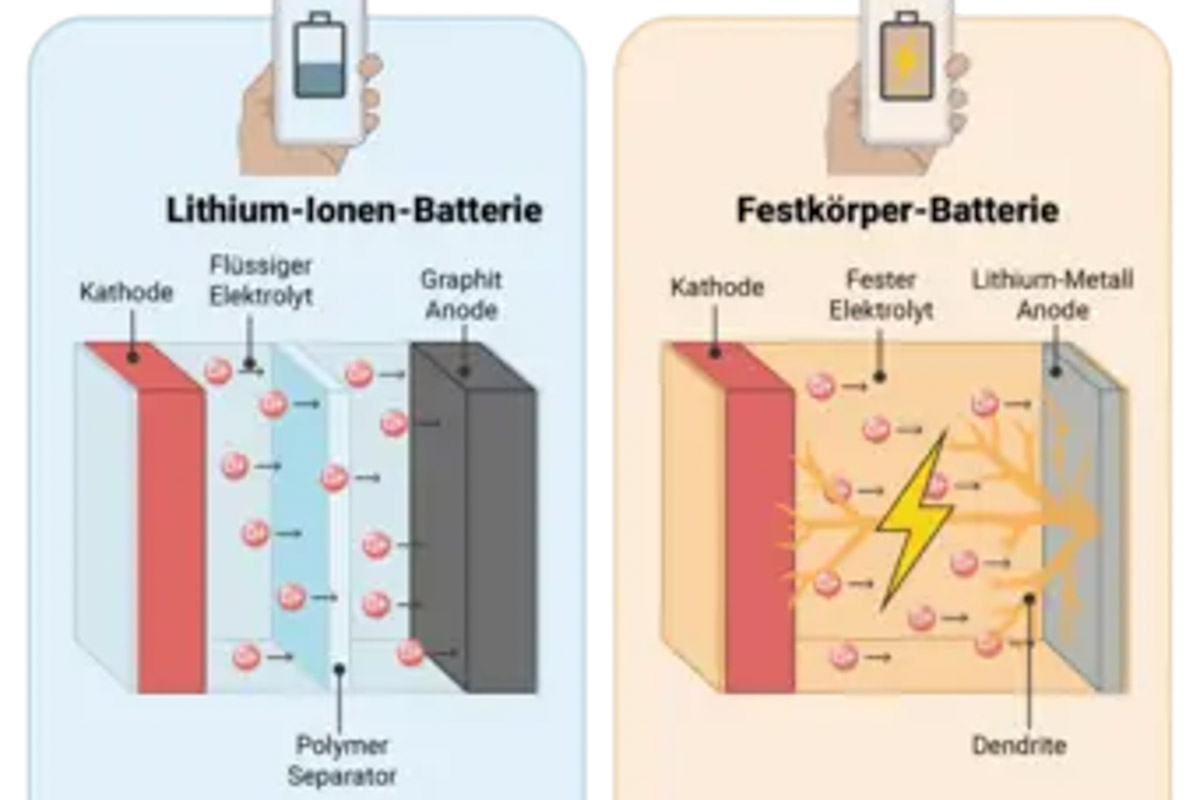
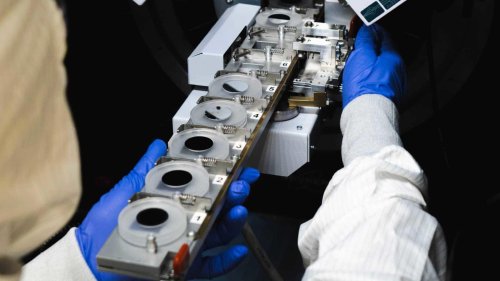
Image: Max-Planck-InstitutDendrites are a well-known problem in today’s lithium-ion batteries that use liquid electrolytes. In these cells, lithium deposits can grow so extensively that they damage the critical separator film, leading to a short circuit between the anode and cathode. However, dendrites also pose a significant challenge in solid-state batteries. Max Planck Institute for Sustainable Materials explains that these tiny, tree-like structures grow from the negative terminal (anode), penetrate the solid electrolyte, and extend to the positive terminal (cathode), causing an internal short circuit in the battery. Until now, the exact mechanism behind this process has been unclear.An interdisciplinary team from the institute has published its findings in the scientific journal Nature. The researchers investigated how the inherently soft lithium metal of the electrodes can damage the hard ceramic electrolyte.“Although the electrodes and the forming dendrites consist of lithium metal, which is soft like a gummy bear, the dendrites are able to penetrate the ceramic electrolyte and lead to a short circuit,” says Yuwei Zhang, lead author of the study and research group leader at the Max Planck Institute for Sustainable Materials. “How can soft dendrites fracture the stiff solid ceramic? There are two hypotheses: either internal stress is built up inside the dendrites and induces mechanical fracture of the solid electrolyte. Or, electrons leak along the grain boundaries of the solid electrolyte, promoting the formation of lithium nuclei that interconnect later.”The experimental setup was complex: the samples were prepared and examined under vacuum and at cryogenic temperatures to exclude the effects of oxygen, water, or the electron beam of the microscopes. The effort paid off, as the results were as clear as expected. The research team found that no additional lithium accumulates at the tip of the dendrites.“The soft lithium metal is able to penetrate the stiff ceramic electrolyte, like a continuous water jet that penetrates a rock. We calculated that hydrostatic stress in the dendrite leads to brittle fracture of the solid electrolyte in the end,” explains Zhang. Simulations and measurements using electron backscatter diffraction confirmed this result.This insight is crucial for preventing or at least slowing dendrite growth to ensure that short circuits do not occur during a battery’s typical lifespan. “Possible approaches include increasing the strength of the electrolyte to stop or slow crack formation, introducing microscopic cavities to redirect dendrite growth, or applying protective coatings to the lithium electrodes to suppress dendrite formation,” states the institute.mpie.de