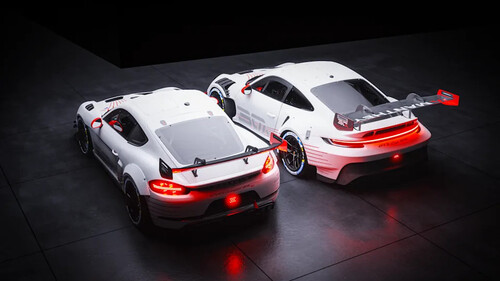
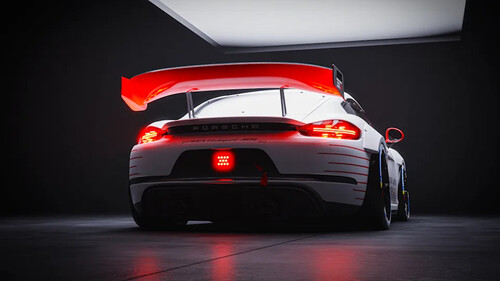
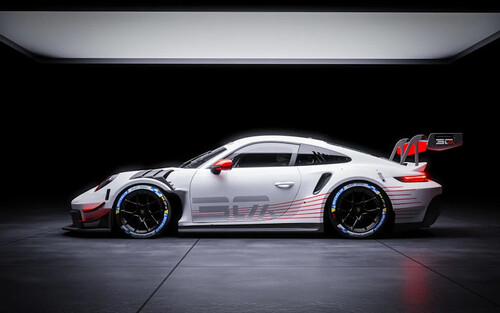
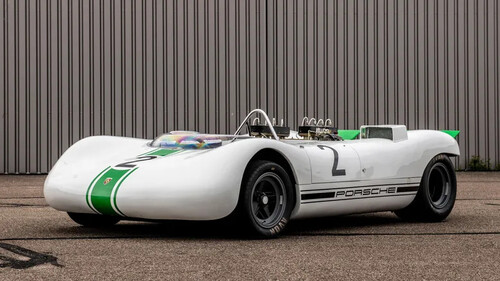
If you’re a real Porsche race fan, and if you’re reading this you probably are, you recall the mighty and powerful 935 of the 1970s and '80s. Porsche is celebrating the 50th anniversary of that car at the same time as its own 75th anniversary of racing with a special livery at this weekend’s IMSA Weathertech Sports Car Championship.That timeframe was also the dawn of the personal computer, and since the race takes place at Weathertech Raceway Laguna Seca, just a crankshaft’s throw from Apple Park, the company’s worldwide headquarters in Silicon Valley, Porsche will run vintage Apple Computer liveries on a pair of its championship-winning Porsche Penske Motorsport 963s. The special wrap is based on the D*** Barbour Racing Porsche 935 K3, which ran in 1980, including at the 24 hours of Le Mans. Vintage Apple Computers At The Computer History Museum, Mountain ViewA Porsche race car first carried Apple colors in that 1980 season, when the US-based D*** Barbour Racing customer team entered an appropriately liveried 935 K3. It was at that same venue – Laguna Seca - that Porsche Motorsport’s success story began in 1951 with a class victory for the 356 SL.The fourth round of the IMSA WeatherTech SportsCar Championship at Laguna Seca Raceway will be contested over two hours and 40 minutes on May 3. In the top-tier GTP category, Porsche Penske Motorsport will field two Porsche 963 entries. The No. 6 car will be shared by France’s Kévin Estre and Belgian Laurens Vanthoor. In the sister car, No. 7, Frenchman Julien Andlauer and Brazilian Felipe Nasr will take the wheel. Together with German Laurin Heinrich, the duo opened the season with victories at the 24 Hours of Daytona and the 12 Hours of Sebring and currently lead the championship standings. Porsche also sits atop the manufacturers’ classification.“The Laguna Seca circuit suits both our team and our car extremely well,” said Urs Kuratle, head of Works Motorsport LMDh. “Last year, we achieved a one-two finish there and further underlined the status of the Porsche 963 as the most successful car built to LMDh regulations. Beginning of April, a two-day test at Laguna Seca provided us with valuable data that will help us fine-tune our hybrid prototypes for the upcoming race weekend.”Der ErsteThe 935, as you’ll recall, started with the 1976 model. “Few racing cars embody the relentless pushing of boundaries as consistently as the Porsche 935,” the company noted on the car’s golden anniversary date March 30 2026. “Developed on the basis of the Porsche 911 and designed for the then newly introduced Group 5 category, it took shape precisely where the regulations left room for interpretation – while simultaneously challenging those very limits.”It did that with widened fenders and much more power.“We wanted to eliminate the drawbacks of the large single turbocharger,” Norbert Singer recalled in a documentary made for the anniversary. Singer, a visionary racing engineer and master of aerodynamics, played a role in every overall victory for Porsche at Le Mans from 1970 to 1998 – from the 917 to the 911 GT1 '98. “Two smaller turbochargers respond more quickly, which means less turbo lag and more controllable power delivery. For the drivers, this was a major step forward in terms of drivability.”Das BabyThat was followed by removing as much weight as possible.“Anything that wasn’t absolutely necessary was removed,” Singer said. “We examined every single part and questioned its purpose.” That meant doing without seat adjustment and even punching holes in the ignition key. The underbody was replaced by an aluminium frame, steel disappeared, and stiffness was rethought. The result was a chassis that weighed below the minimum limit. The downsized 1.4-liter engine placed the ‘Baby’ in the two-liter class. It had plenty of power, but it needed to rev high. In the documentary, two-time Le Mans winner Timo Bernhard describes the experience from a race car driver’s perspective: “Restrained below 5,000 rpm, but suddenly assertive above that. A car that demands concentration. And respect.”Der Moby DickEpisodes of extremes: the 935/78 “Moby D***”When Singer recognized the potential of Group 5 in the autumn of 1977, he didn’t create another derivative of the 911, Porsche noted. He designed a car at the very edge of the regulations. The rules allowed extensive modifications, and he reimagined the 935 with a clear goal: a Le Mans contender whose aerodynamics deliberately broke away from the familiar silhouette. The 935/78, later nicknamed “Moby D***,” made its public debut in 1978. Already in practice for the six-hour race at Silverstone, it was two seconds faster than the rest of the field and went on to win the World Championship race with a commanding lead. The technical foundation: a 3.2-liter flat-six with twin-turbocharging, featuring water-cooled four-valve cylinder heads for the first time on air-cooled cylinders.For sprint and World Championship races, up to 845 hp was available, while power was deliberately reduced for Le Mans. “What matters isn’t just power, but how the car resists the airflow,” Singer explained. He also detailed the measures taken to reduce drag to such an extent that the car reached 366 km/h (227 mph) on the Hunaudières straight. Its career was short-lived and limited to just two vehicles. And yet the “Moby D***” remains unforgettable to this day: “It was the crowning achievement of the whole project,” said Singer.Porsche 935The first: the 935/77 test carIn the fifth and final episode of the documentary series, Bernhard and Singer come full circle with a car that was never intended for championship glory yet made everything possible: the first 935 test car from 1977. The test car itself saw only one race at the Norisring. Its real purpose lay elsewhere. It served as a test bed, a think tank on wheels. It even played a part in an extraordinary project: a speed record attempt with track cyclist Jean-Claude Rude, with the 935 serving as a pace car and aiming for speeds beyond 240 km/h (149 mph).Porsche 935Finally, the race engineer looked back on all the evolutions of the 935. What remains true in the anniversary year of “75 Years of Porsche Motorsport” was already true back then: a racing car must be fast, but also reliable, intuitive, and robust. Only once it proves capable of winning does it go to the customers. And they, in turn, went to score points on racetracks around the world.