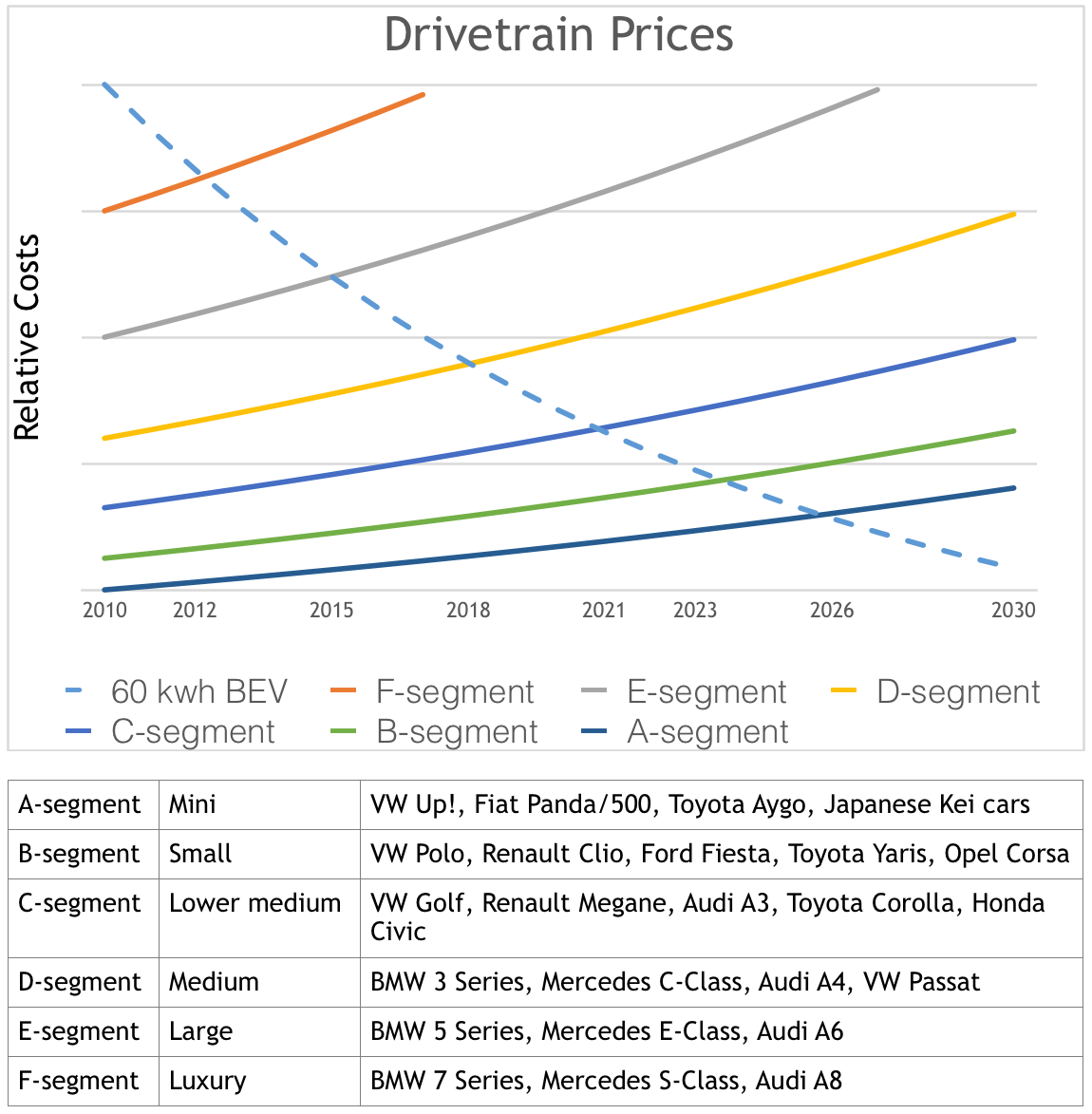
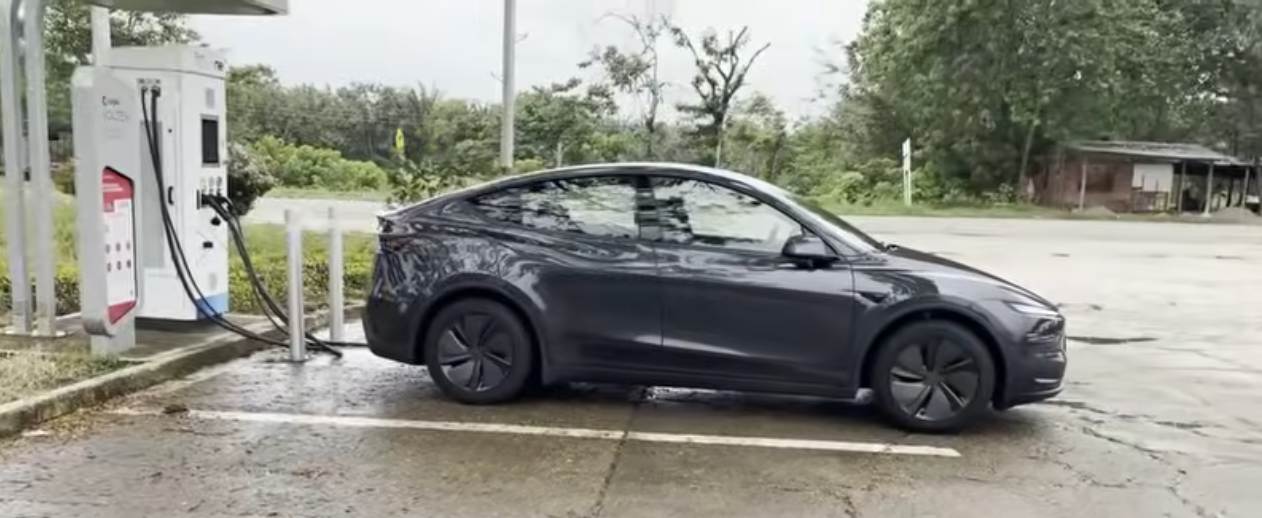



















Back in 2019, I read an article in this very site regarding the Osborne effect and the upcoming risks it represented for the Auto Industry. It remains one of my favorite articles of all time, and it had this very interesting chart that put into perspective what had been the promise for EVs since the beginning of that decade: that they would, one day, be as affordable as ICEVs: Back then, this was little more than a dream. Sure, the Model 3 was being produced in full swing by then, but at some $37,000 it remained expensive, more so if we remember than in those days a Toyota Corolla could be purchased by $23,000. Sure, the US, Europe and China had very generous incentive schemes, but that was of little relevance for us natives of developing nations, where EVs remained a very expensive rarity. I remember well that here in Colombia a Renault Zoe with the 40kWh battery would cost exactly three times as much as the comparable Renault Sandero, while being much less useful overall. Sales back then were counted in the dozens, with the total tally for the country well below a thousand for an entire year. But the tide has changed. Thanks to hyper-affordable Chinese EVs, many markets around the world have started to see more and more accessible electric vehicles; in some, thanks to a combination between competition and policy, EVs can already be found at cheaper prices than their direct combustion competition. I live in one such countries. The change has been dramatic and much faster than the most optimistic among us expected. And I’m here to tell you all about it. The road to price parity We start our story back in the pre-pandemic times, when — as mentioned — an average EV would cost about three times as much as an ICEV. By 2022 the difference between the technologies had shrunk and some EVs (mainly from less-known brands) were “only” around twice as much as comparable combustion cars. Unlike the gentle slope in the graph we presented at the beginning of this article, the trend was not linear. Things stayed more or less static until 2024, when the arrival of the BYD Seagull and Yuan Up further pressured EV prices down, arguably bringing price parity in the entry-level SUV segment. After a few months, things moved again with the arrival of affordable SUVs around mid-2025, being particularly relevant the Chery ICar 03, the first capable EV off-roader in the country. But the trigger for the dramatic price war we’ve seen in 2026 was Tesla. After arriving with the most affordable Teslas in the world in 2025, the start of deliveries (with quite a few delays) has cemented the notion that the EV market is no longer a premium one, and the way to go is to offer electric cars that are cheaper than their combustion counterparts. And boy has the marked moved. The Chery E5, a 4.5m long SUV, became the second most affordable SUV in the market last month, at a mere $21,150, only outpriced by the fossil MG ZS at $20,000, and massively cheaper than the popular Mazda CX30 which costs $29,900. The Chery ICar 03 remains the second most affordable off-roader in the country, only outcompeted by the much smaller Suzuki Jimny. Electric city cars have also fallen in price, with the JAC E10X now only $1,600 more expensive than the Kia Picanto and the Renault Kwid (Colombia’s most affordable ICEVs). E-Hatchbacks, a very important segment in the country, have stabilized at around $20,000, with the Dongfeng Box, the Geely EX2 and the new MG4 arriving at just below that price, and the slightly larger and better equipped GAC Aion UT at $21,150. This is already at price parity with most ICEVs in this segment (such as the Suzuki Swift or the Chevrolet Onix), and only some $2,500 more expensive than the entry level Renault Sandero and Kia Soluto (which have far worse equipment). And, unsurprisingly, Tesla has completely dominated the overall market, with the Model Y becoming Colombia’s most sold vehicle in March and April, nearly tripling the results of the second place (Renault Duster), and the Model 3 being the country’s most-sold sedan, outselling the much more affordable Renault Logan and Mazda 2. The mainstreaming of EVs EVs were already hot in Colombia, but Tesla’s arrival has poured fuel on what was already a burning fire. Local media has started to talk about the “Tesla Effect” — the lowering of prices on most EV segments (and some ICEV segments) as a result of competition from Musk’s brand. But I’d argue the effect has gone beyond that: besides lower prices, Tesla’s arrival has triggered what could be called the “mainstreaming” of EVs, both because the popularity of the brand has nearly doubled EV sales (with BEVs reaching 20% market share in April) and because the price war that it triggered has brought a lot of attention on many other models. This has been visible in the media — now regularly covering things such as charging infrastructure limitations, Tesla delivery delays, and of course every new affordable model arriving in the country — and in car forums online, where the discourse has quickly switched from “EVs will never work” to “my next car will be an EV once the infrastructure is there.” And this is perhaps the most notable change. Forums where people would normally discuss whether a Toyota, Kia or Hyundai would be a better purchase, now always have several comments recommending a Tesla, a Chery or a BYD. MG, Dongfeng, Chery and Deepal have gone from barely known names to well recognized brands in a matter of months, thanks either to their aggressive designs (in the case of Deepal) or to the amount of recognition their hyper-affordable models have been gathering. Lots of people now regularly comment that they’re considering an EV despite never thinking about it before simply because they are affordable enough to compete on their own merits, plus the exemption from traffic restrictions makes them very desirable. Curiously, savings from lower fuel and maintenance cost seem to be a distant third reason why people would prefer them. Infrastructure has been popping up everywhere, and at least two new companies have launched their own apps since Tesla arrived, but EV sales have grown more rapidly and this remains the main bottleneck for EVs: last peak travel season, there were reports of 12-hour wait times in some stations (50kW, one plug, 10 cars waiting). There have also been videos on lines in fast-charging stations in the big cities. Despite this, tons of comments insist that so long as you have an outlet at home, you can basically forego public charging stations until the time comes when there are enough of them. Final thoughts There are a lot of reasons to be very optimistic about the future of EV sales in the Colombian market. Videos of Tesla drivers doing very long trips have become common on Youtube. People watch, learn, and get a bit less scared of buying their own afterwards, comments are overwhelmingly positive, and you can see in the videos the interest the charging EVs bring upon themselves from other drivers. Tesla Model Y charging in Colombia. Source: Viaje de 1,000 km en Model Y (Bogotá – Barranquilla) Charging infrastructure is still limited, but frankly the negative comments have been far less than I expected; it’s mostly a “charge at home until it’s better” thing, and there’s hope that it will improve. Apartment owners have also joined forces to press for the authorization of installing plugs in their parking spots (which here are normally owned by the person, not the building, though there are exceptions), and there has been learning on that matter, though requests are still often denied. I myself am involved in one such requests. The market has matured very fast, and where there once were only a couple options, we now have plenty. Brands try to one-up each other by showing more modern, capable and affordable EVs, and this has brought a lot of compelling models in multiple segments, providing options for every taste. Still, even then, the chart presented at the start of this article was too optimistic, as it presented the expected prices for a car with a 60 kWh battery … and those are still (more) expensive. The affordable city-cars are still limited to 30 kWh, the affordable hatchbacks, to 40 kWh. The entry level electric SUV segment normally boasts a 50 kWh battery. To get to a 60 kWh car, you have to move up all the way to a GAC Aion Y ($28,250) or a Geely EX5 ($29,000). But neither range, nor charging speeds, nor charging infrastructure, have proven to be the limit that many said they would be. I argued many times in the past that in developing markets economy trumps comfort, and thus that cost was the main factor limiting EV adoption; well, now I argue that cost is the main factor promoting it, as EVs are being perceived as more useful vehicles at equal or lower prices. Low EV prices are not only a matter of competition: the Colombian government has waived all tariffs on BEVs and charges a preferential VAT of only 5% on them (one of the main reasons they remain so much more popular than PHEVs). These policies are likely to be reversed by the end of the decade at the latest, hopefully, by then prices will have fallen to a point where this will only be a minor nuisance. At last, it’s good to see Tesla going back into the EV business and taking ownership on what used to be its mission, even if only in a small market such as ours. EVs would be booming either way, but the rate has now increased thanks to this brand, and we’re well on course to reaching 50% by 2028 at the latest. Hopefully, it will be even faster than that.