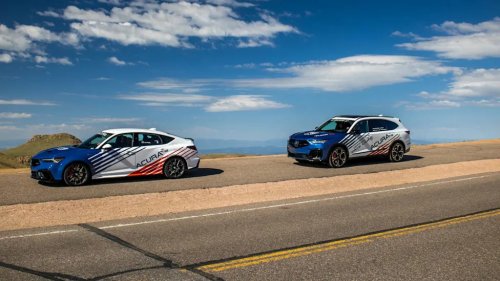
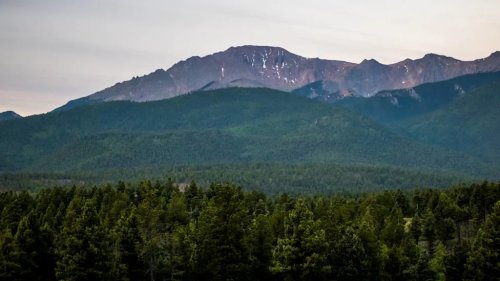
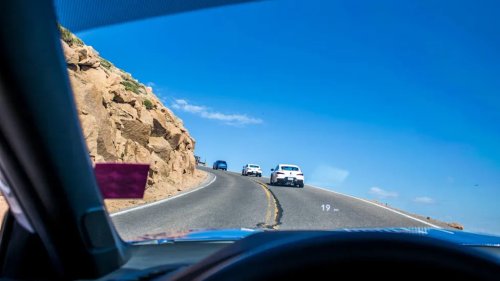
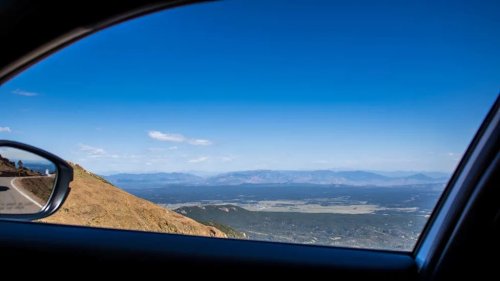
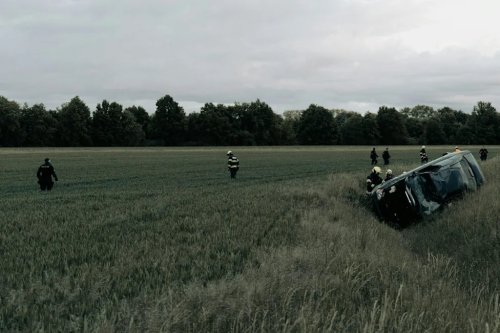
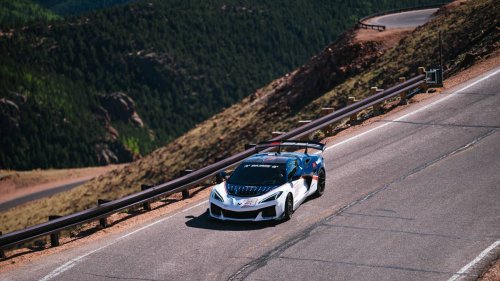
Autoblog and Yahoo may earn commission from links in this article.Pikes Peak is a mountain of mornings. Early ones. My 6:00 AM call time, therefore, felt luxurious. Four identical Acura Integra Type S sat wrapped in a special livery outside the hotel. A fifth, this year's pace car, would join us, driven by Two-time Olympian Kaysha Love and co-piloted by her fiancé and Olympian Hunter Powell.Our goal is everyone's goal over the long race weekend: get to the top. We'd be going as tourists in a well-managed convoy, though, not tearing up the mountain in a blur in Dai Yoshihara's red, roll-cage-laden Type S racer that would be gunning for the front-drive record. Despite that huge safety net, it's still too easy to get lost on the mountain and make a mistake.Pikes Peak Leaves No Margin For ErrorThe lower sections of Pikes Peak are familiar to anyone who has driven through a temperate forest before. Conifers, pines, and aspen trees frequently keep you from seeing more than a few feet off the roadside. The road itself is, like so many others in Colorado, just two lanes - one in each direction. At first, this isn't very intimidating, the trees shielding you from a reality you're scarcely aware of at normal speeds: altitudeEventually, the trees lose the ability to grow, revealing just how thin the margins are at Pikes Peak.Chase BierenkovenAll day, I lingered at the back of the convoy, slowing to six or seven miles per hour, then racing up behind the next car, trying to taste what it would be like to run the course at pace. Drivers don't get this chance - even in practice. Instead, the only time anyone drives Pikes Peak Highway in anger is during their one and only attempt at a time on race day.At Pikes Peak, Death Sits On Every ApexAround 12,500 feet in elevation, the green wrapper falls away, leaving naked rock and asphalt. Overwhelmingly, accidents seem to happen here. Jeremy Foley's famous crash near the top is the de facto example of how quickly things can go wrong. All it takes is misplacing one corner in the map in your head. 156 turns is a big map to keep locked away up there. At near 14,000 feet, your brain stops working the way it does at sea level: the thin air plays havoc on your ability to reason, to breathe, to move your body.Days later, we'd see the crashes happen in front of our eyes, on the roads we had just driven, and in some cases, just before. Rob Holland, a lifelong racer who lives in Colorado, has done the course nine previous times and crashed his car in practice. Holland called it the biggest crash of his career, and he was lucky his car crashed on the inside of the corner, and not over the edge as so many dread.AdvertisementAdvertisementPatrick Culligan was less lucky. In the same place as Holland, he crashed. Losing control, the car slammed into the rock, breaking his femur and his pelvis. Alive but battered, he was airlifted to a hospital after suffering a horrible accident on roads tourists drive up every day. The line, always, is truly that thin.Horrifying, Pikes Peak Is Also MagicalAble to be viewed from over two hours away in Denver, the summit of Pikes Peak is remarkably flat up closeChase BierenkovenThe Integra Type S isn't a bad car for the job, if you're going to the top. Front-wheel drive, the small, stick-shift hatchback is also turbocharged. With 320 horsepower to those front wheels, the grip is there for those tight corners where the car floats up on three or even two wheels as you scamble up the ever-steepening grades. Turbocharging means altitude carries less of a penalty, as the turbo compresses the thinning air and feeds it into the engine.At times, the road simply vanishes, fading to sky.Chase BierenkovenView the 2 images of this gallery on the original articleOf course, the course is a lot more fun with the rules of the road acting as a safety net. Frequent animal crossings, traffic, and cars ahead keep your pace low, but the trechery is clear. Loni Unser was seated next to me on the upper sections of the track, and served as a guide for the most trecherous sections. According to Unser, the real danger isn't the speed - even more ametur drivers are comfortable driving faster than most people ever will. Instead, the bumps are a real threat. One car slammed down so hard its turbochargers broke, another journalist told me.AdvertisementAdvertisementIn an effort to curb that, sections were repaved. Now eerily smooth amid what feels like a minefield at even 40 miles per hour, the track surface change is so sudden it throws drivers off, says Unser. It also makes setting up the car just right nearly impossible.Some drops exceed thousands of feet.Chase BierenkovenThe real curveball is that every corner looks the same above treeline. Each curves left or right before simply vanishing, either into steep rock walls or an open field of vibrant blue. One corner fades into the next, and even at normal speeds you spend more time looking up at the horizon than down a stretch of asphalt.The mountain, as it turns out, is like most things in the natural world. Ours is deeply predictable, things arrive on time, the Prime delivery gets there Tuesday if you order it Sunday. Pikes Peak, though paved since 2011, still feels unbent to our will. It's not a road. The road sits on something completely untamed, something that will hurt you if you forget, and something that will continue to reach out to you after you've left, whether by airlift or by car.This story was originally published by Autoblog on Jun 24, 2026, where it first appeared in the Features section. Add Autoblog as a Preferred Source by clicking here.