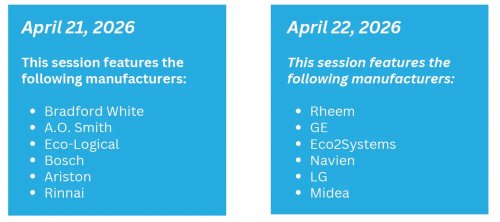
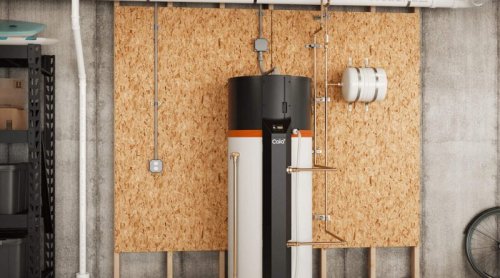
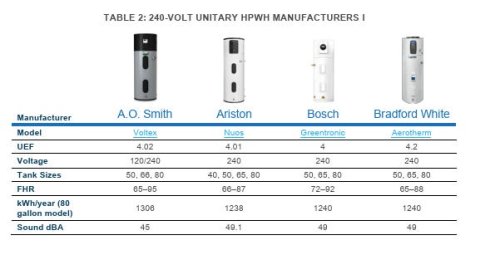
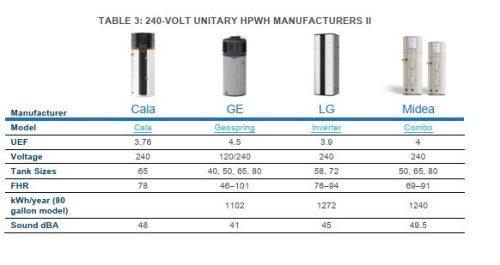
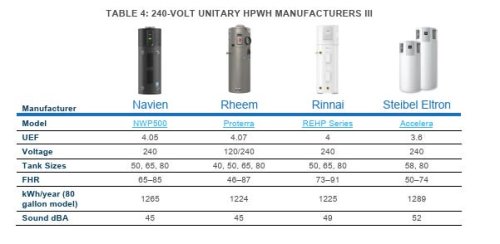
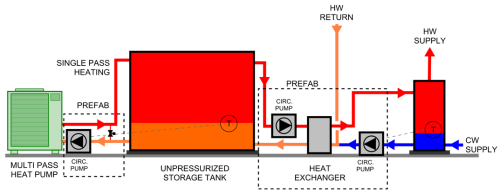
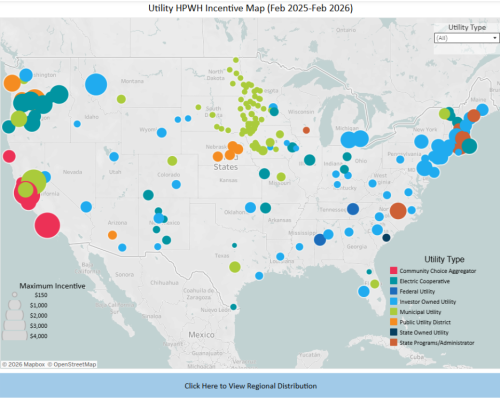
2025 was a good year for heat pump water heaters (HPWHs). In our annual State of the Heat Pump Water Heater Market report, we talk about how residential and commercial manufacturers released more new and updated products last year than any other year in the product’s history. Five new residential manufacturers brought heat pump water heaters to market, and many other established manufacturers brought updated and increasingly innovative products to market. New configurations and form factors also emerged, from flexible voltage (120-volt and 240-volt in the same unit) products, to split systems (where the compressor and tank are separated), to high temperature commercial and industrial HPWHs, to HPWHs with thermal storage. HPWH innovators did breathtaking work in 2025. 4 of the residential HPWHs currently in market and featured in our report. Here are a couple key highlights of what we saw happen last year: New Manufacturers & Updated Products In the residential HPWH space, several established and startup manufacturers released products in 2025. GE, Navien, Cala, Ecological, and Midea brought HPWH products to market for the first time in 2025, increasing the number of HPWH manufacturers to 13 (we list them all in the report). 4 of the residential HPWHs currently in market and featured in our report. Manufacturers already in the market also released innovative updates to their HPWHs. Bradford White, Rheem, and Ariston all released updated versions of their HPWHs. Meanwhile, the remaining manufacturers, Bosch, LG, Rinnai, and A.O. Smith either brought to market new HPWHs or updated models in 2024. The HPWH product category as a whole thus shows rapid innovation. 4 of the residential HPWHs currently in market and featured in our report. New Innovation Both residential and commercial HPWHs saw a lot of exciting innovation last year. Residential Innovation Key innovations in residential HPWHs included: Improved performance – This includes even more efficiency and quieter operation with some manufacturers moving to variable speed compressors to achieve this. Top and side water connections – This makes it easier to install HPWHs. Some manufacturers are also venting off the top rather than the sides for less required wall clearance. New features – These included lower global warming potential (GWP) refrigerants, paired recirculation pumps, stainless steel tanks, predictive controls and improved ducting capabilities. New form factors – Split HPWHs and flexible voltage HPWHs are two important types of HPWH that started having a moment in 2025. Flexible voltage HPWHs emerged in 2025 can plug into either 120V or 240V Commercial HPWH (CHPWH) Innovation Key innovations in commercial HPWHs included: CHPWH Sizes – The commercial HPWH market is expanding from its base in the multifamily sector to include commercial kitchens and other small commercial applications. This means smaller unitary CHPWH and split HPWHs are being used for small commercial applications. Storage – There were several innovations in storing hot water that emerged in 2025 including unpressurized storage, using phase change materials to store heat, and shifting from in-series storage to parallel tanks. Temperature and refrigerants – High temperature commercial HPWHs also saw a lot of research and momentum in 2025 along with systems that moved to lower global warming potential refrigerants. Unpressurized storage in CHPWH emerged as an innovative idea to potentially lower costs Image courtesy of Ecotope Policy Headwinds The policy landscape for all energy efficient technologies was, needless to say, challenging in 2025. The biggest policy challenges affecting HPWHs were: The loss of IRA tax credits — HPWHs lost their IRA tax credits of up to $2,000 at the end of 2025 which was a bummer. While the removal of these tax credits will have an unknown effect on most consumers (tax credits are a significantly deferred incentive which may have less influence on consumer decision making), they had an immediate and negative impact on HPWHs being installed in new construction. Some large home builders announced that they would no longer install HPWHs as a standard option in their new homes as a result of the lost tax credit depriving the market of tens of thousands of sales annually. Loss of ENERGY STAR — ENERGY STAR was in serious limbo for all of 2025. Staff were reduced and reassigned and the beloved program was on life support with a skeletal staff much of the year. Now it looks like ENERGY STAR is moving over to DOE which means more uncertainty around the program. ENERGY STAR’s absence hurt HPWHs in two ways. First, ENERGY STAR does a lot of great outreach and education around the technology which was greatly missed last year. Second, ENERGY STAR tracks HPWH shipment data and 2025 was the first year this data wasn’t released, meaning we don’t know exactly how the residential market is doing. We did our best to try to estimate it in our report, but we hope ENERGY STAR returns in full force ASAP. Still, there are strong policies driving HPWH adoption. From building codes in states like Washington and California that are driving installations in new construction, to air districts that are regulating the air pollution emitted by combustion water heaters, to the Federal water heating standard that is still in place to transition from electric water heaters to HPWHs (over 35 gallons) in 2029, there are significant policies in place to drive HPWH adoption strongly over the next 5-10 years. HPWH Incentives still going strong — And utilities are still highly incentivizing these energy saving appliances. We created a map that shows approximately 150 utility HPWH incentives across the US by size and geography. Check it out here. Utility HPWH incentive map. Check it out here. All in all, 2025 was a good year for HPWHs. The technology innovations and advancements more than made up for the policy headwinds from the new administration. 2026 looks like a continuation of trends from 2025, where innovative heat pump technology accelerates, more manufacturers enter the market, and growth continues. This positive momentum will be key to preparing the market for the rapid adoption of this key energy efficiency technology predicted by the end of the decade. Check out our full report on heat pump water heaters in our State of the Market Report.





















 +28 others