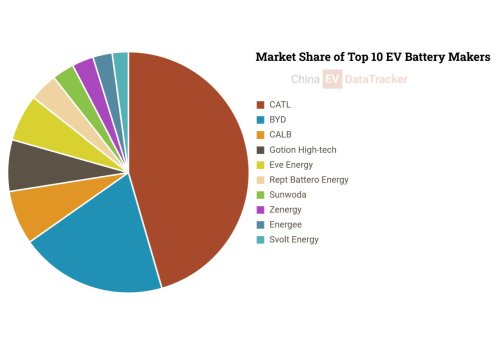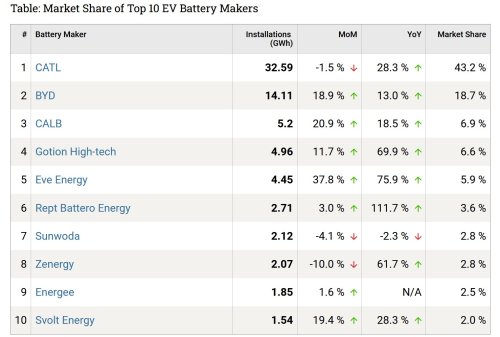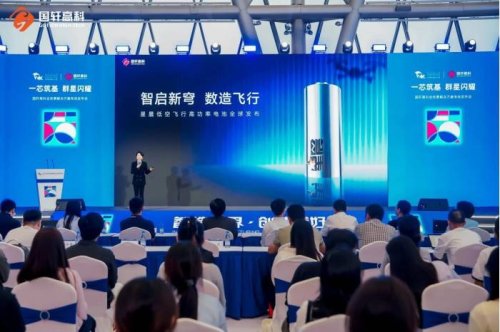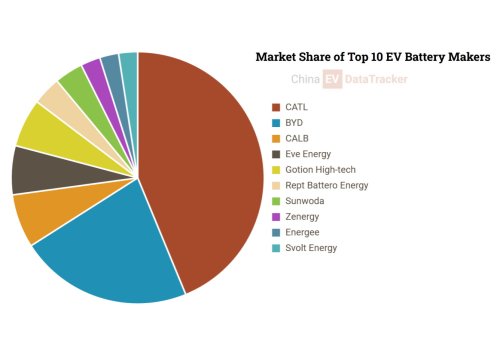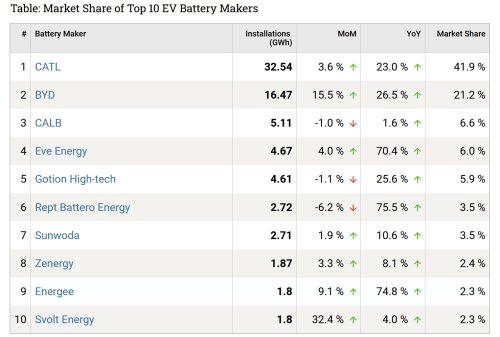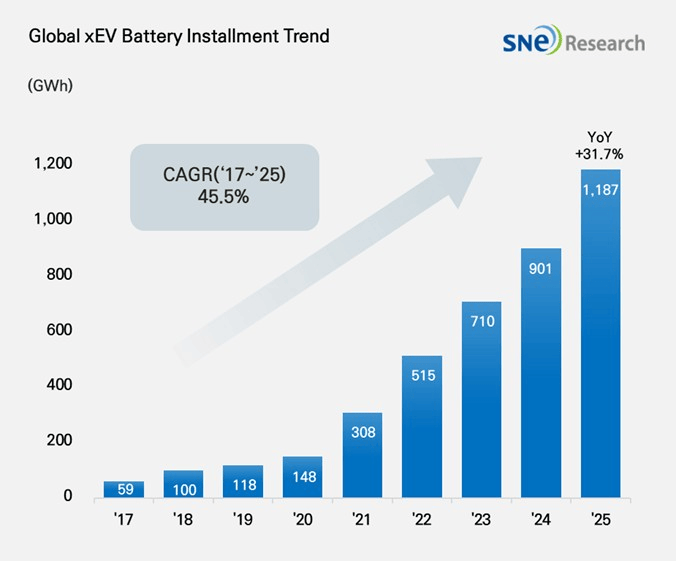
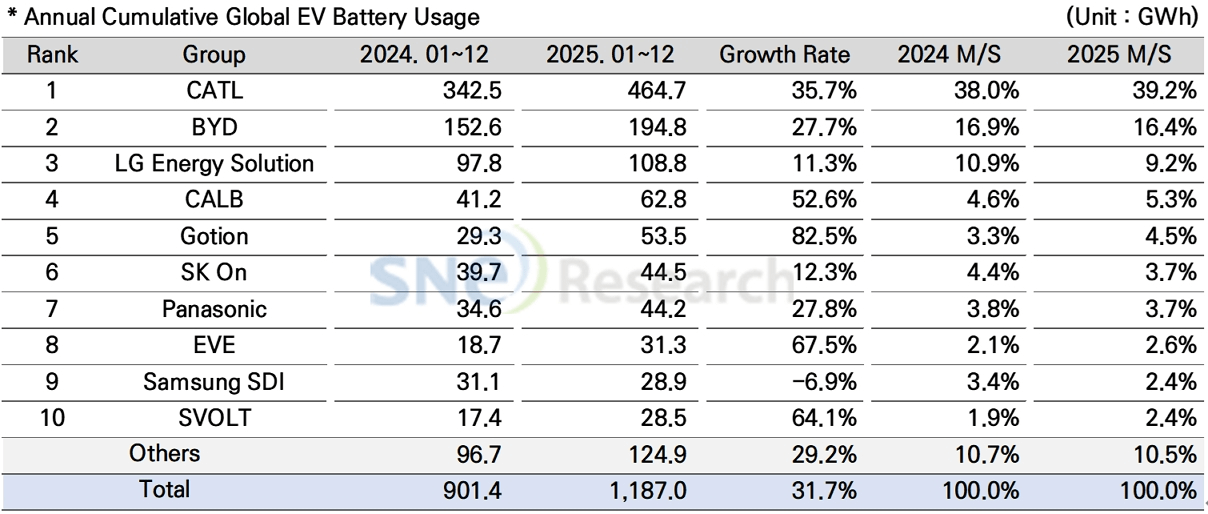
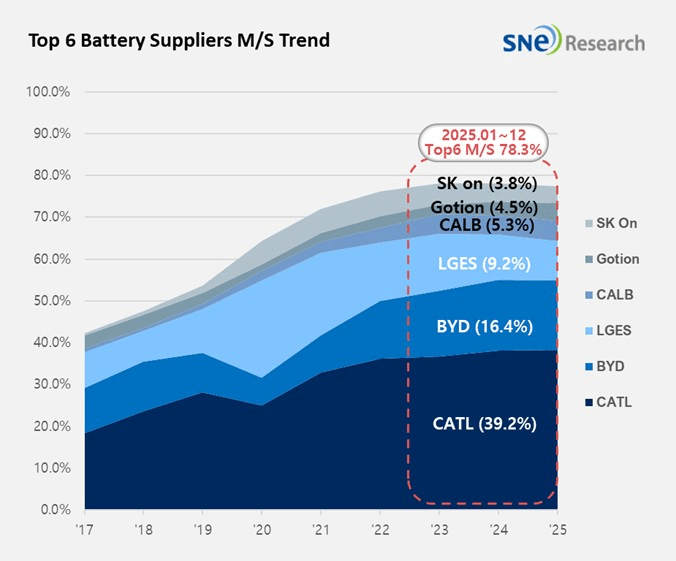



















CATL and BYD, forming the top tier, together commanded 55.6% of global power battery installations in 2025. South Korean research agency SNE Research has released the 2025 Global Electric Vehicle Battery Usage Report. Data shows that from January to December 2025, global electric vehicle battery usage reached 1,187 GWh, a year-on-year increase of 31.7%. Global installed capacity surpassed the 1,000 GWh mark for the first time, with market growth primarily driven by Chinese battery manufacturers led by CATL. Global EV Battery Installment Trend From an overall market perspective, the global power battery market continued its trend of concentration at the top in 2025, but the source of growth momentum underwent structural changes. Chinese power battery enterprises continued to expand their market share. Among the top 10 global power battery manufacturers by installed capacity, 6 spots are occupied by Chinese companies. CATL and BYD form the leading tier. In 2025, their combined power battery installed capacity accounted for 55.6% of the global market share. Among them, CATL maintained its top position with an installed capacity of 464.7 GWh, a year-on-year increase of 35.7%, capturing a 39.2% market share. BYD ranked second with an installed capacity of 194.8 GWh, holding a 16.4% market share. Annual Cumulative Global EV Battery Usage Furthermore, the growth rates of other Chinese battery manufacturers are also remarkable. Among them, Gotion (53.5 GWh) achieved a high year-on-year growth rate of 82.5% in 2025, ranking fifth; EVE and SVOLT both saw growth rates exceeding 60%, with installed capacities of 31.3 GWh and 17.4 GWh, respectively. Top6 Battery Suppliers M/S Trend In contrast to the strong advancement of Chinese companies, the combined market share of the three major South Korean battery manufacturers showed a noticeable contraction. Data indicates that the combined market share of LG Energy Solution, SK On, and Samsung SDI declined from approximately 18.7% in 2024 to about 15.4% in 2025. SNE Research specifically emphasized that due to slowing electric vehicle demand in North America and intensifying competition in Europe, the profit recovery for South Korean battery manufacturers in 2026 may be delayed.