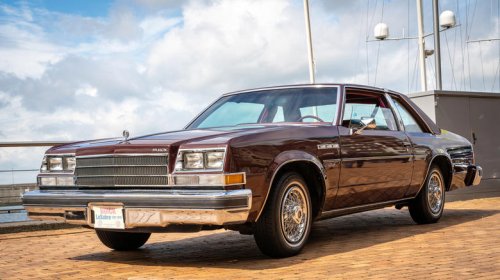
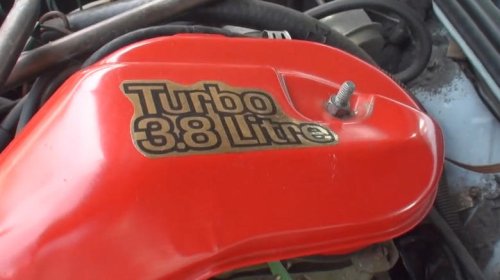
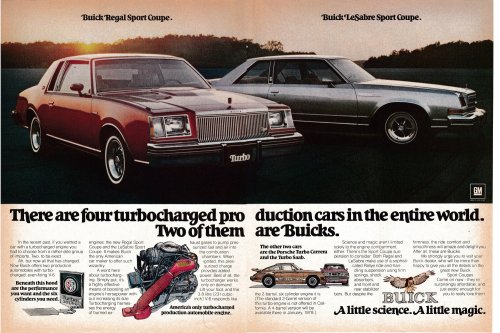
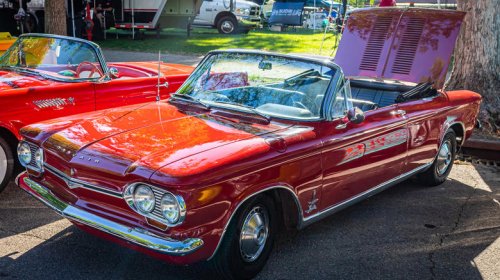
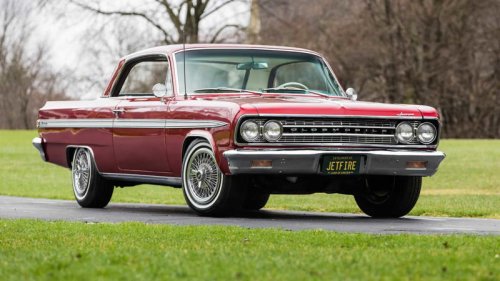
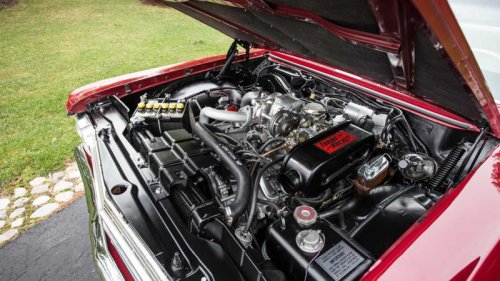
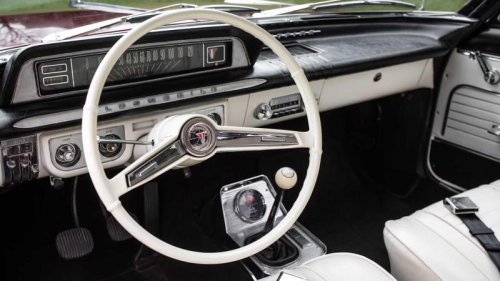
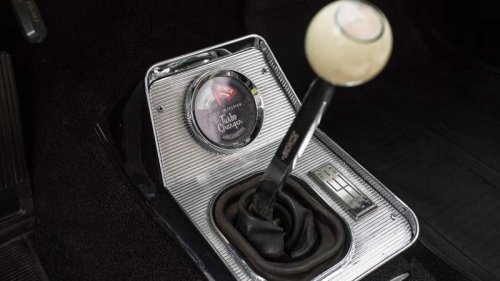
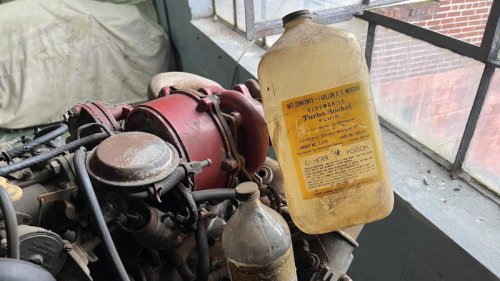
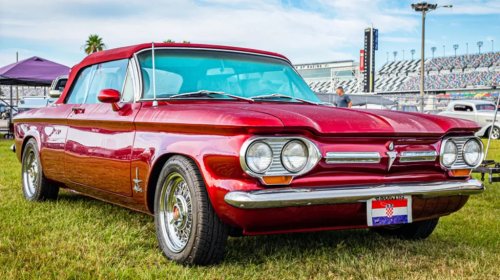
A brown 1979 Buick LeSabre Sport CoupeWhile some auto-industry innovations come and go, turbocharging tech has proven its worth and is absolutely here to stay. While the technology won favor in the late 1970s and '80s as a way of boosting performance, turbochargers are now favored for their ability to produce more efficient engines, which don't drink as much fuel as their older, naturally aspirated counterparts.So the industry owes a lot of thanks to the early heroes of turbocharging tech success, and while some of them are well-celebrated — think Saab 99 and Porsche 911 Turbo — two Buicks joined these models in 1978 with turbos under the hood. Yet they seem to be all but forgotten today. Well, it's time to shine a little spotlight on them.The models in question are the Regal Sport Coupe and the LeSabre Sport Coupe. Notice that Buick wasn't shouting from the rooftops about the new tech under the hood — while both the Saab and Porsche proudly boast "Turbo" in their names, the Buicks instead get "Sport." Perhaps Buick was anxious about how the American public would respond to turbo tech.Wizardry, science, and magic — all are terms Buick used to advertise the new boosted models in 1970s advertisements, and while we might chuckle at such ads today, turbochargers really were that new and exciting at the time. Outside of Buick dealers, your only other options in 1978 were those two rather exotic imports. A closer look at Buick's boosted V6The air cleaner cover from a 1978 Buick Regal Sport CoupeAs proudly stated in its late-1970s advertising material, this was "America's only turbocharged production automobile engine." And what an engine it was. Its history dates back to 1975, with initial experimentation beginning as part of Buick's Indy Pace Car program. It was based on the 231-cubic-inch even-fire V6, with numerous changes to make the engine boost-ready. Upgrades included new pistons, an entirely new camshaft profile, other internal changes, and of course, the AiResearch TB03 turbocharger.The result was a V6 that kicked out 150 or 175 horsepower, depending on whether the buyer chose a two- or four-barrel carbureted engine. For reference, Buick's 350ci V8 at the time mustered up 145 horses, and was no match for the V6 in terms of fuel efficiency, either. With the two-barrel setup, the Regal returned 25 mpg on the highway, and 18 mpg around town. The turbo V6 delivered 245 or 265 pound-feet of torque, a world away from the outputs of the naturally aspirated 231, which delivered 105 horses and 185 lb-ft.The turbo Buicks's suspension also was built for performance. Buick dubbed the setup "Rallye ride and handling," and the new setup consisted of firmer springs and shocks, with uprated front and rear stabilizer bars. In addition to grippy Firestone tires, all were equipped with TH350 Turbo Hydra-Matic automatic transmissions. A rather uninspiring 0-60 mph time of 11.2 seconds resulted, but for a six-cylinder car with 175 horses, tipping the scales at around 3,500 pounds in the 1970s, that's a fair outcome if not an exciting one. Buick was beaten to the punchA red 1965 Chevrolet Corvair Monza Spyder Turbo with its top down and its trunk up.While Buick had the only American production turbo engine on the market in '78, plus half of all turbo models for sale, the brand wasn't the first to offer a boosted American automobile to the masses. In fact, Buick was beaten to the punch by both Oldsmobile and Chevrolet, and by some margin. You'd have to wind the clock back 16 years more to find America's (and indeed the world's) first turbocharged production models, the 1962 Oldsmobile F-85 Jetfire and Corvair Monza Spyder. The Jetfire, produced only for the '62 and '63 model years, featured 215ci V8 that produced a handy one horsepower per cubic inch, notably more powerful than the Buick that followed in '78. Remember, though, the Olds hails from an era that predates unleaded fuel and catalytic converters, and it sports two extra cylinders, so the comparison isn't fair.America's other early effort was the ever-controversial Corvair. A redesigned version in 1965, the Corsa, introduced a number of changes, among them a boosted engine dubbed the Turbo-Air 6. This mill was unusual in just about every way imaginable, being a turbocharged, air-cooled flat-6. It's the most formidable of all Corvair variants — not a high bar, admittedly — with output peaking at 180 horsepower and 232 lb-ft. Much like the Buicks that followed, the Corvair was equipped with uprated suspension, and handled the 60 mph sprint in roughly 11 seconds. Its turbo era ended in 1966, three years before the Corvair was discontinued.So the Buicks might not have been first, but they were certainly flying the flag for America just as turbo tech really started to take off. Today, they represent a chapter of innovative development in the American auto industry. Want more like this? Join the Jalopnik newsletter to get the latest auto news sent straight to your inbox, and add us as a preferred search source on Google.