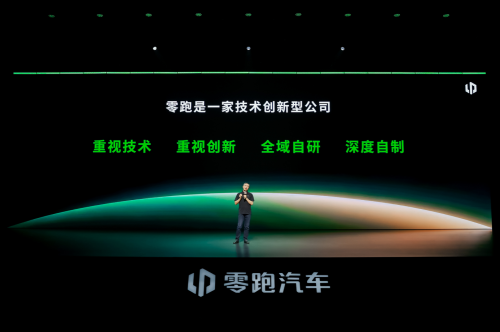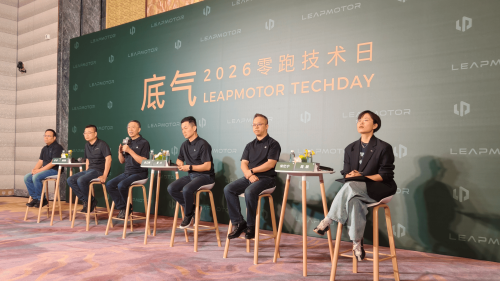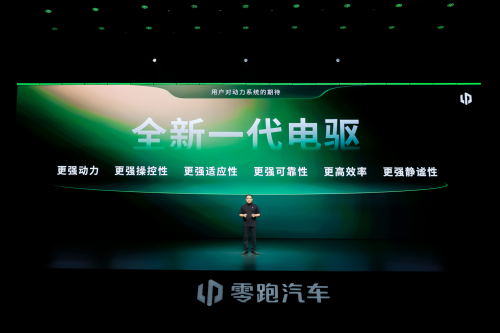
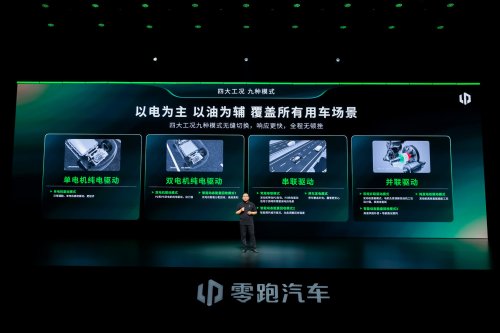
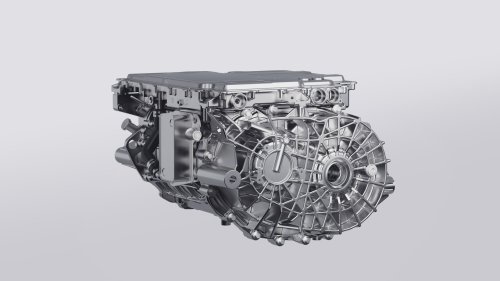
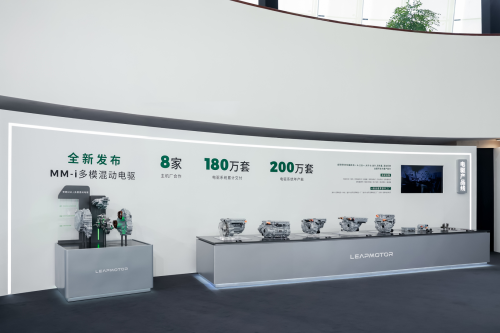



















Gasgoo Munich- On September 16, Leapmotor Tech Day took place as scheduled. At this annual flagship event, long anticipated by the industry, Leapmotor unveiled a vehicle architecture for a new category of vehicles. It also introduced three core technologies in one sweep. The showcase highlighted the company's systematic innovation capabilities. These were honed over 11 years of full-stack in-house R&D.Image source: LeapmotorAmong the lineup, the "MM-i multi-mode hybrid electric drive" from the e-drive product line drew particular attention. This technology breaks with industry convention. It ensures the generator is no longer responsible solely for generating power, nor the drive motor solely for driving. Instead, through "generator full-time reuse" and a coaxial electromagnetic clutch, the hybrid system re-optimizes the balance between power, efficiency, volume, and weight.To dig deeper into this new hybrid technology and the R&D story behind it, Gasgoo Auto sat down with Wu Cun, head of Leapmotor Tech's e-drive product line. As employee No. 001 of the e-drive team, Wu has been there since September 2015. He witnessed the journey from zero to one, from three-in-one to eight-in-one integration, from water-cooling to oil-cooling, and from internal use to external supply. In a nearly two-hour conversation, he discussed the new tech, R&D anecdotes, quality and manufacturing, and the "innovative spirit" accumulated by the Leapmotor e-drive team over 11 years.Breaking a Century of Division: "Full-Time Reuse" for GeneratorsIn traditional hybrid architectures, the P1 motor generates power and the P3 motor handles driving—they operate in isolation. This is a division the industry has long accepted. The core breakthrough of Leapmotor's intelligent multi-mode hybrid system lies in "full-time reuse" of the generator. It can generate power, drive the wheels, or work in tandem with the P3 drive motor. It can even have one generate while the other drives, ensuring energy always flows through the optimal path.Wu Cun explains it in layman's terms: "In traditional schemes, the generator and drive motor never interact. Our new architecture breaks that division. When power is needed, the two motors can work in parallel. They can even join forces with the engine for three-source drive. When high power isn't needed, the smaller motor handles the work. At highway cruising speeds, one motor is enough to maintain momentum. The other dynamically adjusts between generating and driving to balance power, consumption, and reliability."He specifically cited global hybrid benchmarks like Toyota's THS and Honda's i-MMD. Toyota THS is oil-centric, a holdover from the internal combustion era. It cannot perform pure electric driving. Honda's i-MMD uses dual motors that are not decoupled. They rely on a "soft connection" via the circuit. This maintains a rigid division of labor where the generator only generates and the drive motor only drives. "Our technical solution allows the generator and drive motor to drive together. It also allows for one to specialize in generation. They can also dynamically adjust between driving and generating during high-speed cruising. This is an architectural breakthrough."Supporting this breakthrough is Leapmotor's innovative coaxial electromagnetic clutch technology. Traditional wet clutches rely on friction plates for gradual coupling, resulting in slow response and large volume. Leapmotor uses an electromagnetic clutch, controlled by a motor to engage and disengage. It fully disengages in about 150 milliseconds, offering faster response and smaller size. Combined with a coaxial layout, axial space is drastically compressed.Consequently, a set of seemingly contradictory data emerged: this hybrid system achieves a power density of 1.94kW/kg. This is the highest in the hybrid industry. Its thickness is just 313mm, marking the first time a hybrid system can be fitted into an A0-class small car. Compared to competitors, it is 30% smaller in volume and 40% lighter. Yet it outperforms in efficiency, power density, and energy consumption."If we followed the traditional scheme, the drive motor would need to handle all driving conditions. The higher the power, the larger the volume. Pushing from 150 kilowatts to 200 kilowatts might add 10 kilograms. This simply wouldn't fit in the front compartment. You'd have to sacrifice either crash safety or interior space," Wu said. Leapmotor's solution allows the generator to participate in parallel drive when necessary. It instantly boosts power to over 200 kilowatts, allowing the motor to be significantly lighter.For example, in city driving conditions of 10 to 20 kilowatts, the small motor works alone. At highway cruising speeds of 120 km/h, a two-ton vehicle requires a rated power of about 40 to 50 kilowatts. One motor is sufficient. When overtaking, the generator switches to drive mode within 150 milliseconds. It jumps from 100 kilowatts to 200 kilowatts. Once acceleration is complete, it returns to the most efficient cruising state.For users, the most direct experience is: more powerful acceleration, better fuel and electricity economy, and no compromise on space. It also offers the flexibility of oil or electric power. On a deeper level, Wu also mentioned national energy security. Prioritizing electricity while treating oil as auxiliary makes fuel use more efficient. It also large-scale reduces the use of non-ferrous metals like copper, precious metals, and heavy rare earths. This has implications for energy and strategic resource security.Image source: LeapmotorSo why did Leapmotor choose to invest heavily in hybrids at this specific moment? Wu's answer remains user-centric. Extended-range electric vehicles (EREVs) have sold well, but the pain points are obvious. They are "a powerhouse when charged, a slug when the battery dies." Hybrids hold advantages over EREVs in pure electric range, vibration, and fuel consumption.Looking at the usage environment, China is vast with complex conditions. The Yangtze River Delta has sound charging infrastructure and short commutes, so pure electric works for many. But for holiday long-distance travel or cold weather in the north, pure electric still faces challenges. Globally, foreign new energy development lags China by 3 to 5 years. South America lacks energy, making hybrids most suitable. Europe prefers small cars, but larger vehicles need hybridization. As the innovation diffusion curve moves into its later stages, the remaining conservative users—those reluctant to change driving habits—need a car that runs on oil or electricity. It must drive like an EV and cost close to an EV. It should offer range without anxiety. "The core is still supporting Leapmotor's product globalization, centered on user needs," Wu said.This user-centric, inertia-breaking mindset didn't form overnight. Behind it lies the systematic capability built piece by piece by the Leapmotor e-drive team, starting with employee No. 001.From Employee No. 001 to Oil-Cooling, Multi-in-One, and Hybrid ArchitectureIn September 2015, Wu Cun joined Leapmotor, becoming the e-drive team's first employee. Previously, he spent years working at foreign firms like Bosch, Samsung, and Emerson. His reason for leaving Bosch for a startup was simple: dreams."Working at a foreign firm is comfortable, but you have no say in core technology leadership. Basically, technology is passed down from abroad, and you just localize it. This limits your growth space," he said. After more than 40 years of reform and opening up, China has built sufficient capacity in engineering talent and innovation systems. China's development dictates that it must pursue innovation-driven growth. It cannot let core technology be controlled by others. "When I got the offer from Leapmotor, I was thrilled. The era has given us a task, and we must catch it."When he first arrived at Leapmotor, there was barely a ready-made path for e-drives. The first thing Wu did was build a forward-looking systematic R&D capability. He hired a simulation team and built reliability and durability labs. He also recruited talent for motors, electronic controls, hardware, reducers, and system integration. This ensured simulation and testing verification could support genuine innovation.The beginning is always the hardest. Developing the first motor, when the domestic mainstream was 8,000 rpm, Leapmotor pushed straight to 12,000 rpm. In the past, e-drive noise was poor, and many cars spent money on sound insulation shielding. But founder Zhu Jiangming insisted: e-drives cannot use sound insulation materials, and product quality must be far higher than peers. The team worked day and night, and ultimately, not a single car used sound insulation devices. Yet customers experienced the best e-drive sound quality.In 2019, Leapmotor developed an eight-in-one e-drive when the industry mainstream was three-in-one. Some argued that "the more you integrate, the worse the reliability," and users had doubts. Wu explained from a systems engineering perspective: the fewer connection points in a system, the lower the probability of failure. The more connection points, the higher the cumulative failure probability. Multi-in-one integration fuses many component functions together, reducing failure at the system level.In practical application, the first-generation C11 e-drive was 200 kilowatts and three-in-one. The T03 used a four-in-one e-drive. With the same power source and supplier, and a fleet of 100,000 units, the multi-in-one e-drive had a lower power source failure rate. This verified the reliability advantages of system integration. Now, Leapmotor has integrated the VCU and MCU onto a single chip. It improved the communication cycle from 10 milliseconds to 0.5 milliseconds—a 20-fold increase. This enables more control response strategies.Oil-cooling was another tough battle. In 2016, most of the industry used water-cooling, but Leapmotor insisted on oil-cooling. The first challenge came from thermal load. The first-generation water-cooled 200-kilowatt e-drive would surge to 150 degrees after passing the 135-degree protection point. The insulation design life was selected for 200 degrees. But every 10-degree rise cuts the expected life in half, forcing the team to start reducing torque and power at 120 degrees. After encountering difficulties with water-cooling, Wu decided to switch to oil-cooling."We weren't being rash. We developed water-cooling first, but increasingly felt it was a bottleneck, so we invested in oil-cooling. We are bold in technological innovation but cautious in product development and verification." While developing water-cooling, the team was actually just three months away from simultaneously developing an oil-cooled e-drive. Later, seeing Tesla release oil-cooling technology along the same route further solidified their direction.The bigger challenge with oil-cooling lay in the oil pump system. Traditional engine oil pumps are large and slow to control. Domestically, there was no supply of electronic oil pumps, and Tesla developed its own without external supply. Wu, who had experience with compressors, decided to lead the team to build their own. Leapmotor's first-generation self-developed oil pump weighed only 760 grams. It is now sold through agents to many foreign OEMs.From multi-in-one to switching from water to oil cooling, and then to domain control, Leapmotor's e-drive has hit the beat almost every step of the way. Wu said the core is centering on user needs, plus a forward-looking R&D system. Leapmotor discusses and updates its technology strategy every quarter. Products refresh every two years. If users want stronger power, better handling, and faster charging, technology iteration must be fast.Leapmotor was also the first in the industry to conduct power cycle bench tests. Electric vehicles frequently switch between driving and generating conditions, causing repeated start-stop shocks to power modules, capacitors, gears, motors, insulation, and bearings. Traditional reliability theories couldn't verify this. Leapmotor runs the e-drive assembly from 0 to full power in 8 seconds. Then it stops for 3 seconds. It uses 125 kilowatts of energy recovery to brake to 0 within 8 seconds. This process runs continuously. Based on cumulative damage theory, 60,000 cycles of equivalent peak power roughly equate to a 300,000-kilometer lifespan. This allows them to locate fatigue damage points in gears and bearings and optimize them. Anticipating risks in the design phase minimizes problems in mass production.Image source: LeapmotorThe smart multi-mode hybrid system released this time followed the same pattern. Leapmotor started working on extended-range hybrids in 2021, becoming the first company to mass-produce an oil-cooled direct-drive extended-range system. In 2022, it began researching hybrid technology architecture, a study that lasted three years. After collecting feedback from partners on the powertrain needs of new energy users in various regions, Leapmotor realized strategically that hybrids are crucial for globalization. The company-level project approval was completed in just one week. "With sufficient information, decisions are fast," Wu said.841 Patents, Lifetime Warranty, and External SupplyAdvanced technology must ultimately deliver results. For mass-manufactured products like e-drives, the most direct results are patents, quality, and external recognition.As of July 31, the Leapmotor e-drive team has applied for 841 patents. It ranks first in patent count among new energy vehicle OEMs and e-drive Tier 1 suppliers. It holds the most invention algorithm authorizations, with over 30. Patents cover motors, reducers, controllers, software, hardware, system architecture, NVH, structure, differentials, electronic oil pumps, and power electronics. "We have no external technology dependencies—this is the confidence brought by self-development and self-manufacturing," Wu said.In terms of quality, Leapmotor's e-drive failure rate per thousand vehicles is only 15% of the industry average. How is quality maintained without sliding back? Wu's answer is the Zero Defect quality system."Quality is designed in and manufactured in. There is no perfect quality; Zero Defect is the goal, but that goal must be continuously iterated." Upon receiving vehicle project requirements, the team converts user needs into functions. It determines whether to use multi-in-one or three-in-one integration. It also decides between water-cooling or oil-cooling. This is a technical architecture issue. Then, power and torque are quantified, and DFMEA (Design Failure Mode and Effects Analysis) is conducted. The team reviews past development cases to assess new requirement conditions. Once DFMEA is complete, it is converted to PFMEA (Process Failure Mode and Effects Analysis), and the two must be aligned.He gave the example of stator shrink fitting. R&D drawings only specify assembly dimensional tolerances, plus a note like "no foreign matter after shrink fitting." But for the manufacturing engineering team, the challenge is huge. A robotic arm grabs a 30-kilogram iron core. If the claws aren't centered, they can scrape the core itself, generating foreign matter. During shrink fitting, misalignment in concentricity, position, or cylindrical expansion can scrape off aluminum shavings. PFMEA is harder than DFMEA because it must consider both process failure and functional failure caused by assembly.One of the biggest manufacturing challenges for oil-cooled e-drives is foreign matter control. In water-cooled motors, water cools the outside of the casing, so internal foreign matter doesn't affect reliability. In oil-cooled e-drives, the oil circulates. The oil pump sucks up oil and sprays it onto enamel wires, gears, and bearings, so control must be extremely strict. Stator shrink fitting requirements are harsh. The team optimized continuously for a year, reviewing weekly, pursuing zero defects. For every 5 units produced, 1 is dissected to check if the core is scratched or if there is foreign matter.Notably, Leapmotor was also the first in the industry to use hydrocarbon cleaning for iron cores. A set costs 4 to 5 yuan to remove stamping burrs of about 0.04 millimeters left on silicon steel sheets. This prevents them from falling off and damaging bearings after oil-cooling flushing. Shell aluminum alloy die castings use two cleaning processes: ultrasonic and high-pressure cleaning. Supplier Rushup, which also supplies Tesla, lamented that Leapmotor's requirements for parts were even higher than Tesla's.These controls from design, manufacturing, and the supplier end all converge into the same traceability and closed-loop system. Leapmotor collects and monitors MES data for supplier core components. It integrates this with production data, R&D test data, simulation data, assembly data, assembly test data, and vehicle user data. If a defect appears in the market, it is traced back to its source. The team determines if it is a design, material, or manufacturing issue. It also checks for condition or robustness faults. This forms a cycle to ensure reliable quality.Behind this closed loop is Leapmotor e-drive's long-term adherence to the Zero Defect strategy. Wu said he has always insisted on a quality-first business strategy. He constantly requires himself to be responsible for quality. "We are marching towards zero defects so users will always trust our products. The confidence comes from the end-to-end zero-defect system covering R&D, manufacturing, and the entire process." It is precisely because of this that "lifetime warranty" for e-drives is rare in the industry, yet Leapmotor has the confidence to back it up.Image source: LeapmotorQuality and system capabilities don't just serve their own products; they also support external supply. Regarding external supply, Leapmotor has set up an independent company, Lingsheng Power, outside its e-drive product line. It has secured project nominations from global TOP 10 OEMs and domestic TOP 10 OEMs, with mass production starting gradually from 2027.When asked if the path is easy for an OEM-backed company becoming a supplier, Wu believes the company hopes for internal and external dual circulation. Supplying only internally risks working in a silo. External supply is a process of proving oneself. Leapmotor itself is very open, both self-developing and purchasing components from peers. Peers choose Leapmotor e-drive primarily for performance and quality. In customer QPD (Quality, Price, Delivery) comprehensive supplier assessments, Leapmotor e-drive ranked first overall, with the highest scores for quality and performance.Hybrids Are Here to Stay: Prepared for Million-Unit SalesExternal supply proves current system capabilities, but looking to the future, Leapmotor still has to answer another question. How far can hybrids actually go?There is a view in the industry: "Pure electric is the endgame, hybrids are a transition." Yet Leapmotor is investing heavily in hybrids—how does the company view the hybrid lifecycle internally?"Whether the endgame is purely electric is open to question," Wu said. In the 2008 southern snowstorms, the power grid was frozen by rain and snow, and even electric trains were affected. Relying entirely on electricity is a single dependency with structural safety issues. China's energy will certainly be primarily electric, supported by wind, nuclear, hydro, and clean fuel power generation—it cannot be all electricity. "The endgame might be 70% pure electric and 30% multi-energy forms. Hybrids, extended-range, synthetic fuels, and clean energy are all possibilities. It won't be a single energy source."Zhu Jiangming recently reiterated that "technological self-research is the only path to cross the competitive cycle." From an e-drive perspective, what is the biggest return on persisting in full-stack self-research for 11 years? Wu stated that the biggest return is building a strong, confident, and systematic team. "We can do innovation work in 'no man's land.' When you have confidence and ability, you can do things others dare not imagine."He emphasized that the only winning strategy in emerging industries is technological innovation. The automotive industry has iterated from internal combustion engines and transmissions, from manual to automatic, from 4AT to 6AT to 8AT. Only through continuous innovation can we deliver high performance, high quality, and a good experience to customers. Leapmotor's full-stack self-research logic is the same: through technological innovation, giving users better configurations and products that are good yet affordable.If summarizing the engineer spirit of the Leapmotor e-drive team in one word, Wu chooses: "Innovative and Enterprising." Behind this is Leapmotor's systematic capability and the confidence built over 11 years of self-research.The company progressed from "generator full-time reuse" to coaxial electromagnetic clutches. It moved from oil-cooling and eight-in-one integration to domain control. It advanced from the Huzhou factory's precision and flat wire alignment to dissecting units, patents, and lifetime warranty. These efforts prove that Leapmotor e-drive's daring and practicality are not slogans. They are verified technical routes and manufacturing bottlenecks overcome one by one. The debate between hybrids and pure electrics may continue, but Leapmotor chooses to use technical architecture innovation to give users another choice. It also provides another "no man's land" sample for China's new energy industry chain.