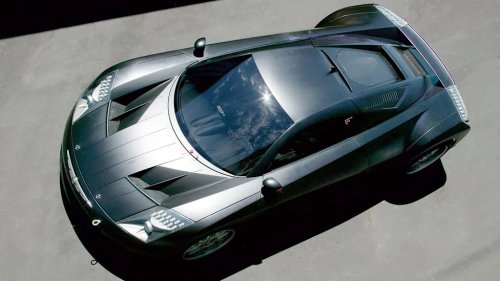
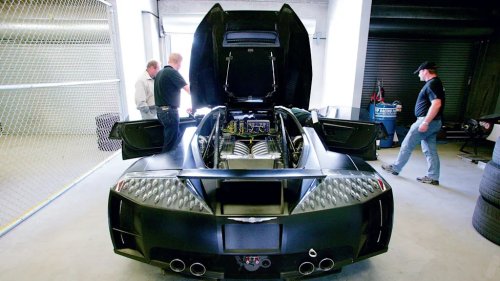
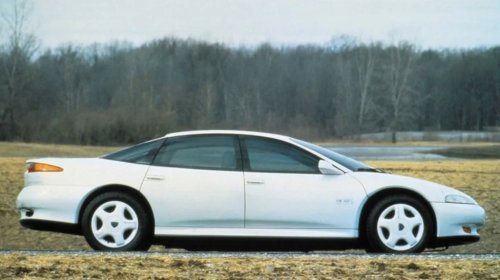
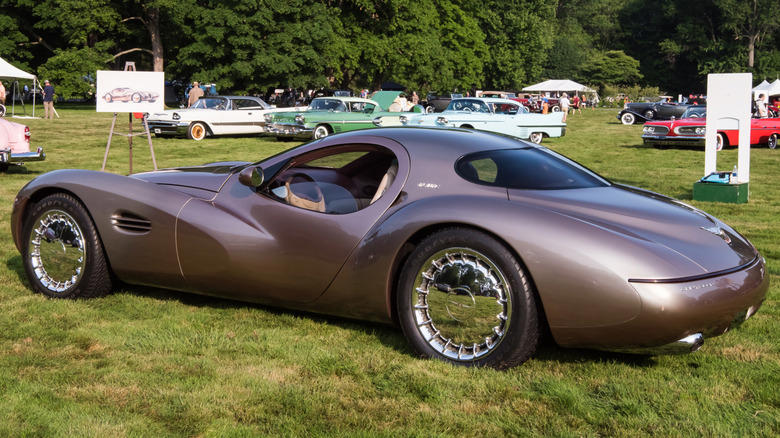
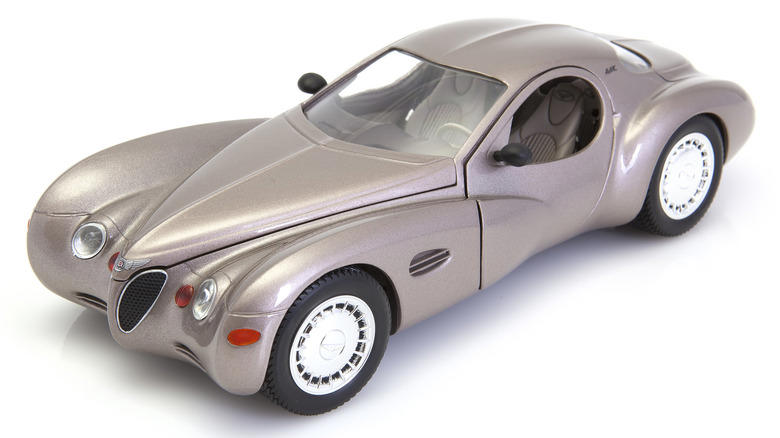
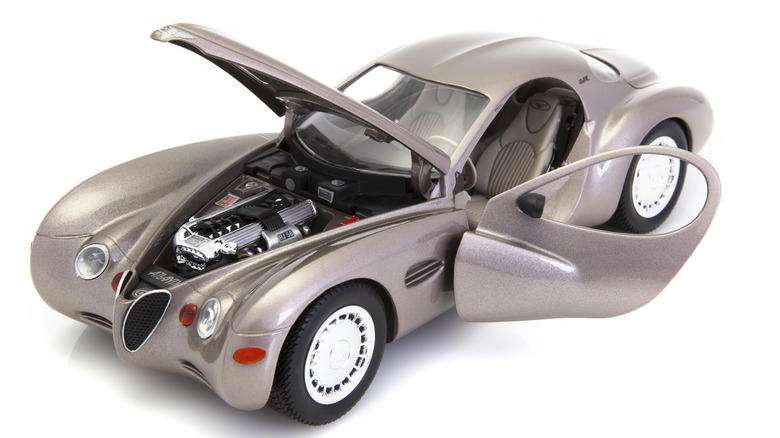
The 1995 Chrysler Atlantic Concept on in a grassy field at an auto show.If you're reading that headline and thinking that those words don't belong in the same sentence, you'd almost always be right. However, for one very brief moment in time, they did actually make sense together. That's because in 1995, Chrysler created a concept car designed to pay tribute to the stunning, exotic grand touring cars of the 1930s, cars like the Talbot Lago Type 150-C-S and the Bugatti Type 57 SC Atlantic. Mostly the latter, though, which is where the concept's Chrysler Atlantic name came from. But did the Chrysler Atlantic also get an exotic engine, like the Talbot's 4.0-liter I6 or the Bugatti's 3.3-liter I8? Well, it did have a straight-8 ... just one made from two Dodge Neon four-cylinders. Let's forgive Chrysler for inadvertently (we hope) insulting Bugatti's legendary touring car by paying homage to it with Neon engines, because the car itself was beautiful. The Chrysler Atlantic was such a stunning tribute to the swoopy cruisers of the '30s that, despite only being designed as a concept car from the beginning, public interest was so high that Chrysler almost built it. The Atlantic Concept was possibly the prettiest car to wear a Chrysler badgeThe 1995 Chrysler Atlantic conceptChrysler absolutely nailed the Atlantic's design — it looked exactly as such a car should. With a massively long hood, a short rear deck, and hugely curvaceous haunches, the Atlantic concept was stunning and would have looked perfectly at home in the 1930s. Its trident-shaped front end made it unusual, and added some edge to an otherwise round design. If you look at the front end from above, you can even see a little of the rolling midlife crisis known as the Plymouth Prowler, which came out just two years after the Atlantic debuted. Its nearly circular side windows were clearly inspired by the Bugatti, as was its overall shape, but its split rear window is oddly reminiscent of the C2-generation Corvette. I doubt Chrysler would have ever admitted to drawing inspiration from a rival, but being compared to that timeless beauty is no insult. Inside, the Chrysler Atlantic was pretty subdued, even if its two-tone burgundy and cream color scheme was eye-catching. The overall design was typical of the '90s, when car interior designers were obsessed with ovals. There probably should have been a bit more wood trim, considering the Atlantic was designed to hark back to vintage cars whose cabins were lined with beautiful woodwork. So while the interior was nice by '90s standards, it seemed like an afterthought compared to the outrageous body style. Perhaps Chrysler felt that since the car was never destined for production, and was merely a design exercise, its passengers didn't need much luxury. Its engine was just two Dodge Neon four-cylinders bolted togetherA Chrysler Atlantic concept with its driver's door and hood open, showing off its straight-8 engine.There were rumors that Chrysler wanted to fit a Dodge Viper V10 under the Atlantic's hood, which would truly have been wild. Okay, a screaming V10 wouldn't have been in keeping with the Atlantic's retro vibes, but it would have still been awesome. Instead of the supercar engine, Chrysler decided to fuse two Dodge Neon four-cylinder engines together, Human Centipede-style, to create a straight-8. It's a very appropriate engine configuration for such an homage, as many cars of the 1930s had eight cylinders in a row. But the Neon's engine didn't belong in a luxurious coupe, despite being fine for econobox duty.Rare for a concept car, the Chrysler Atlantic actually drove. It was a structural mess because it wasn't meant for speeds higher than those needed to get it onto an auto-show stand. But it ran and drove, thanks to that monstrous creation of an engine and a four-speed transaxle. According to Below the Radar, though, John McCormick drove the Chrysler Atlantic for Autocar magazine back in the day and had less-than-kind things to say about the engine. "My growing appreciation for the car is shattered when the four-litre straight-eight is started," McCormick reportedly said. "Created by joining together two humble Neon two-litre 16-valve fours, the engine sounds suitably potent at idle, but as soon as the revs rise a horrible barking cacophony takes over." Despite that horrific engine, McCormick appreciated the Atlantic's design and ability to drive at all. There was plenty of interest in the Atlantic from customers, too, enough to make Chrysler flirt with putting it into production. Unfortunately, that never came to be and we lost out on a car with stunning 1930s looks. At least we weren't subjected to that engine. Want more like this? Join the Jalopnik newsletter to get the latest auto news sent straight to your inbox, and add us as a preferred search source on Google.



















 +61 others