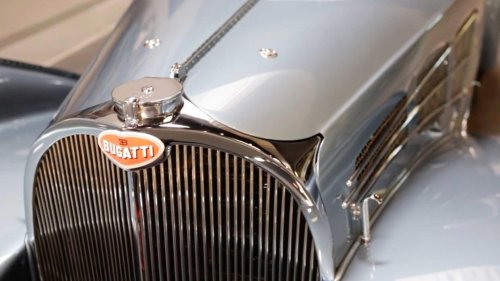
Nowadays, Supercars and Hypercars arrive almost like software updates for your phone. They arrive faster, lighter and with more dramatic looks to match. There’s always something waiting in the wings to eclipse what’s come before, and that means it really does take something genuinely different to have everyone pause and appreciate what’s right in front of them, as if its presence alone cannot be outdone by something else.Long before lap times and power outputs became the currency for bragging rights, there were cars designed to be admired like a statue - a fixed, immovable object that was almost impossible to miss. One notable example is a 1930s Bugatti, and is so exclusive, it manages to upstage even the most modern hypercar of today. Modern Hypercars Became Technological Marvels But Lost Their Sense Of Soul Via KoenigseggModern hypercars are incredible pieces of kit - record-breaking top speeds, drivetrains that look like they’ve come from a sci-fi movie, and the type of wind tunnel precision that saw us visit the moon. But in the pursuit of making headlines, something much less measurable has started to fade: individuality. At the very top of the collector world, the contrast is stark. Pre-war Bugatti’s were personal and deeply original creations, and established the benchmark for individuality that modern hypercars, for all their brilliance, arguably don't have so much. For serious collectors, the question is not so much about how a car performs, but what it represents: history, craftsmanship, and irreplaceability. Jean Bugatti Designed A Rolling Sculpture That Changed Automotive Design Forever Double Clutch/ YouTubeWhen Jean Bugatti designed a car which is now widely considered the ultimate automotive "Holy Grail", it was never made to follow any trends, and was perhaps, ahead of its time. Instead, Bugatti set out to redefine what a car could look like when form, airflow, and imagination were given equal weight. This fresh approach was reflected when the car made its debut in 1936 with a dramatic silhouette that was bound to turn heads, featuring long, flowing bodywork and sweeping fenders.Only four of these cars were ever built, though one was tragically struck by a train, while another mysteriously vanished during World War II. This leaves us with just two left in existence, and one can be found preserved at the Mullin Automotive Museum in California, while the second example survives as the reference point for the entire model - the car most enthusiasts mentally picture when its name is ever mentioned. Chassis 57591: Ralph Lauren’s Bugatti Type 57SC Atlantic Is A Collector Car Icon Worth Millions A8C100/YouTube If there is a single car that proves collecting cars is not just about speed and motorsport success stories, it is the 1938 Bugatti Type 57SC Atlantic owned by fashion designer Ralph Lauren. With the chassis number 57591, it is valued at up to $100 million, making it one of the most valuable cars in existence.As a side note, each Atlantic eventually became known by a distinctive nickname tied to one of its notable owners. Lauren's car was commonly referred to as the “Pope Atlantic” after original British owner R.B. Pope. When the car was built in May 1938, it began life in London, finished in a very elegant Dark Sapphire Blue finish, and complete with the EXK6 registration plate it still carries today. A supercharger was later added in 1939 for improved performance, before being passed into the hands of respected Bugatti author Barry Price during the 1960s.Years later, Lauren acquired the Atlantic from venture capitalist Tom Perkins in 1988, and entrusted renowned restoration specialist Paul Russell with returning the car to concours-level condition. The restoration became far more than a cosmetic rebuild. Over the course of two painstaking years, Russell’s team uncovered remarkable traces of the car’s original craftsmanship, including tan goatskin upholstery and seat cushions stuffed with horsehair - small details that revealed just how carefully these cars had once been assembled by hand.By the time it appeared at the 1990 Pebble Beach Concours d’Elegance, where it won Best of Show, it had adopted the now-famous deep black finish that now defines its modern identity, and has since become one of the most recognizable cars in ultra high-end car collecting. While Lauren’s collection also includes icons such as the Ferrari 250 GTO and McLaren F1 LM, they still don’t carry the same historical and artistic significance as the Type 57SC Atlantic, which is why many still consider it the centerpiece of his collection today. The Bugatti Atlantic Was Also Decades Ahead Of Its Time Bugatti While The Atlantic is incredibly rare, it’s widely considered the first supercar too. Built on Jean Bugatti’s advanced Type 57 chassis, the SC in its name stood for "surbaissé" (lowered) and "compresseur" (supercharger), and was a significant upgrade over base Type 57 models.In the SC configuration was a supercharged straight-eight engine with an ultra-light, riveted magnesium-alloy body - a construction approach so advanced for the 1930s that it still feels experimental today. It had an estimated power output of around 200 horsepower, making it that little bit quicker than the horse-drawn carts that were still being used at the time.But more importantly, it was concealed in an aerodynamic teardrop-shaped bodyshell that looked genuinely futuristic for the time, and was designed for high-speed stability when most luxury cars were still squarish and heavy. With the Atlantic, Bugatti married art with technical ambition that had never been done before, making it a timeless, automotive icon. Performance Specifications — 1938 Bugatti Type 57SC Atlantic The Atlantic’s Appeal Comes From Craftsmanship Modern Cars Cannot Replicate Bugatti While modern hypercars deliver rapid straight-line pace that would have your breakfast reappear as sick on your lap, they rarely feel as personal in the same way the Atlantic does. Engineers behind it were not chasing Guinness World Records and bragging rights, but rather, focused on craftsmanship and originality instead. Nothing about it feels mass-produced, because it wasn’t. Like those brushstrokes you see in a painting, they give it character, and are a reminder that human hands created it. With subtle differences, tiny imperfections, and individual quirks, each Atlantic is very much the same. While these things would be flagged by modern standards, the subtle inconsistencies only add to the Atlantic's charm. The Atlantic’s Most Iconic Feature Was Born By Accident BugattiThen there are the Atlantic’s unmistakable design features, like its dramatic central spine running from the hood to the tail. Like stitching on a tailored glove, those exposed seams became one of the car’s defining visual signatures. Admittedly, this was an engineering necessity rather than a styling exercise, since the Atlantic's lightweight magnesium-alloy body panels could not be welded together due to their flammability. To get around this, the panels were riveted together externally, inadvertently creating a design detail so distinctive, that it made the Atlantic not just beautiful, but instantly recognizable.And it’s because of these things that collectors like Ralph Lauren rarely view cars like this as investments in the traditional sense. Yes, the Atlantic is worth an extraordinary amount of money, but it deserves far more than being appreciated purely as a financial asset. They are historically important machines, and Lauren has admitted his collection was never really built as an investment portfolio in the traditional sense. “I just wanted the cars I was dreaming about,” he once said - a mindset that helps explain why the Atlantic feels less like an asset in his garage, and more like a piece of art that is to be preserved for future generations. Ralph Lauren’s Atlantic Still Represents The Pinnacle Of Automotive Desire BuggatiWhat makes Ralph Lauren’s Atlantic so compelling isn’t just that it’s rare or historically important - it’s that it feels completely outside the norm, so to speak. Most cars get replaced, updated, or forgotten as technology moves on. Even modern Bugattis of today still have you thinking, “right, what comes after this one”? This isn't quite the same with the Atlantic, because it's a timeless classic that can never really be replaced. It was also built in such small numbers, with such a specific idea behind it, that it feels less like a part of automotive progress, and more like a fixed moment in time.And that’s ultimately why it sits in a different category for collectors. In Ralph Lauren’s hands, it’s not talked about like a showpiece. Instead, it’s considered more as something like the Mona Lisa - to be looked after, almost protected, because of what it represents.While modern hypercars will continue to redefine speed and performance - getting quicker and more extreme, they’ll still end up being replaced by whatever comes next. The Atlantic, however, simply endures, and it's that irreplaceable status that makes it feel even more significant as time goes on.

























 +43 others