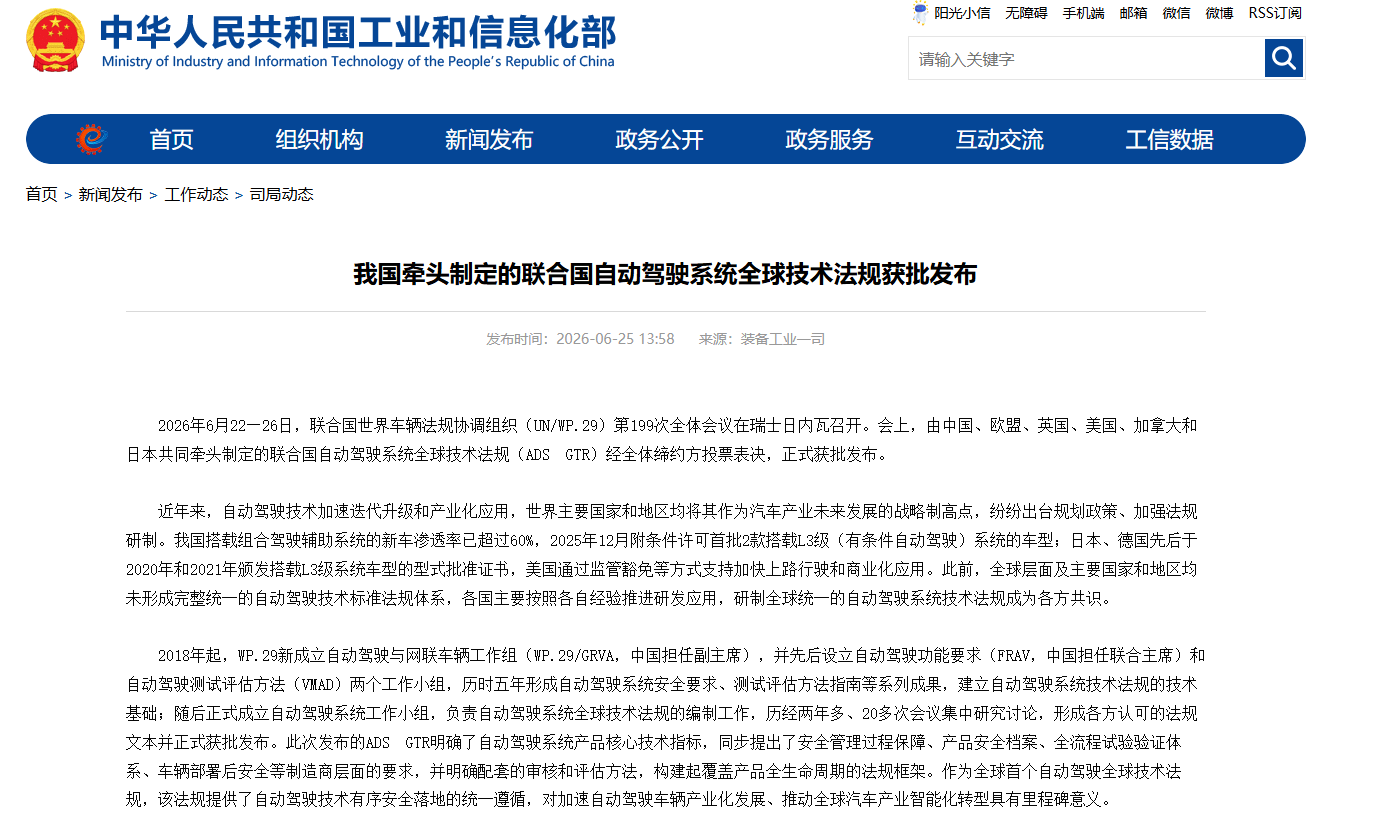
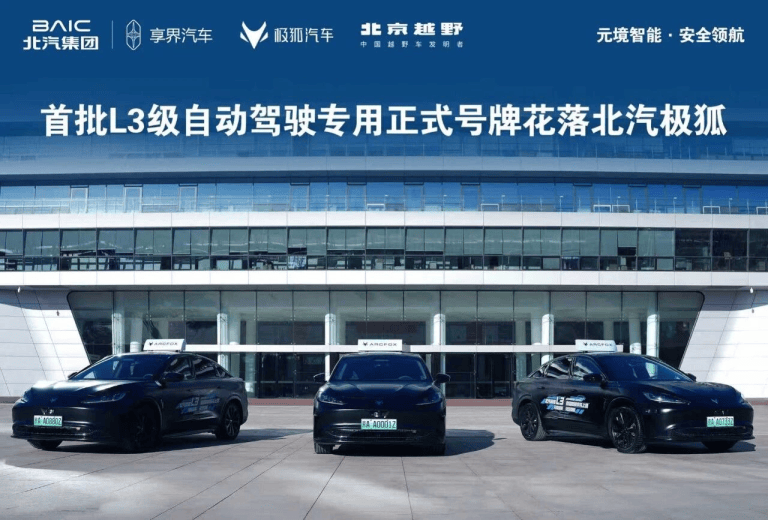
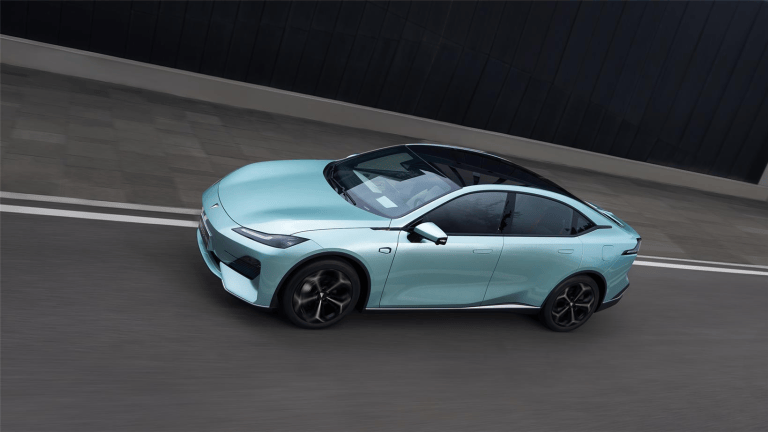



















On June 25, China’s Ministry of Industry and Information Technology (MIIT) announced that the United Nations Global Technical Regulation for Automated Driving Systems (ADS GTR), led by China, has been formally approved and released. The regulation represents the world’s first unified technical regulatory framework specifically developed for automated driving systems. The regulation was adopted during the 199th session of the United Nations World Forum for Harmonization of Vehicle Regulations (UN/WP.29), held from June 22 to June 26, 2026. China, the European Union, the United Kingdom, the United States, Canada and Japan jointly participated in drafting the regulation. Following a vote by contracting parties, the framework was formally approved and published. Over the past several years, major automotive markets including Japan, Germany, the United States and China have accelerated the deployment of autonomous driving technologies. Germany and Japan granted type approval to vehicles equipped with Level 3 automated driving systems in 2020 and 2021, respectively. The United States has promoted commercialization through regulatory exemptions and pilot deployment programs. However, regulatory systems and technical requirements have remained fragmented across jurisdictions. The newly adopted ADS GTR is the first international framework to establish harmonized core technical requirements and safety standards for automated driving systems. The regulation covers not only the automated driving system itself, but also product safety documentation, testing and validation procedures, manufacturer safety management processes, and post-deployment safety oversight, creating a regulatory framework that spans the entire product lifecycle. First-Ever L3 Autonomous Vehicle Plates for BAIC Arcfox The development of the regulation has taken nearly seven years. In 2018, the United Nations established the Working Party on Automated/Autonomous and Connected Vehicles (GRVA), with China serving as vice chair. Two additional expert groups—the Functional Requirements for Automated Vehicles (FRAV) and Validation Methods for Automated Driving (VMAD) working groups—were subsequently established, with China serving as one of the co-chairs. Throughout the process, China contributed not only to rulemaking efforts but also extensive operational and testing experience. MIIT organized participation from the China Automotive Technology and Research Center (CATARC), the China Academy of Information and Communications Technology (CAICT), and multiple industry stakeholders. China also shared large volumes of data from closed-course testing facilities, public-road trials, and vehicle-to-infrastructure (V2X) applications, providing important support for the development of the regulation. Meanwhile, China’s autonomous driving industry is entering a new phase of development. Data show that penetration of combined driving-assistance systems in newly sold vehicles has already exceeded 60% in the domestic market. Deepal SL03 gains approval of conditional autonomous driving By the end of 2025, China’s first two vehicle models equipped with Level 3 conditional automated driving systems received conditional market access approval, signaling the industry’s transition from advanced driver-assistance systems toward higher levels of vehicle automation. Alongside progress on international regulations, China’s mandatory national standard for automated driving systems has also completed drafting and is currently awaiting final regulatory approval. Compared with the ADS GTR, the domestic standard not only incorporates its core requirements but also introduces more detailed technical provisions for Level 3 and Level 4 automated driving systems, while adding requirements related to user training, risk disclosure, and standardized testing scenarios.