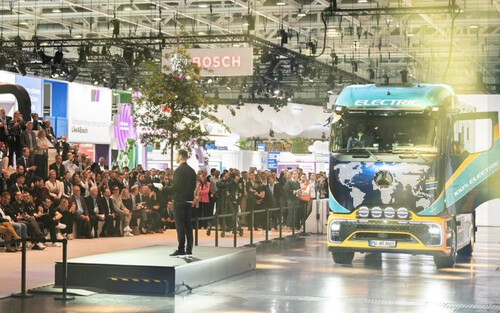
Image: CellcentricCellcentric is progressing towards market readiness with its new fuel cell generation, which is designed to be smaller, more powerful and more efficient than the current BZA150 system. Previously developed under the project name ‘NextGen’ and presented at the Hannover Messe, the BZA375 system is now available for testing and further industrial scaling across a broad range of heavy-duty applications. However, product development has primarily focused on long-haul trucks.Cellcentric first announced the new fuel cell system in mid-2024, and just three months later, the company presented a virtual 3D model of the solution at the IAA Transportation. The joint venture highlights the rapid development time in its latest announcement: “In less than three years, BZA375 was developed through a combination of innovative solutions, continuous improvement and a solid understanding of customer requirements.”350 kW continuous net power outputThanks to its compact design, a continuous net power output of up to 350 kW and low weight due to new packaging, the BZA375 is expected to match the performance characteristics of comparable conventionally powered long-haul trucks while reducing fuel consumption by 20% compared to the current BZA150 generation, ‘enabling a fully loaded 40-ton truck to operate on less than 6 kg of hydrogen per 100 kilometers under real-world driving conditions.’Specifically, the new system weighs less than 500 kilograms and offers a 40% higher power density. This is intended to simplify integration into existing vehicle architectures further. According to the developers, the BZA375 now fits into installation spaces originally designed for conventional 13-litre diesel engines.Particularly relevant for easy integration into trucks: the system design and performance enable a 40% reduction in waste heat at 300 kW net power output, significantly lowering the truck’s cooling requirements.Further enhancements in power densityWhat matters for the company in production and for customers in terms of costs: the new system also features a 40% reduction in manufacturing complexity, again compared to the BZA150. This is achieved through fewer components and interfaces. At the same time, the system is designed to be so robust that it offers a lifespan of around 25,000 operating hours – ‘equivalent to a 10-year service life in a heavy-duty truck, comparable to modern diesel engines.’Interestingly, Cellcentric made further adjustments between the system’s announcement in mid-2024 and its presentation at the Hannover Messe: around two years ago, the system was still expected to weigh a maximum of 400 kg, which is 100 kg less than its current weight. However, the joint venture has simultaneously increased the power density—from a 30% to a 40% improvement over the current generation.The fundamental design remains unchanged: a major difference lies in the packaging. For the next generation, Cellcentric is moving away from the ‘Twin-System’ approach of the BZA150 and will instead use a single-system package. This is intended to reduce complexity, simplify integration into existing vehicle platforms and enable a more compact and cost-effective solution.Prototype production of the BZA375 systems has now begun in Esslingen, Germany. According to Cellcentric, the first prototypes have been undergoing rigorous performance and durability tests for months and are now available to customers for their own testing and validation activities. Important to note: full-scale series production is not expected to begin until the end of the decade. However, even before series production starts, customers will be provided with ‘larger volumes of mature prototype systems’ for testing, validation and initial fleet applications, as the joint venture confirms.The primary target group for the new system is truck manufacturers, as the BZA375 is primarily designed for heavy-duty long-haul trucks. However, Cellcentric emphasises that the new development is also ‘suited for a broad range of further demanding use cases with comparable requirements: coaches, stationary power generation, rail and mining.’The motto is: one system for many applications. Indeed, Cellcentric is explicitly pursuing a ‘one-product strategy,’ aiming for ‘significant economies of scale and a sizable potential for further cost reduction in fuel-cell technology.’‘We are open to partnering with any OEMs’Moreover, the new product is not intended for use solely by the shareholders. Instead, the company envisions broad market adoption.Nicholas Loughlan, CTO of Cellcentric, put it this way: “BZA375 is custom-tailored for the needs of heavy-duty, long-haul trucks and an excellent fit in other applications with comparable requirements. At Cellcentric, we are deliberately set up as an independent Tier 1 supplier and open to partnering with any OEMs that are driving the decarbonization of their portfolios.”“Two key technologies will lead the way on our path to decarbonise transport: battery-electric and hydrogen. We’ve already taken important steps, and Cellentric’s new fuel cell system is the next major milestone. Building on the success of its predecessor, it represents a new level of efficiency and performance,” added Karin Rådström, President and CEO of Daimler Truck AG.Martin Lundstedt, President and CEO of the Volvo Group, also weighed in: “With the launch of the BZA375, Cellcentric and its partners have created the blueprint for zero-emission long-haul transportation in the heavy-duty segment. This is a game changer for logistics providers and society at large, and it takes us yet another step towards the decarbonisation of the industry.”Cellcentric was founded in 2021 as a joint venture between Daimler Truck and the Volvo Group to produce fuel cells for heavy-duty commercial vehicles. The company is constructing a large-scale production facility in Weilheim an der Teck, Germany, though completion has been delayed. It is unsurprising, given that Daimler Truck’s GenH2 Truck is already in customer trials, yet the manufacturer has postponed series production of fuel cell electric trucks from the end of this decade to the 2030s. Accordingly, Cellcentric must also revise its plans.Meanwhile, it was recently announced that Toyota intends to join Cellcentric as an equal shareholder alongside the two founding partners. The goal is to ‘create one of the world-leading fuel cell systems for heavy commercial vehicles.’cellcentric.net